







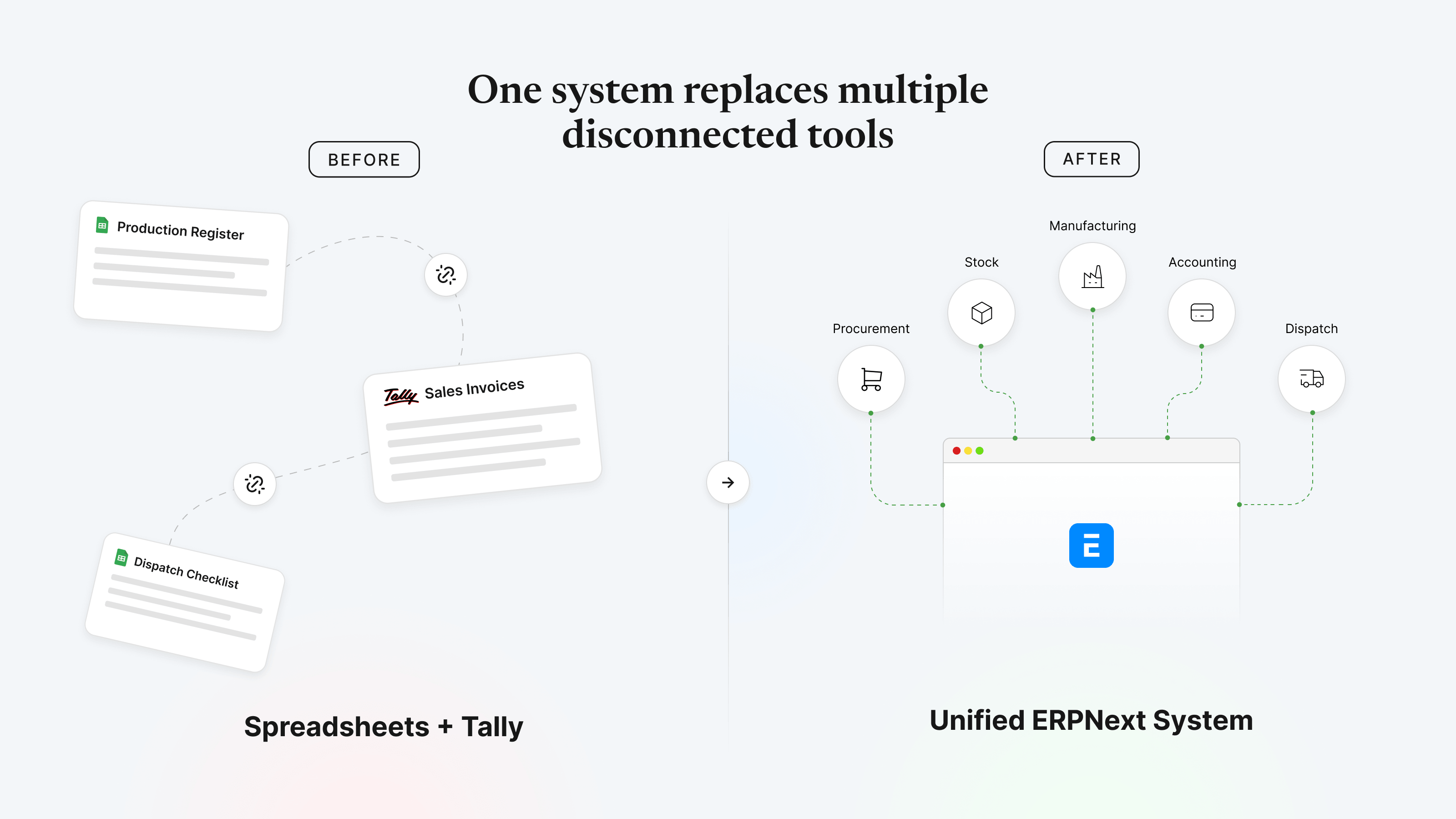
The problem : five functions, no single source of truth
lived in one spreadsheet, updated manually by whoever last touched it.
lived in another, reconciled against the warehouse by physical spot-checks because nobody fully trusted the numbers on screen.
were made by phone and email, based on stock levels that were often a day or two stale.
were tracked in Tally, separately from the production schedule that was supposed to fulfill them.
was coordinated by whoever happened to know what had actually shipped.
ERPNext Textile Manufacturing Case Study: What Changed on the Floor
Aavatto implemented ERPNext to bring production, inventory, procurement, sales, and dispatch onto a single platform, replacing both the spreadsheet stack and Tally for these workflows. The core shift wasn’t just digitizing what already existed — it was making the five functions reference the same live data instead of five separately maintained versions of it.
Concretely, that meant: a production plan that draws directly from actual, current inventory rather than a snapshot from whenever someone last updated a sheet; stock levels that update automatically as materials move through production, rather than requiring a manual recount; and a sales order that’s visible to production and dispatch the moment it’s confirmed, instead of surfacing only when someone forwards the Tally entry.
This is also where the implementation approach mattered. A 12-week timeline for a change touching five interconnected functions only works if the rollout is sequenced deliberately — inventory and production data have to be clean and mapped correctly before sales and dispatch can reliably draw from them. Rushing that order is a common reason ERP rollouts stall in manufacturing environments; sequencing it correctly is a large part of why this one didn’t. We cover the full sequencing and rollout approach in our textile manufacturing case study.
The results
28% faster production planning
plans are built against live inventory and order data instead of manually reconciled spreadsheets, cutting the back-and-forth needed to confirm what's actually available before scheduling a run.
97.8% inventory accuracy
stock levels reflect actual movement through the system in near real time, rather than periodic manual recounts trying to catch up to reality.
42% reduction in order processing time
orders move from confirmation to dispatch within one system, removing the manual handoffs between sales, production, and dispatch that previously introduced delay at every step.
12-week implementation
achieved by sequencing the rollout so foundational data (inventory, production) was accurate before dependent functions (sales, dispatch) went live on top of it.
None of these numbers came from a single feature turned on overnight. They’re the result of connecting functions that were previously disconnected, so that accurate information reaches the next step without someone having to manually carry it there.
What other textile and apparel manufacturers should take from this
The specific numbers here belong to this one implementation — every plant’s baseline is different, and a manufacturer with cleaner existing data or simpler product lines might see faster or slower results in different areas. What generalizes is the underlying pattern: when production, inventory, procurement, sales, and dispatch each live in separate tools, the slowdowns tend to show up at the handoffs between them, not within any single function. This is one of several ERPNext success stories in manufacturing we’ve built with clients, and that handoff pattern is usually the first place worth examining before assuming a bigger operational overhaul is needed.
If your production planning is accurate but your dispatch is still slow, or your inventory counts on paper don’t match the warehouse, the gap is often the connective tissue between systems — which is exactly what a unified ERPNext implementation is built to close.
Thinking through what this would look like for your own plant is worth a direct conversation rather than a generic estimate — see how we did this for a textile manufacturer and talk to us about your specific production and inventory setup.
Frequently Asked Questions
This implementation took 12 weeks, covering production, inventory, procurement, sales, and dispatch. Timelines vary based on how many functions are in scope and how clean the existing data is going in — a narrower first phase can go live faster.
In this case, yes — ERPNext replaced both for production, inventory, procurement, sales, and dispatch, bringing them onto one platform instead of coordinating between separate tools.
A sequenced rollout — getting inventory and production data accurate before dependent functions like sales and dispatch go live — is what keeps disruption manageable. That sequencing was central to this implementation completing in 12 weeks.
This implementation reached 97.8% inventory accuracy after go-live, driven by stock levels updating automatically as material moves through production instead of relying on periodic manual counts. Results depend on how inventory processes are set up during implementation.
No — these results reflect one specific implementation and shouldn't be read as a guarantee. The pattern (connecting previously siloed functions) is broadly applicable; the exact percentages depend on each business's starting point.