



Open source ERP vs proprietary ERP comes down to where your money and control sit. Proprietary ERP bundles the software, support, and upgrades into a recurring license fee you don’t control. Open source ERP like ERPNext removes that license cost but shifts spend toward implementation, hosting, and customization — work you commission and own. Neither is cheaper by default; it depends on how much you’ll actually customize and who’s running the project.
That’s a less satisfying answer than most vendor comparison pages give you, but it’s the accurate one. The rest of this article breaks down where the real costs land in each model, what “control” actually means operationally, and how to work out which one fits your business without guessing.
What "Open Source" and "Proprietary" Actually Mean for Your Budget
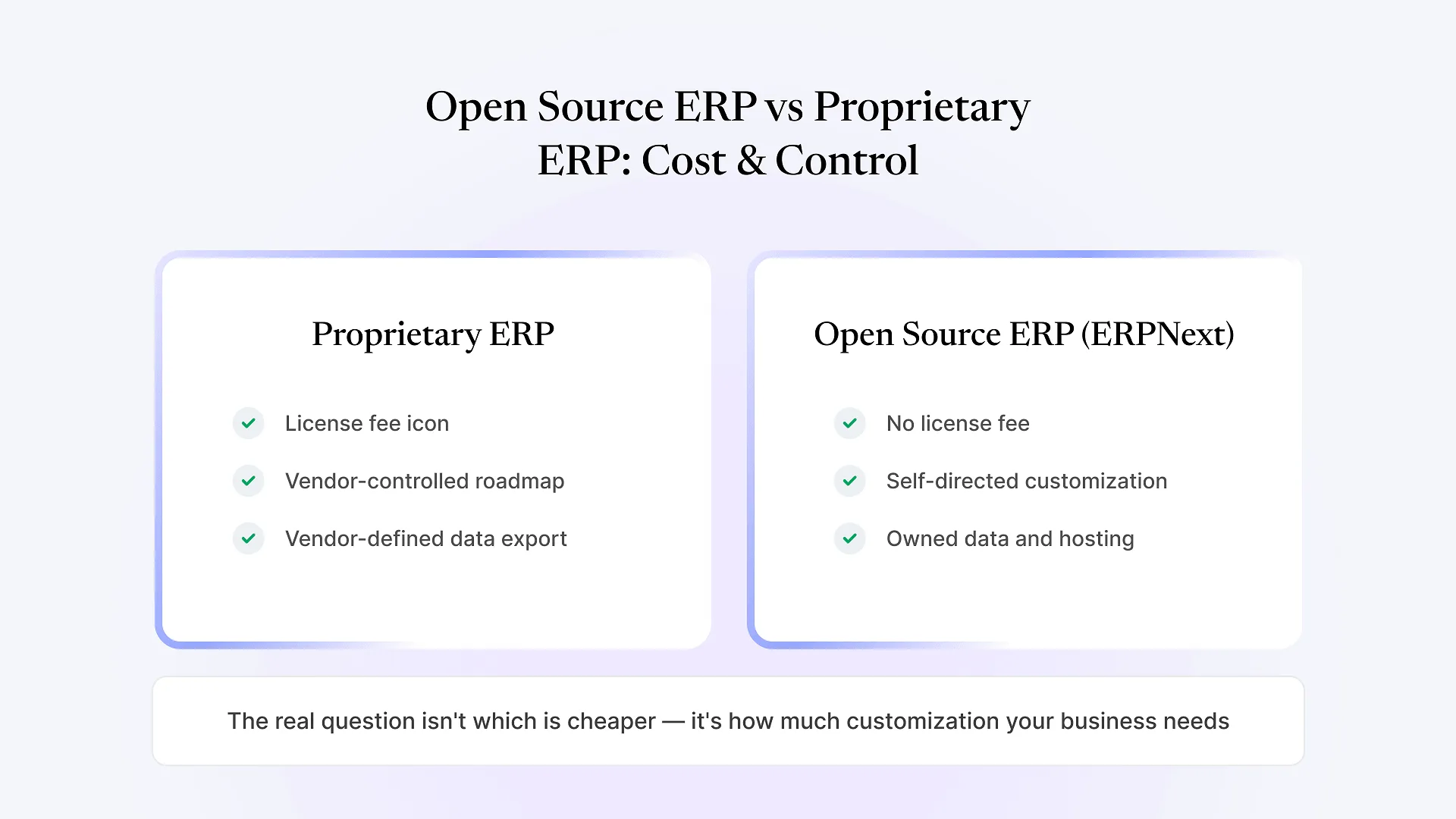
Proprietary ERP — think large-scale enterprise suites sold under per-user or per-module licensing — bundles software access, vendor support, and scheduled upgrades into one recurring fee. You’re paying for the vendor to maintain the code, and in exchange, you don’t get to touch it. Every customization request goes through their configuration layer or a paid professional-services engagement, and every upgrade happens on their schedule, not yours.
Open source ERP, like ERPNext, inverts that. The software itself carries no license fee — you can install it and run it without paying anyone for the right to use it. What you’re actually buying, when you bring in an implementation partner, is the work: configuration, data migration, custom development, hosting, and ongoing support. The source code is yours to read, modify, and extend, which is the single biggest structural difference between the two models.
That distinction matters more than the “free vs. paid” framing most comparison articles lead with. Open source isn’t free — it’s differently priced, with the cost shifted from a recurring license to a project and a support relationship you manage directly.
Cost: Where the Money Actually Goes
| Cost category | Proprietary ERP | Open source ERP (e.g. ERPNext) |
|---|---|---|
| Software license | Recurring, per-user or per-module | None |
| Implementation | Vendor or certified partner, often fixed by vendor rate cards | Any qualified partner; rates vary by scope and market |
| Customization | Limited to vendor-approved configuration; deep changes require paid vendor engagement | Full source-code access; any partner can build against it |
| Hosting | Usually vendor-managed (cloud) or bundled | Your choice — cloud, on-premise, or managed by your partner |
| Upgrades | Included in license, but scheduled by vendor | Self-directed; you control timing and scope |
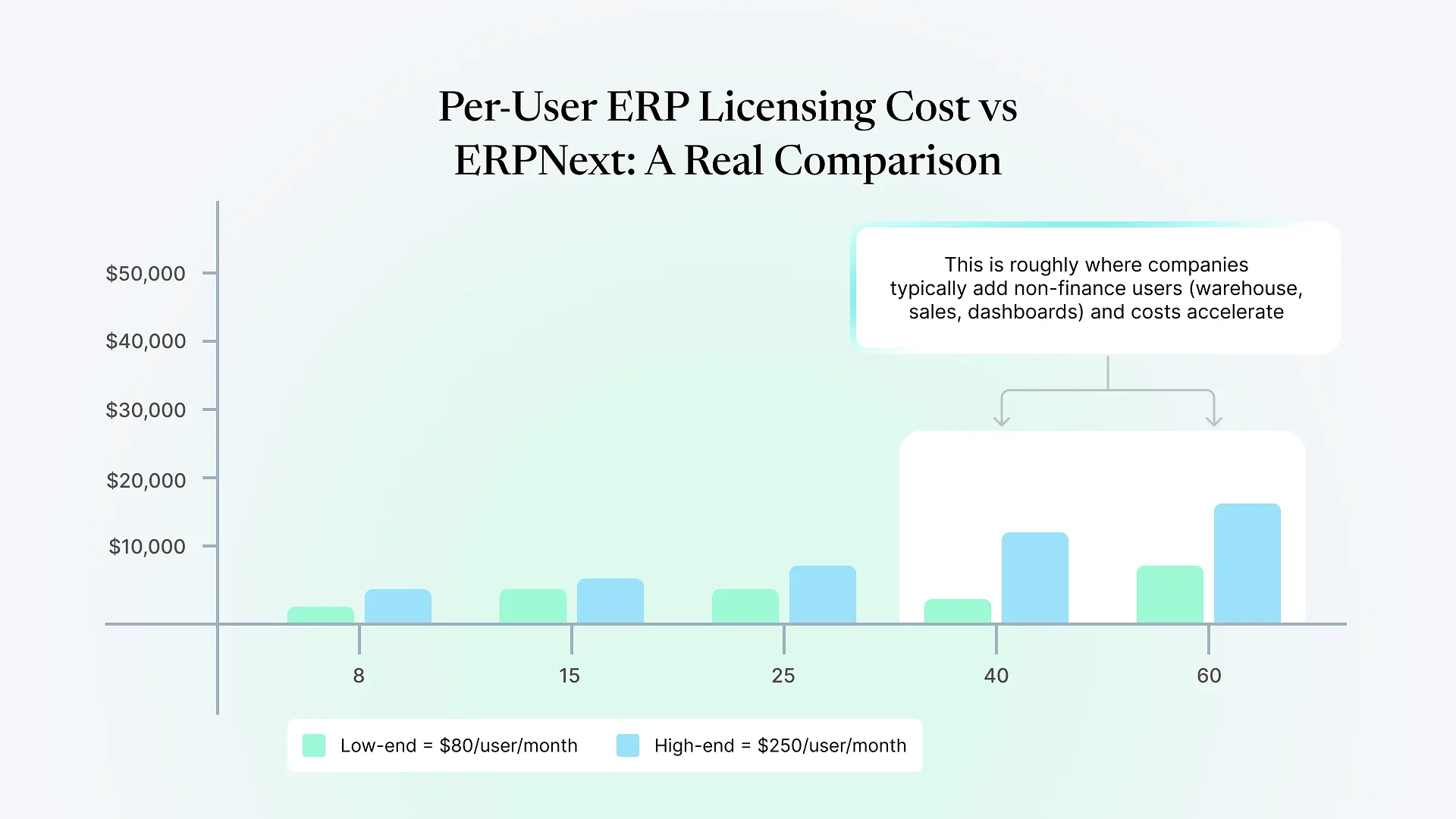
| Long-term scaling cost | Grows with user count and module additions | Grows with customization and support needs, not per-seat fees |
Control: Who Actually Owns Your Data, Your Roadmap, and Your Exit
“Control” gets used loosely in ERP marketing, so it’s worth being specific about what it means in practice.
With proprietary ERP, your data lives in a schema and export format the vendor defines. Migrating away, if you ever need to, means working within whatever export tools they provide — and those tools are rarely built to make leaving easy. Your product roadmap is also the vendor’s roadmap: a feature you need gets built when it fits their release plan, not yours, and a feature they deprecate is gone regardless of how central it was to your workflow.
With open source ERP, the source code and database are yours outright. You can host it wherever you choose, export data in whatever format you need, and bring in a different implementation partner without being locked to the one who built it — because nothing about the software itself depends on that relationship continuing. That doesn’t mean zero switching cost; a new partner still needs time to understand what was built. But it’s a fundamentally different kind of lock-in than being unable to leave a vendor’s platform at all.
This is where Aavatto’s own position is relevant to say plainly: we’ve spent since 2020 implementing and, more often than founders expect, rescuing ERPNext deployments across India and the Middle East where a previous vendor left mid-project or built something the client’s team couldn’t maintain. That happens under proprietary contracts too, but the client’s options afterward are narrower — you’re usually stuck negotiating with the same vendor rather than bringing in someone new to pick up the existing system.
Flexibility: Building for How You Actually Work, Not How the Vendor Assumed You Would
Every ERP ships with assumptions baked into its standard workflows — how approvals route, how inventory gets valued, how a sales order becomes a production order. Most businesses fit those assumptions closely enough that the standard setup works fine. Some don’t, and that’s where the two models diverge sharply.
Proprietary platforms handle deviation through configuration options the vendor pre-built, or through custom development that has to go through their partner network or professional-services team — on their timeline, at their rates. If what you need falls outside what’s configurable, you’re either waiting on their roadmap or living with a workaround.
Open source ERP lets a qualified partner build directly against the source. We’ve seen this play out concretely in apparel and e-commerce operations, where manufacturing and online fulfillment often run as two disconnected systems that happen to sell the same inventory — a gap that’s specific enough to the industry that no standard ERP module handles it out of the box. In our breakdown of connecting manufacturing to e-commerce fulfillment, that kind of workflow was built directly into ERPNext rather than worked around — which is the difference flexibility actually makes when your business doesn’t match the default assumptions.
Where Proprietary ERP Still Wins
This isn’t a case for open source in every situation, and a comparison that pretends otherwise isn’t useful to a CFO trying to make a real decision.
Proprietary ERP tends to be the better fit when your team wants a single vendor accountable for the whole stack, when your workflows are close enough to standard that deep customization is unlikely, or when thin internal IT capacity makes one vendor handling support, hosting, and upgrades worth its bundled cost.
A Decision Framework: Matching the Model to Your Business
| Question | Leans proprietary | Leans open source |
|---|---|---|
| How close are your workflows to standard finance/inventory/sales processes? | Very close | Meaningfully different |
| How much do you want to customize beyond configuration? | Little to none | Ongoing, expected |
| Who do you want accountable for the whole stack? | One vendor | A partner you choose and can replace |
| How important is owning your data/hosting outright? | Less critical | Critical |
| What's your internal capacity to manage an implementation partner? | Limited | Sufficient, or willing to build it |
This is the core of any real enterprise ERP comparison: it’s not a scorecard where one model wins on every line, it’s a match between how your business actually operates and which cost-and-control structure fits it. Most businesses land clearly on one side once they answer these honestly — the ambiguity usually comes from not having asked them yet.
If you’re leaning open source and ERPNext specifically, the next decision that matters as much as this one is who implements it. Our framework for vetting an ERPNext implementation partner covers the questions worth asking before you sign anything — because a poorly chosen partner can erase the cost and flexibility advantages open source is supposed to give you.
Frequently Asked Questions
Not automatically. It removes the license fee but shifts spend to implementation, hosting, and customization. Total cost depends on how much custom work your business needs, not which model you pick.
Yes — ERPNext runs multi-plant manufacturers, multi-warehouse distributors, and multi-entity groups today. Scale is a function of implementation quality and infrastructure choices, not a ceiling built into the software.
Because the source code and data are yours, a different qualified partner can take over — it takes time to get familiar with what was built, but you're not locked to the original vendor the way a proprietary contract can lock you in.
No. Most businesses run ERPNext through an external implementation partner handling development and maintenance — the difference from a proprietary vendor's support team is who you can choose and replace.
Choosing between open source ERP vs proprietary ERP isn’t really a software decision — it’s a decision about where you want cost and control to sit for the next several years. If you’re weighing ERPNext specifically against a proprietary option, talk to an ERPNext consultant before you decide; walking through your actual workflows against the framework above takes less time than most founders expect, and it’s a lot cheaper than reversing the decision two years in.