



The core difference in ERP vs accounting software is scope: accounting software tracks money, while ERP tracks money, inventory, production, and operations in one connected system. Businesses usually start with accounting software because it’s cheap and familiar. They outgrow it not because it stops working, but because everything it doesn’t cover — stock levels, purchase orders, multi-location transfers — ends up managed in spreadsheets that drift out of sync with the books.
If you’re a CEO or CFO comparing ERP vs accounting software right now, you’ve probably already hit the specific moment this article is about: closing the books takes longer each month, and a growing share of that time goes into reconciling numbers between your accounting system and whatever spreadsheet is tracking inventory, orders, or production. That’s not a sign you’re bad at operations. It’s the structural ceiling of accounting software showing up on schedule.
What Accounting Software Actually Does — and Where It Stops
Tools like Tally, QuickBooks, and Zoho Books are built to do one thing well: record financial transactions, generate ledgers, and produce statutory reports like GST returns and P&L statements. That’s genuinely sufficient for a business whose operations are simple enough to describe in a chart of accounts — invoice in, payment out, expense logged.
The gap opens once a business has anything accounting software wasn’t designed to track: stock across multiple warehouses, a bill of materials for what a finished product actually consumes, purchase orders that need approval before they become expenses, or sales across more than one location that all need to hit the same set of books. Accounting software has no native concept of any of that. It can record the financial result once someone enters it, but it can’t generate, track, or connect it to the rest of the business on its own.
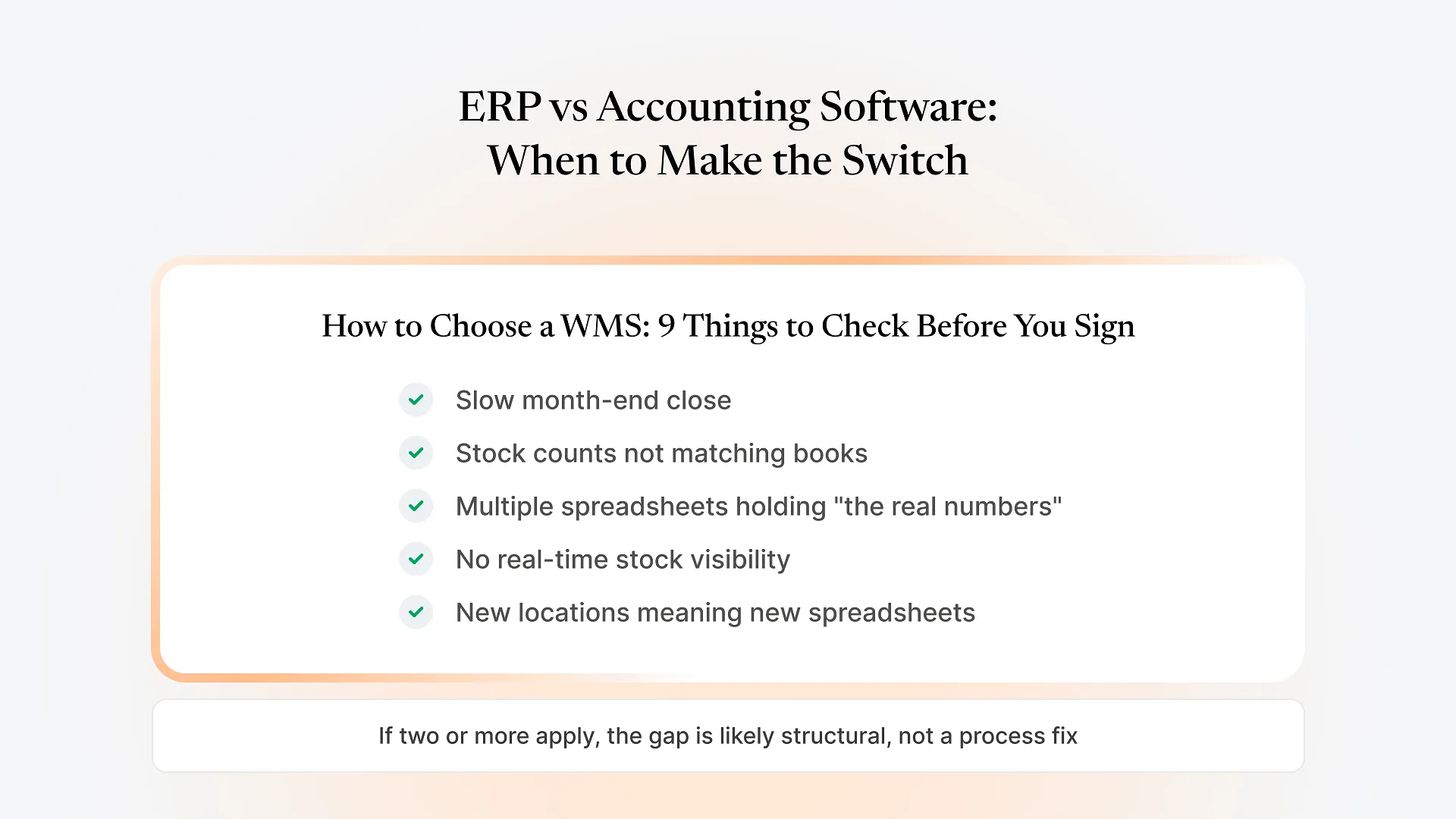
The Signs You've Outgrown Tally-Style Software
What used to take three days now takes ten, mostly spent reconciling accounting entries against inventory or sales spreadsheets that were updated separately.
Nobody entered the mismatch on purpose — it accumulated from manual updates that fell out of sync.
Sales has one spreadsheet, warehouse has another, and finance reconciles both against the accounting system after the fact.
There's no single source of truth that updates in real time.
not extending an existing system.
ERP vs Accounting Software: Side-by-Side
| Accounting software (Tally, QuickBooks, Zoho Books) | ERP (e.g. ERPNext) | |
|---|---|---|
| Core function | Financial transactions, ledgers, statutory reports | Finance, inventory, production, purchasing, sales in one system |
| Inventory tracking | Not native — usually a separate spreadsheet | Built in, updates in real time as stock moves |
| Multi-location visibility | Manual reconciliation across files | Single system across all locations |
| Production / BOM tracking | Not supported | Native, if the business manufactures |
| Data consistency | As accurate as the last manual update | One database, one version of the truth |
| Setup effort | Minimal — install and start entering data | Real implementation project — data migration, configuration, training |
| Best fit | Single-location businesses with no inventory or production complexity | Businesses managing stock, multiple locations, or manufacturing |
What Changes When You Move to ERP
The financial reporting your accounting software already gives you doesn’t disappear in ERP — it’s still there, usually deeper, since it’s now generated from the same data as your operations rather than entered separately. What changes is everything that used to live in a spreadsheet next to it.
Stock levels update the moment a sale, purchase, or transfer happens, instead of waiting for someone to update a file. A purchase order can be raised, approved, and converted into a bill without re-entering the same numbers in two places. For businesses that manufacture, a bill of materials connects what a product consumes to what it costs to produce it — something accounting software has no mechanism for at all.
For distribution-heavy or FMCG businesses in particular, this is where the gap is sharpest: batch tracking, expiry dates, and multi-warehouse stock movements are operational realities that ERPNext handles as part of one connected system rather than a parallel spreadsheet someone maintains by hand.
If you’re at the point of comparing options seriously, it’s worth talking to an ERPNext consultant before you decide — mainly to get a clear-eyed view of what a switch would actually involve for your specific setup, not a generic sales pitch.
Is It Always Worth Switching?
Not necessarily. A single-location business with no inventory to track and no manufacturing component may genuinely be well served by accounting software indefinitely — the switch has real cost and effort attached to it, and there’s no reason to take that on if the structural gaps described above don’t apply to you.
The switch is also not instant. Moving from accounting software to ERP means migrating historical data, mapping how your current processes translate into the new system, and training people who’ve been working a certain way for years. That’s a real project, not a weekend setup. It’s worth going in with that expectation rather than assuming ERP is a drop-in replacement.
Where Aavatto’s experience is specific: since 2020, we’ve implemented ERPNext for India-based SMBs making exactly this switch — including a number of cases where the trigger was a previous accounting-plus-spreadsheets setup that had quietly become the biggest source of manual work in the business. That’s not a claim that every business needs to switch. It’s that when the signs above are genuinely present, the gap tends to be structural, not something a better spreadsheet template fixes.
Frequently Asked Questions
Once the signs above start showing up consistently, the question usually isn’t whether accounting software can be stretched further — it’s how much longer the reconciliation work is worth absorbing before making the switch. If you’re at that point, choosing the right implementation partner matters as much as the platform itself, and talking to an ERPNext consultant before you decide is a reasonable next step.