






How does ERPNext handle multiple GSTINs?
ERPNext handles multiple GSTINs under one PAN by keeping a single company and adding a separate company address for each registered branch, each with its own GSTIN and state. Invoices pick up the GSTIN from the selected company address, tax type follows the place of supply, and GST reports can be filtered by GSTIN.
Why multi GSTIN in ERPNext is more than an address field
Each GSTIN files its own GSTR-1 and GSTR-3B.
Input tax credit sits with the GSTIN that received the invoice. Credit at a Gujarat branch can't be used to pay liability in Maharashtra.
Moving stock from one GSTIN to another is a supply even though nothing is sold, so it needs a tax invoice rather than a delivery challan.
Branches in the same state under one GSTIN are different. They share a registration, and movement between them stays an ordinary stock transfer.
This is why multi GSTIN handling is a structural question, not a data-entry one. Any multi branch GST software has to model these rules, and ERPNext does it through company addresses, tax settings and internal transactions.
One company or several? A decision table
| Situation | Suggested ERPNext structure | Why |
|---|---|---|
| One legal entity (one PAN), branches in several states | One Company, one Company Address per GSTIN | One set of books, consolidated reporting, GST separated by address |
| Separate legal entities (different PANs) | Separate Companies, with inter-company transactions where they trade | Separate books are legally required |
| One entity, branches managed like independent units | One Company plus Accounting Dimensions or Cost Centers per branch | Branch-level P&L without splitting the legal books |
| More than one registration within the same state | One Company, separate addresses, strict address defaults per user | Same mechanics; the main risk is billing from the wrong address |
Configuration checklist for multi-branch GST in ERPNext
Company Address per GSTIN
Create an address for every registered branch, mark it as a company address, and enter the GSTIN and GST state.
GST accounts
Map CGST, SGST, IGST and cess accounts in GST Settings.
Separate tax accounts per GSTIN (optional)
Some businesses keep one set of tax accounts for the whole company. Others use separate accounts per GSTIN so each registration's liability is readable straight from the ledger.
Warehouses tied to branches
Name warehouses so the branch is obvious, and set default company addresses so a branch warehouse never bills from another state's GSTIN.
Naming series per GSTIN
Each registration needs its own consecutive invoice series for the financial year. Use a separate naming series prefix per branch.
e-Invoice and e-Way Bill credentials per GSTIN
Each registration has its own portal credentials. Add them against each GSTIN in GST Settings.
User defaults and permissions
Restrict branch users to their own addresses, warehouses and naming series so they can't post against another registration.
Party addresses
Every customer and supplier address needs a GSTIN (where registered) and a state, so place of supply and tax type resolve correctly.
Inter-branch stock transfers across GSTINs
This is where multi-branch setups most often slip. Say (as an illustration) a Surat branch sends finished goods to a Delhi branch. GST treats that as a taxable supply between distinct persons. Recording it as a plain Stock Entry moves the stock but creates no tax invoice, no output liability for the sending GSTIN and no credit for the receiving one.
The usual ERPNext pattern:
Create an internal customer and internal supplier that represent your own company, linked to the relevant branch addresses.
Raise a Sales Invoice from the sending branch's GSTIN to the internal customer, with an e-way bill where the movement requires one.
Create the matching Purchase Invoice at the receiving branch so that GSTIN books the credit.
Agree the transfer value with your CA, since valuation of supplies between distinct persons follows its own rules.
Transfers between warehouses under the same GSTIN still go through a normal Stock Entry.
If your cross-state transfers currently move on delivery challans alone, that’s the first thing to correct before any other configuration.
Returns, reconciliation and reporting per GSTIN
GSTR-1 and GSTR-3B data are filtered by company GSTIN, so each branch's return is prepared from its own transactions.
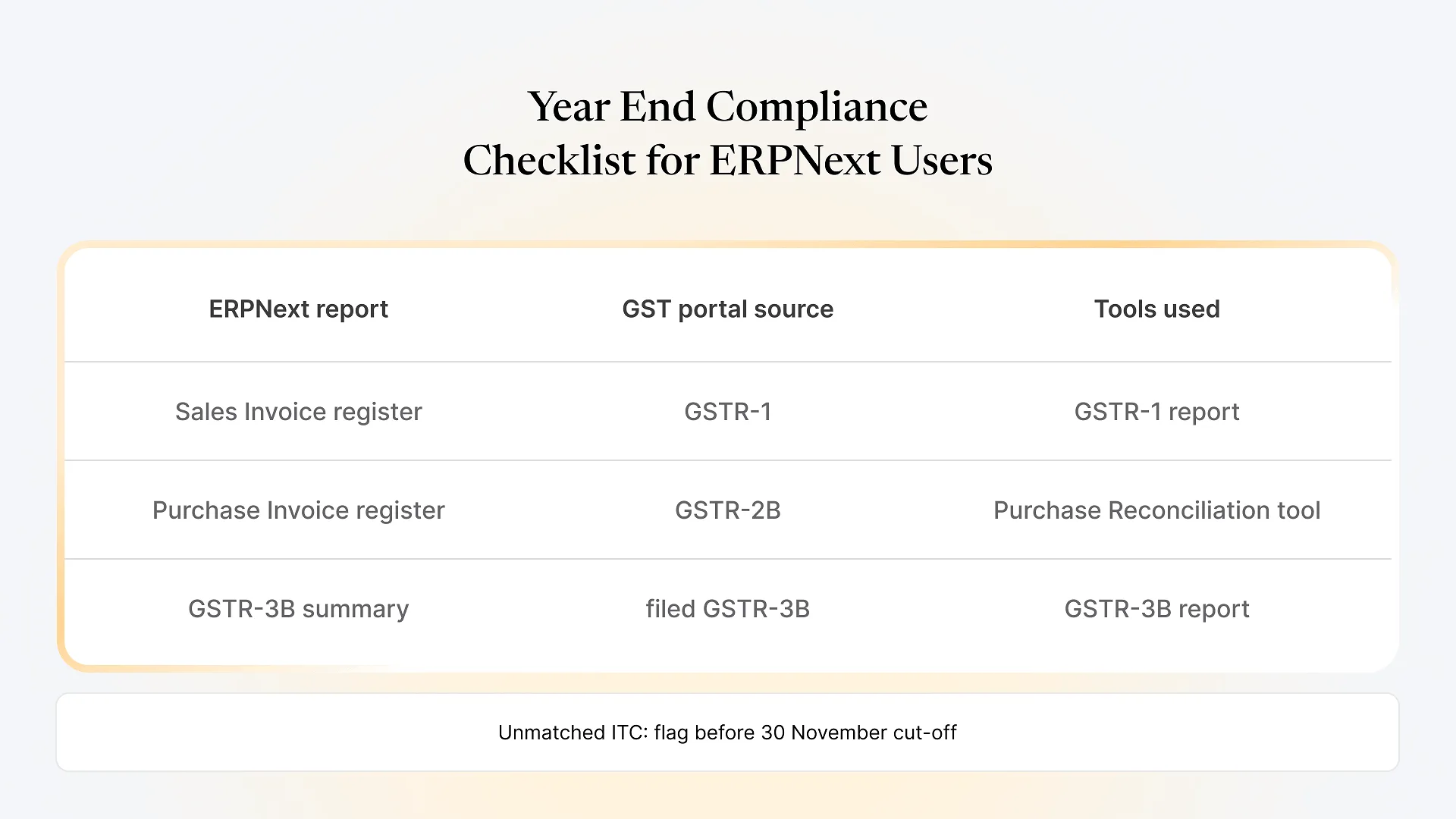
Purchase reconciliation against GSTR-2B runs per GSTIN. A supplier who bills the wrong branch GSTIN puts the credit in the wrong registration, and reconciliation is where you catch it.
Common services such as head-office software or audit fees raise a separate question: how credit on shared costs reaches each branch. The Input Service Distributor mechanism exists for this, and your CA should confirm how it applies to you before you configure it.
Consolidated financials still come from the single company, so management sees one P&L and balance sheet.
What we usually find when reviewing existing multi-GSTIN setups
One company created per GSTIN under a single PAN, followed by months of consolidation workarounds.
A single default company address, so every invoice prints the head-office GSTIN.
Inter-state stock moved with Stock Entry only, leaving gaps in both branches' returns.
One invoice naming series shared across all registrations.
No check on which branch GSTIN suppliers are billing, so credit drifts between registrations.
Frequently Asked Questions
Getting the structure right first
Multi-GSTIN handling in ERPNext is a structure decision first and configuration second. If you’re planning a rollout across states, or your current setup prints the wrong GSTIN or skips inter-branch invoices, our tailored ERPNext implementation work starts with exactly this review. Book a free ERPNext consultation and we’ll walk through your branch and registration structure with you.