





Most brands don’t start by asking whether they need a custom ecommerce development company. They start on Shopify, WooCommerce, or a similar builder, because it’s fast and it works — until it doesn’t. The question usually shows up later, once the storefront is fine but everything behind it isn’t.
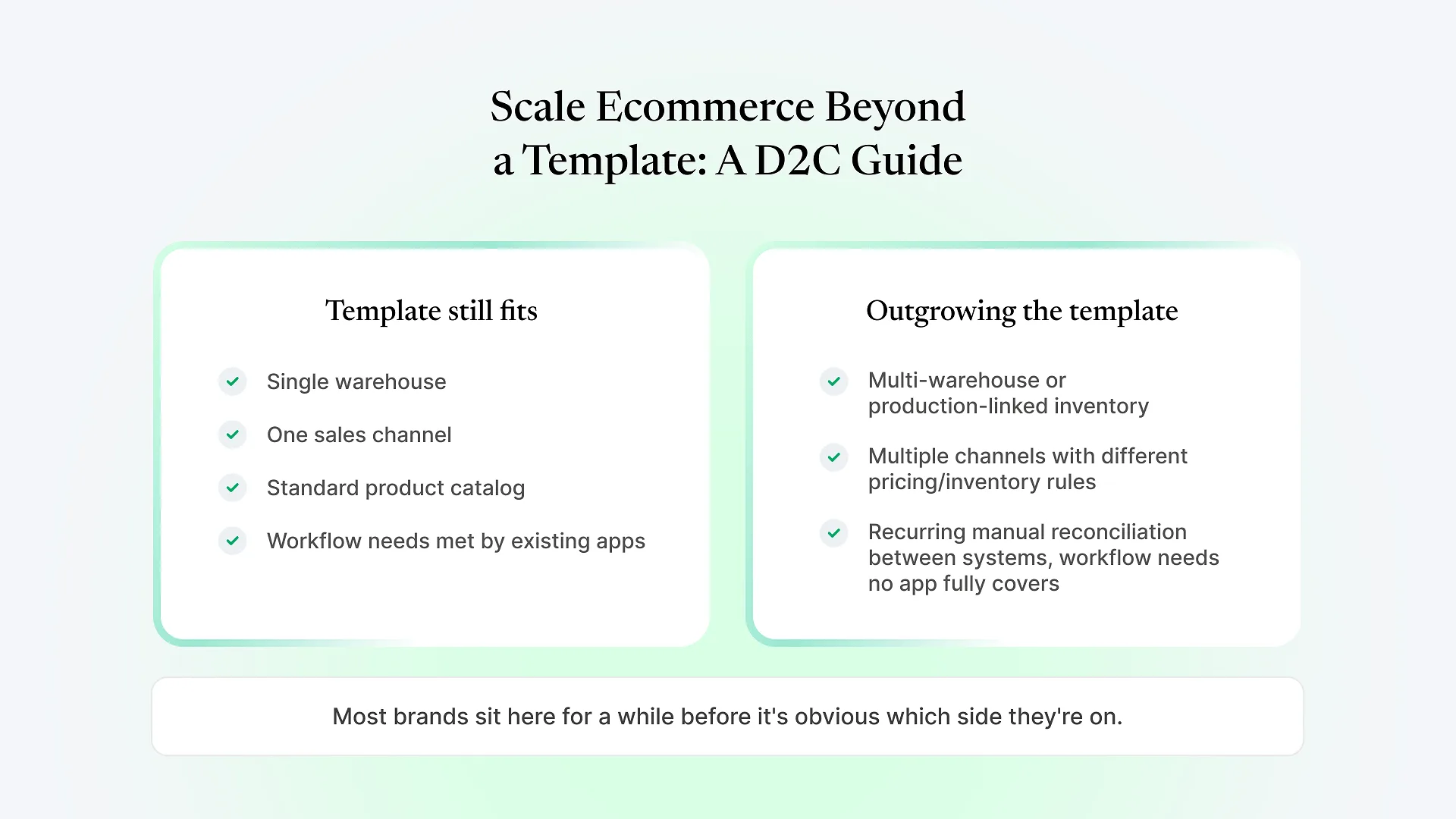
If your product catalog, pricing logic, or inventory sync outgrows what plugins and workarounds can handle — and you’re spending more time patching integrations than running the business — that’s the signal you need custom ecommerce development rather than another app from the marketplace. Off-the-shelf builders are the right call when your catalog, pricing, and fulfillment are simple and standard. Custom becomes worth it when your operations aren’t.
That’s the real dividing line, and it has less to do with design preferences than most comparisons suggest.
Why This Decision Usually Isn't About the Storefront
Search “custom vs off-the-shelf ecommerce” and most of what comes back compares templates, themes, checkout flexibility, and monthly subscription costs versus development budgets. That’s a real part of the decision, but for manufacturing and D2C brands with physical inventory, it’s rarely the part that actually forces the switch.
The trigger is almost always operational: the storefront shows one thing, the warehouse has another, and someone is manually reconciling the two — in a spreadsheet, at the end of the day, hoping nothing sold out in the gap.
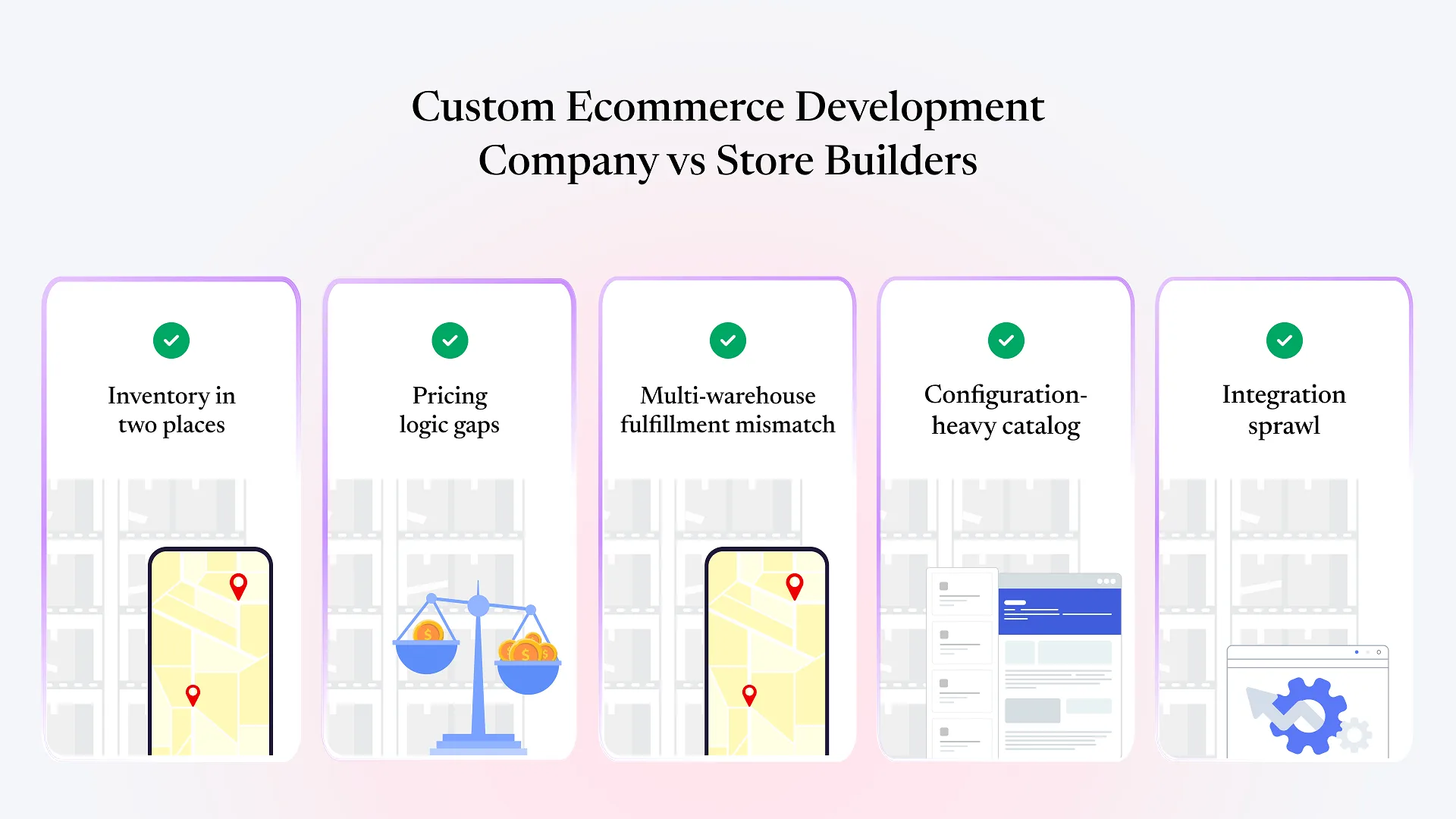
The Five Signals That You've Outgrown Off-the-Shelf
Inventory that lives in two places
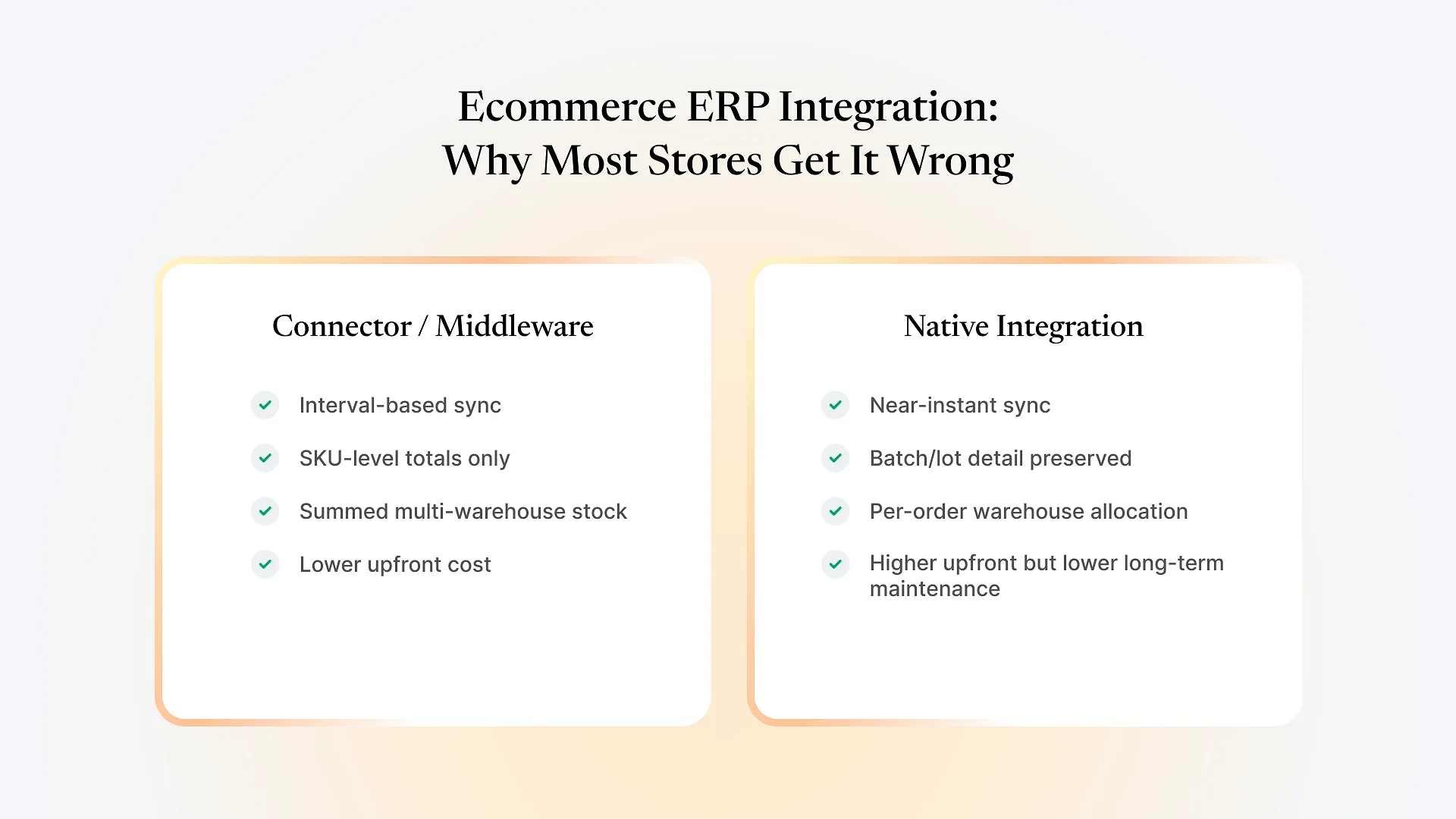
Your ecommerce platform shows stock levels, and your ERP or warehouse system shows the real ones — and they drift apart because there's no true real-time link between them, just a periodic export/import or a plugin doing its best. Every out-of-sync SKU is either a lost sale or an oversell you have to apologize for.
Pricing logic your platform wasn't built for
Tiered B2B pricing, customer-specific price lists, quantity breaks tied to production batch sizes, or region-specific pricing for India versus Middle East buyers — these are common for manufacturing and wholesale-adjacent brands, and they're exactly the kind of logic that off-the-shelf platforms handle through bolted-on apps, each with its own limitations and its own subscription fee.
Fulfillment that doesn't map to a single warehouse
If orders route across multiple warehouses, a mix of your own stock and a distributor's, or production-to-order timelines rather than pick-and-pack from a shelf, most store builders assume a simplicity that doesn't match how you actually ship.
A catalog that's really a configuration problem
Products with variants driven by manufacturing specs — fabric, finish, dimensions, batch — rather than simple size/color dropdowns often need logic a template can't express without heavy customization that fights the platform at every update.
Integration sprawl
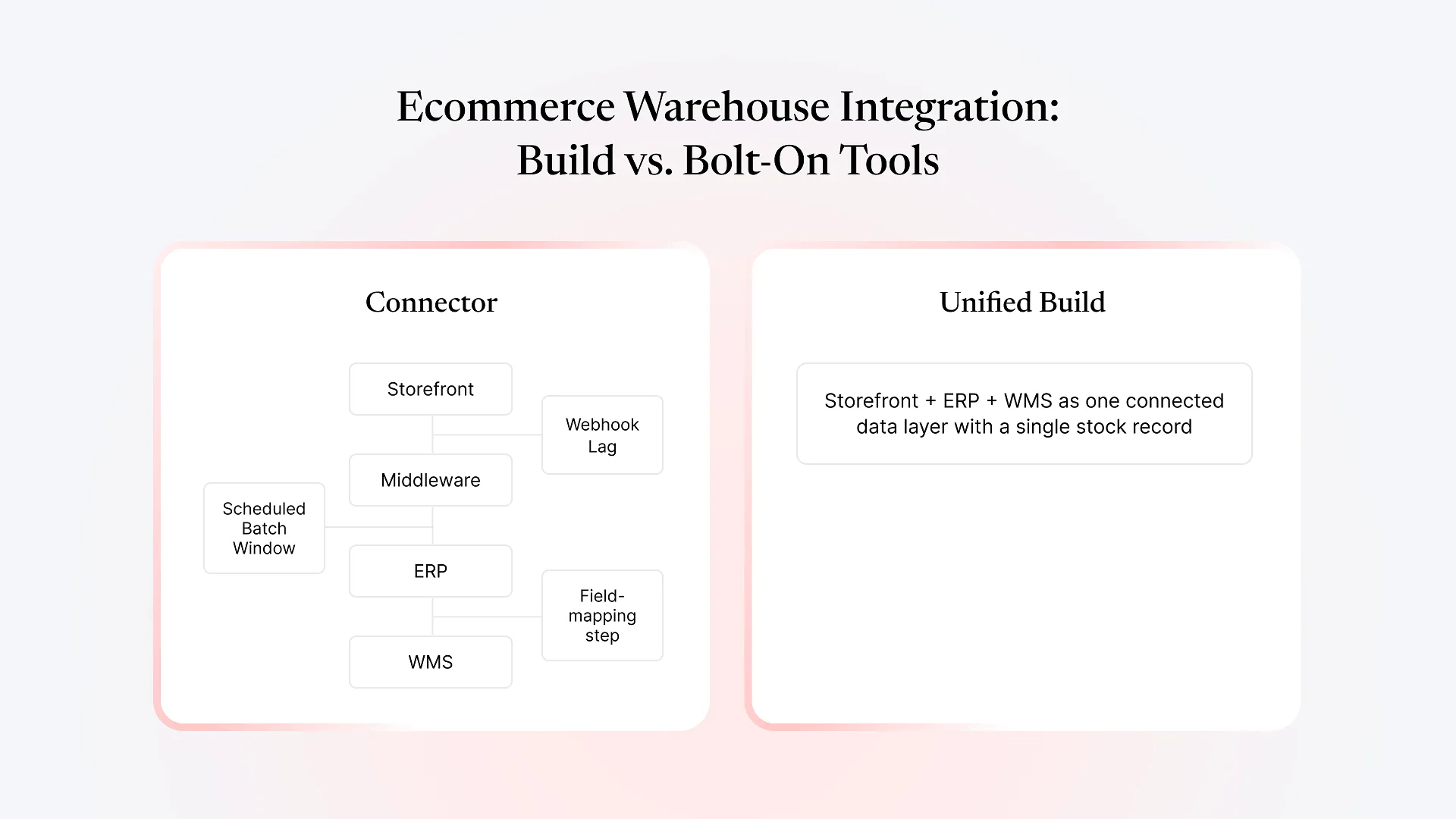
Each new "connector" app between your storefront and your ERP, accounting, or logistics system adds a point of failure, a monthly cost, and a dependency on someone else's roadmap. At a certain number of these, you're already paying for a custom-ish system — just one nobody designed on purpose.
If none of these apply, a well-configured off-the-shelf platform is very likely the more sensible choice, and no amount of “custom is more powerful” messaging should talk you out of that.
Need to see whether this applies to you before committing budget either way? We can walk through your current setup and tell you honestly which side of this you’re on — talk to us about your e-commerce build.
What Off-the-Shelf Still Does Better
A custom ecommerce development company that only tells you why custom is right isn’t giving you the full picture, so it’s worth being direct about the other side.
Off-the-shelf platforms are faster to launch — often weeks, not months. They come with hosting, security patching, and uptime handled for you. They have predictable subscription costs instead of a variable development and maintenance budget. And for a catalog that’s genuinely simple — standard products, standard pricing, one warehouse, no complex backend to sync with — none of the five signals above will ever apply, and custom development would just be over-engineering a problem you don’t have.
The honest version of this decision isn’t “custom is better.” It’s “custom is better once your operations have outgrown what a template can express,” and plenty of businesses never reach that point.
What a Custom Ecommerce Development Company Actually Builds
When the five signals above are present, custom development isn’t about a nicer-looking storefront. It’s about closing the gap between what customers see and what your operations actually do — building the storefront as one connected layer with your inventory, pricing, and fulfillment logic, instead of a front-end that has to be manually kept in sync with the systems that run underneath it.
Aavatto builds these platforms the same way we build ERPNext and Frappe systems for manufacturing and D2C clients across India and the Middle East — as one connected system, not a storefront bolted onto a backend it was never designed to talk to.
Concretely, that usually means:
| Off-the-shelf approach | Custom approach |
|---|---|
| Inventory synced via scheduled export/import or third-party app | Inventory synced via scheduled export/import or third-party app |
| Pricing tiers built as workarounds through pricing apps | Pricing logic built to match how your business actually prices, including India/Middle East regional variance |
| Fulfillment assumes one simple warehouse flow | Fulfillment logic reflects your actual multi-warehouse or production-to-order reality |
| Each new backend integration is another paid app and another failure point | Integrations are built directly into the platform's data layer, reducing the number of moving pieces |
What to Look for in a Custom Ecommerce Development Company
Do they design for real-time sync, or just faster batch sync?
Some agencies will build you a custom storefront that still talks to your backend through a scheduled job, just a more frequent one. That's a faster version of the same problem, not a solution to it. Ask specifically how inventory and order data move between systems, and how often.
Have they worked with your backend system, or only with storefront platforms?
A team that's spent most of its time building themes and checkout flows may not have real experience with ERP data models, production schedules, or multi-warehouse logic. A team with hands-on ERP or Frappe implementation experience will ask different, more operationally grounded questions during scoping.
Can they talk honestly about what won't be simple?
Custom development that's pitched as effortless is a warning sign. A vendor who can name the genuinely hard parts of your specific build — usually around data migration, edge cases in pricing, or reconciling historical records — is more credible than one who promises a smooth timeline regardless of complexity.
What happens if it goes wrong partway through?
Custom builds sometimes stall — scope creep, an unresponsive vendor, or a team that under-scoped the backend integration work. It's worth knowing upfront whether a prospective vendor has experience picking up and stabilizing a project that started elsewhere, not just starting from a blank page.
Cost and Timeline: The Honest Version
Custom ecommerce development costs more upfront and takes longer — there’s no version of this comparison where that isn’t true. A realistic build, scoped around the specific operational gaps above rather than a from-scratch rebuild of every ecommerce feature that already exists in mature platforms, still runs into months, not weeks.
What the upfront cost comparison usually misses is the ongoing cost of the workaround-app approach: every integration app is a recurring fee, and every one of them can break independently when either side updates. Over a few years, brands paying for several connector apps on top of a platform subscription are often spending close to what a properly scoped custom build would have cost — without ever getting the real-time accuracy that was the actual goal.
There’s no single number that applies to every business here, and treating “custom development costs X” as a fixed figure would be misleading. The honest scoping conversation is about which of the five signals apply to you, and how much manual reconciliation work they’re currently costing your team.
Frequently Asked Questions
Where This Decision Actually Gets Made
The build-vs-buy question isn’t really about ecommerce platforms at all — it’s about whether your storefront and your operations are telling the same story. If they already are, an off-the-shelf builder will keep serving you well, and there’s no reason to complicate that. If they aren’t — if inventory drifts, pricing needs workarounds, and fulfillment doesn’t map cleanly to how your platform expects orders to flow — that’s the point where a custom ecommerce development company stops being a nice-to-have and starts being the more economical option.
If you’re not sure which side of that line you’re on, that’s a conversation worth having before committing to either path. Talk to us about your e-commerce build and we’ll give you a straight answer, even if that answer is “you don’t need custom yet.”