



Can ERPNext handle chemical manufacturing?
Yes, for most small and mid-sized process units. ERPNext stores each formula as a Bill of Materials with a defined batch size, records every production batch against a Work Order, tracks raw material and output lots by batch number, and builds batch cost from actual consumption. Potency-adjusted formulas and pollution-board records need custom work.
Why the Ankleshwar-Vapi belt needs a different ERP conversation
Many units are a principal (sending material out for a step) and a job worker (processing someone else's material) in the same month.
Reaction yields shift batch to batch with raw material quality, temperature control and operator practice.
Solvents bought in litres, charged into the reactor by weight, sold in drums or bags.
Effluent generation, hazardous waste movement and pollution-board returns sit alongside production records.
Recovered solvent and saleable by-products carry real value but are often left out of costing.
How formula-based production works in ERPNext for chemical manufacturing
The formula as a Bill of Materials
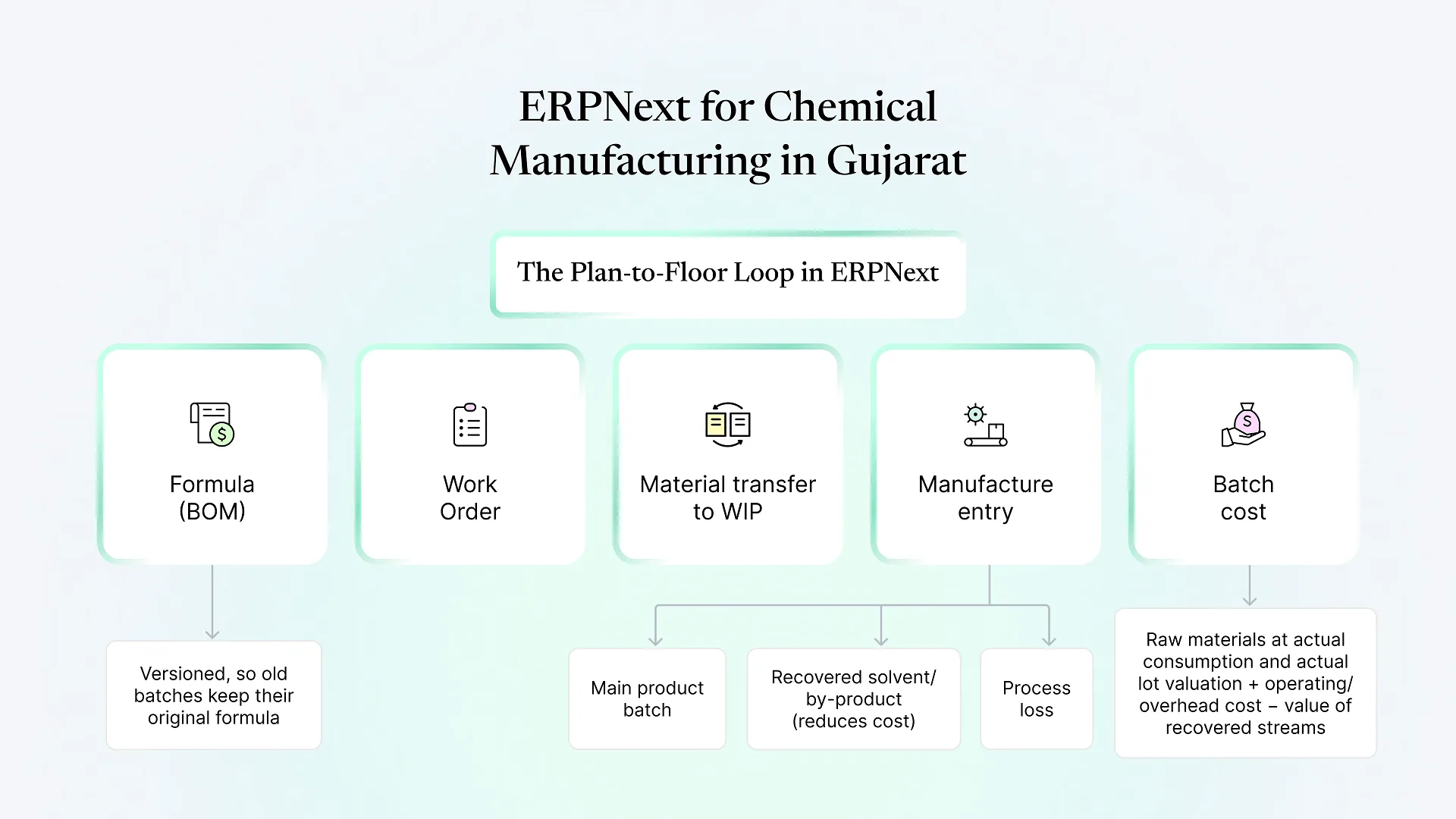
In ERPNext, a formula lives in a Bill of Materials (BOM). You define the output item, a standard batch quantity (for example, one reactor charge), and each input with its quantity for that batch. Multi-step processes use multi-level BOMs: the intermediate from step one is its own item with its own BOM, consumed by step two.BOMs are versioned. When your chemist adjusts a formula, you create a new BOM and set it as default rather than overwriting the old one. Past batches stay costed against the formula they actually used, which matters when a customer queries a lot from six months ago.
Batch production through Work Orders
A Work Order instructs the plant to make a quantity against a specific BOM. Raw materials are transferred into work-in-progress, then a manufacture entry records what was actually consumed and what actually came out. If the operator charged more solvent than the formula says, or the batch yielded less, that is recorded as it happened.The gap between what the BOM expected and what the manufacture entry recorded is where most of the costing insight comes from.
Scrap, recovered solvent and process loss
ERPNext BOMs support two things process units need:
Process loss percentage, for the yield loss you expect as a normal part of the reaction.
Scrap items with a rate, which you can use for recovered solvent or a saleable by-product so its value reduces the batch cost instead of vanishing from the books.
Handling kg, litres and drums
Each item can have several units of measure with conversion factors, so you can buy in litres, consume in kg and sell in drums. The limitation is that each conversion factor is fixed per item. If density varies meaningfully with grade or temperature and you need that reflected, it has to be handled through separate items or a custom calculation.
Batch costing: where most units lose visibility
What goes into a batch cost
A manufactured batch in ERPNext is costed from the valuation of the raw materials actually consumed, plus any operating or overhead cost defined on the BOM or Work Order, minus the value of scrap items. Because raw materials are tracked by batch, the cost reflects the specific lots you charged, not a plant-wide average.
Why yield variance matters more than price variance
Purchase price changes are visible the day the invoice arrives. Yield changes are not, unless the system captures actual output against standard.Consider a qualitative example. Two batches of the same intermediate use the same raw material lots at the same prices. One yields close to the formula's expectation; the other comes in noticeably short. In a spreadsheet costed at standard, both batches look identical. In ERPNext, the short batch carries the same input cost spread over less output, so its per-kg cost is visibly higher. Review that across a month and patterns emerge: a particular product, a particular reactor, or a particular shift.
Freight, loading and import costs
Freight, unloading and customs charges on bought-in intermediates can be added to stock valuation through a Landed Cost Voucher. Those charges then flow into the cost of every batch that consumes that material, instead of sitting in a general expense account.
Job work and subcontracting
ERPNext's subcontracting flow lets you issue raw materials to a job worker, see what stock they are holding on your behalf, and receive the processed output with raw material consumption reconciled against the BOM. Material sent out for job work has GST reporting obligations; ERPNext keeps the movement records, but confirm the return format and filing process with your tax advisor.
This needs a different setup. The customer's material is held in your plant but is not your stock and should not inflate your inventory value. You bill only the processing charge. It is typically set up with separate warehouses and items for customer-provided material, and the configuration should be settled before go-live rather than patched later.
Quality, traceability and compliance records
Quality Inspection templates record test parameters (assay, pH, moisture, colour, and so on) against incoming raw material and outgoing batches.
Batch traceability lets you trace a finished batch back to the raw material lots it consumed, and forward to the customers who received it.
Certificates of Analysis can be produced as a print format built from inspection data, though the layout has to be designed for your customers' expectations.
Environmental and pollution-board records, such as hazardous waste movement or effluent logs, are not native and usually need a custom DocType with matching reports.
Keeping formulas confidential
Where ERPNext needs configuration or custom work
| Requirement | Out of the box | Typically needs |
|---|---|---|
| Formula BOM with batch size and versions | Yes | Configuration |
| Multi-step intermediates | Yes | Configuration |
| Process loss and scrap valuation | Yes | Configuration |
| Co-product cost allocation | No | Custom logic |
| Potency/assay-adjusted formula quantities | No | Custom logic |
| Variable density conversion | No | Custom logic or separate items |
| Reactor and vessel scheduling | Partial (workstations) | Configuration or custom work |
| Pollution-board and hazardous-waste records | No | Custom DocType and reports |
| Certificate of Analysis | Partial | Print format design |
This is where implementation approach matters more than the software. A tailored ERPNext implementation should separate what can be configured from what needs custom code, and keep custom code in a separate Frappe app so ERPNext upgrades don’t break it.
Aavatto is based in Ahmedabad and has worked only on ERPNext and Frappe since 2020, for manufacturers across India and the Middle East. We also take over setups that another vendor started and didn’t finish, which is a common story among units evaluating Ankleshwar Vapi ERP software for the second time.
Is ERPNext right for your chemical unit? A quick checklist
You make products from defined formulas, even if they change periodically
You want batch-level cost, not just monthly averages
You send or receive job work regularly
Customers or auditors ask you to trace batches back to raw material lots
Someone in the business will own formula and yield data in the system, not only in a chemist's notebook
If most of these apply, ERPNext is likely a reasonable fit, and the conversation shifts to what needs customising. You can see how Aavatto has handled other manufacturing implementations in our case studies.