



Most ERP evaluations start with a feature checklist and end with the vendor who gave the best demo. That’s how businesses end up with systems that technically do everything on the list and still don’t fit how the company actually operates six months after go-live. Knowing how to evaluate ERP vendors properly means scoring fit across five dimensions — not just features — before you ever sit through a sales pitch.
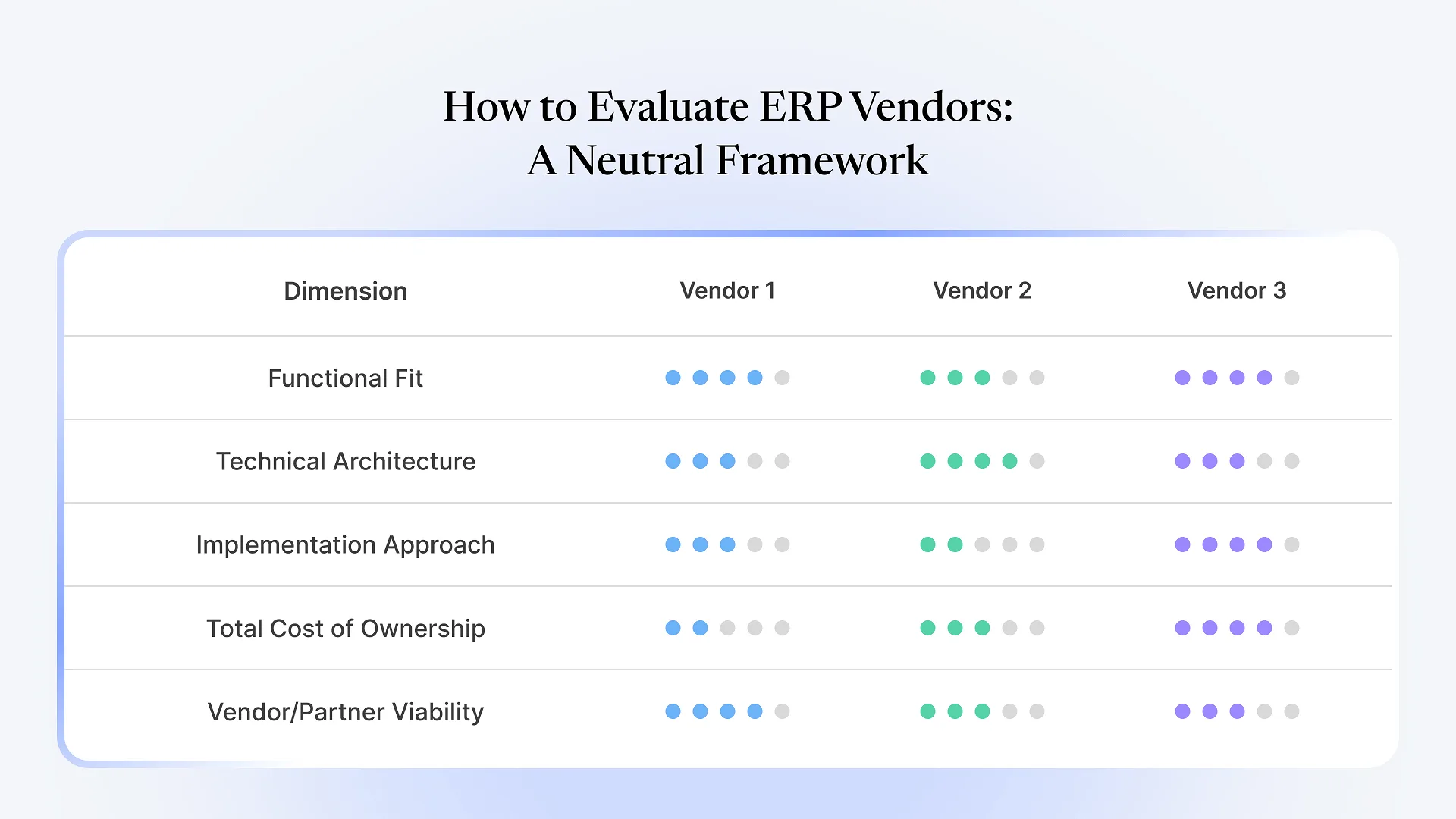
To evaluate ERP vendors properly, score each one across five dimensions: functional fit to your actual workflows, technical architecture and deployment model, implementation approach, total cost of ownership over 3-5 years, and vendor/partner viability and support. Weight these by what matters most to your business, then compare finalists against the same criteria — not against whichever one presented last.
This isn’t a generic checklist. It’s the framework worth using regardless of whether you’re looking at ERPNext, an open-source alternative, or a proprietary platform — because the mistakes that sink ERP decisions happen in evaluation, long before implementation begins.
Why feature checklists miss what actually breaks ERP projects
Most published ERP vendor evaluation checklists are built around software features: does it do inventory, does it do accounting, does it handle multi-currency. That’s a reasonable starting filter, but it’s rarely where projects go wrong. Nearly every serious ERP platform on the market today can technically handle standard business processes.
What separates a smooth implementation from a stalled one is usually one of three things: the vendor didn’t understand the client’s actual workflow before quoting, the implementation approach didn’t match the company’s risk tolerance, or the support model fell apart after go-live when the sales team moved on to the next deal. None of those show up on a feature checklist. They show up in how a vendor answers questions about their process, not their product.
The five-dimension evaluation framework
| Dimension | What you're really testing | Questions to ask the vendor |
|---|---|---|
| Functional fit | Does it match how your business actually works, not a generic version of your industry | "Walk me through how this handles [your specific workflow], not a standard demo scenario." |
| Technical architecture | Cloud, on-premise, or hybrid — and what that means for your data, your IT team, and future changes | "What happens to our data and customizations if we outgrow this deployment model?" |
| Implementation approach | Whether their methodology matches how much disruption your business can tolerate | "What does a typical project timeline look like, and where have your projects typically slipped?" |
| Total cost of ownership | The real 3-5 year cost, not the license or subscription quote | "What's included in this quote, and what's typically billed separately once we're mid-project?" |
| Vendor/partner viability | Whether this company — or this specific implementation partner — will still be reachable in three years | "Who supports us after go-live, and is that the same team that's talking to us now?" |
Total cost of ownership: where evaluations go wrong
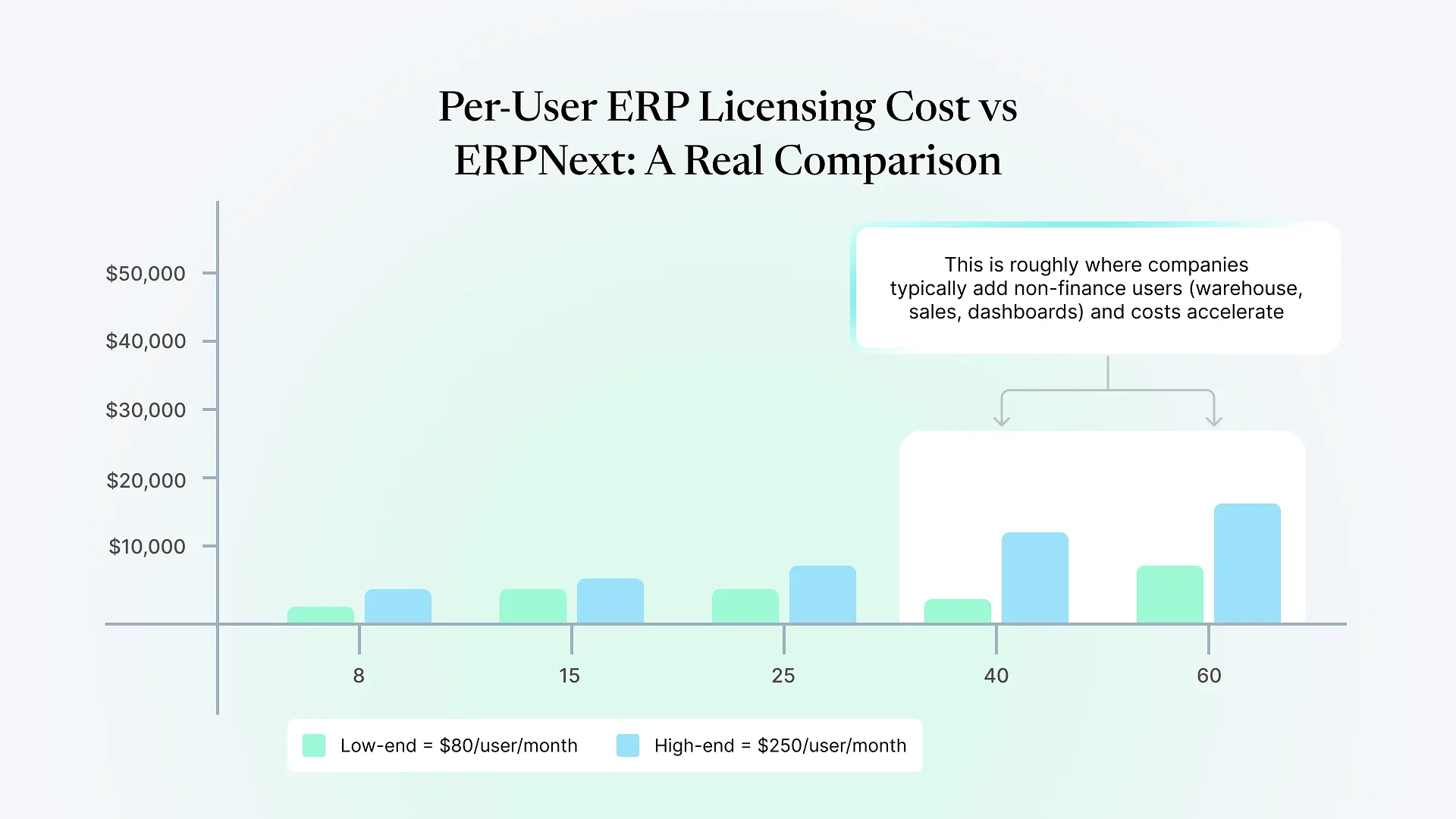
The license or subscription fee is the number vendors lead with, and it’s usually the smallest piece of the real cost. Implementation services, data migration from whatever system you’re replacing, integrations with tools you’re not replacing, user training, and the first year of post-go-live support all sit outside that headline number — and they vary far more between vendors than the license fee does.
Ask every finalist for a cost breakdown that separates these line items explicitly, not a single bundled number. A vendor who can’t or won’t itemize this is telling you something about how change requests will be billed later.
If you’re already comparing quotes and the total cost picture feels unclear, talk to an ERPNext consultant before you decide — a scoped conversation about your specific requirements will surface cost gaps a generic comparison can’t.
Open-source vs. proprietary: a sixth consideration worth naming
The five-dimension framework above applies whether you’re evaluating open-source platforms like ERPNext or proprietary systems with per-user licensing. But the deployment model does change how a few of those dimensions play out. With open-source ERP, technical architecture and vendor viability shift meaning: the software itself isn’t tied to one company’s survival, but your implementation partner’s competence and continuity still are. With proprietary ERP, you’re evaluating the software vendor and the implementation partner as two separate risks, which is worth naming explicitly rather than assuming one vendor’s stability covers both.
Neither model is automatically the right answer — it depends on how much control your team wants over customization, and how much you’re willing to pay in licensing versus implementation flexibility.
Once you've narrowed to a platform, the partner question replaces the vendor question
If your evaluation lands on ERPNext specifically, the framework above still applies, but the “vendor” you’re now evaluating is really an implementation partner, not a software company — since ERPNext itself is open source. That’s a different evaluation, with different questions about industry experience, customization philosophy, and support terms. Our guide on how to choose an ERPNext implementation partner walks through the ten questions worth asking at that stage.
Common mistakes CEOs and CFOs make during ERP evaluation
Scoring the demo, not the fit
A polished demo reflects the vendor's sales team, not necessarily how the system will handle your actual edge cases.
Treating the license quote as the total cost
Implementation, migration, and support costs routinely exceed the software cost itself over the first three years.
Skipping reference checks with recently completed projects
A vendor's oldest, happiest client isn't representative of what a new implementation will look like today.
Assuming the sales team and the implementation team are the same people
They frequently aren't, and the handoff between them is where expectations set during evaluation start slipping.
Not asking who owns support after go-live
This is the single most common gap we see when called in to review an implementation that's already underway or already stalled.
FAQ: ERP vendor evaluation questions
If you’re weighing ERP vendors right now and want a second, less sales-driven opinion on where a specific option fits your business, talk to an ERPNext consultant before you decide — a short conversation focused on your actual requirements tends to surface more than another round of vendor demos will.