



A picker walks to a bin the system says is full. It’s empty. A sales rep promises next-day delivery on a SKU that was sold out an hour earlier by a different team. A stock count at month-end turns up numbers nobody can explain. None of this means the warehouse is badly run — it usually means the system is showing yesterday’s truth, not today’s.
Real-time inventory visibility is the ability to see accurate stock levels, locations, and movements the moment they happen — not after a batch update, an end-of-day sync, or a manual recount. Every team checking stock, from the warehouse floor to sales, sees the same current number instead of a delayed snapshot.
That gap isn’t a technology footnote. It’s the difference between a warehouse team that trusts its system and one that quietly keeps a shadow spreadsheet “just in case.”
Why Warehouses End Up Without Real-Time Visibility
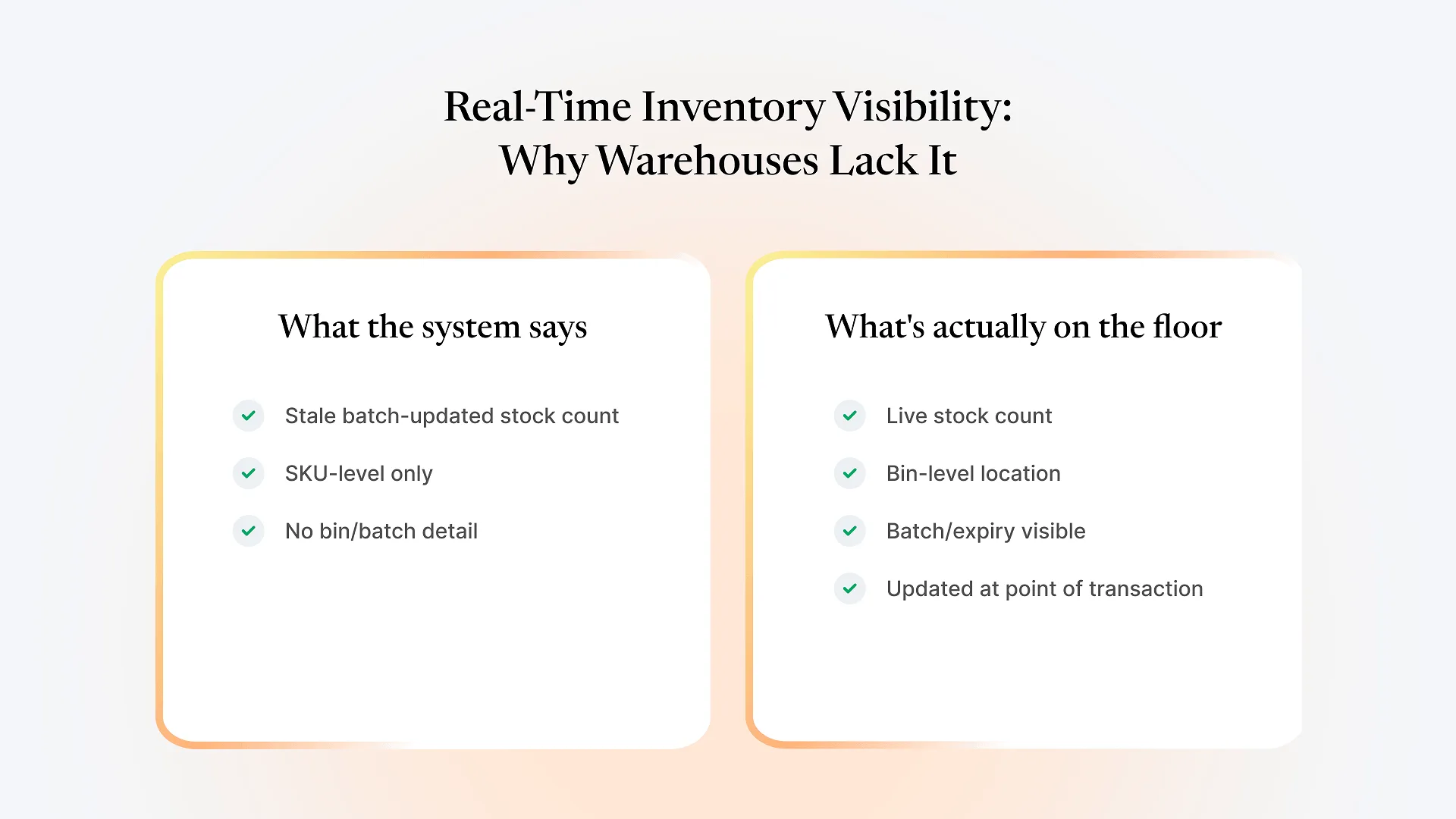
Many systems — including some ERPs configured without care — update stock counts on a schedule: nightly, hourly, or whenever someone remembers to run a sync. Between updates, the system is confidently wrong. A manager checking stock at 11am is looking at 6am's reality.
When the core system can't be trusted for real-time answers, teams build workarounds — a shared spreadsheet for "what's actually on the floor," a WhatsApp group for urgent stock checks, a supervisor who just knows. These workarounds feel faster in the moment, but they fragment the single source of truth further, and nobody outside that team can see them.
A system might say "500 units of SKU-4471 in Warehouse B" without saying which bin, which batch, or which expiry date. That's visibility at the SKU level, not the level a picker or a quality controller actually needs. The stock is technically "known" and practically unfindable.
As operations grow past a single warehouse, visibility often gets worse rather than better — because each location tracks stock its own way, and consolidating that into one live view either doesn't happen or happens too late to be useful for a same-day decision.
If getting an accurate number requires someone to physically walk the floor or cross-check three spreadsheets, that's not real-time visibility with an occasional manual check — that's manual counting with software attached.
What It Costs to Not Have It
Stockouts that shouldn't have happened, because the system said stock existed when it didn't, or two channels sold against the same unit before either knew.
Picking time lost to searching, because the system's location data doesn't match reality closely enough to trust.
Overstocking as a defensive habit, because if you can't trust what's actually available, ordering more "just in case" feels safer than it should.
Recurring physical stock counts that eat staff hours correcting a gap that shouldn't exist if the system were accurate between counts.
A warehouse team that stops trusting the system and starts trusting their own memory and spreadsheets instead — which quietly undermines the entire point of having a system.
What to Look for When Fixing It
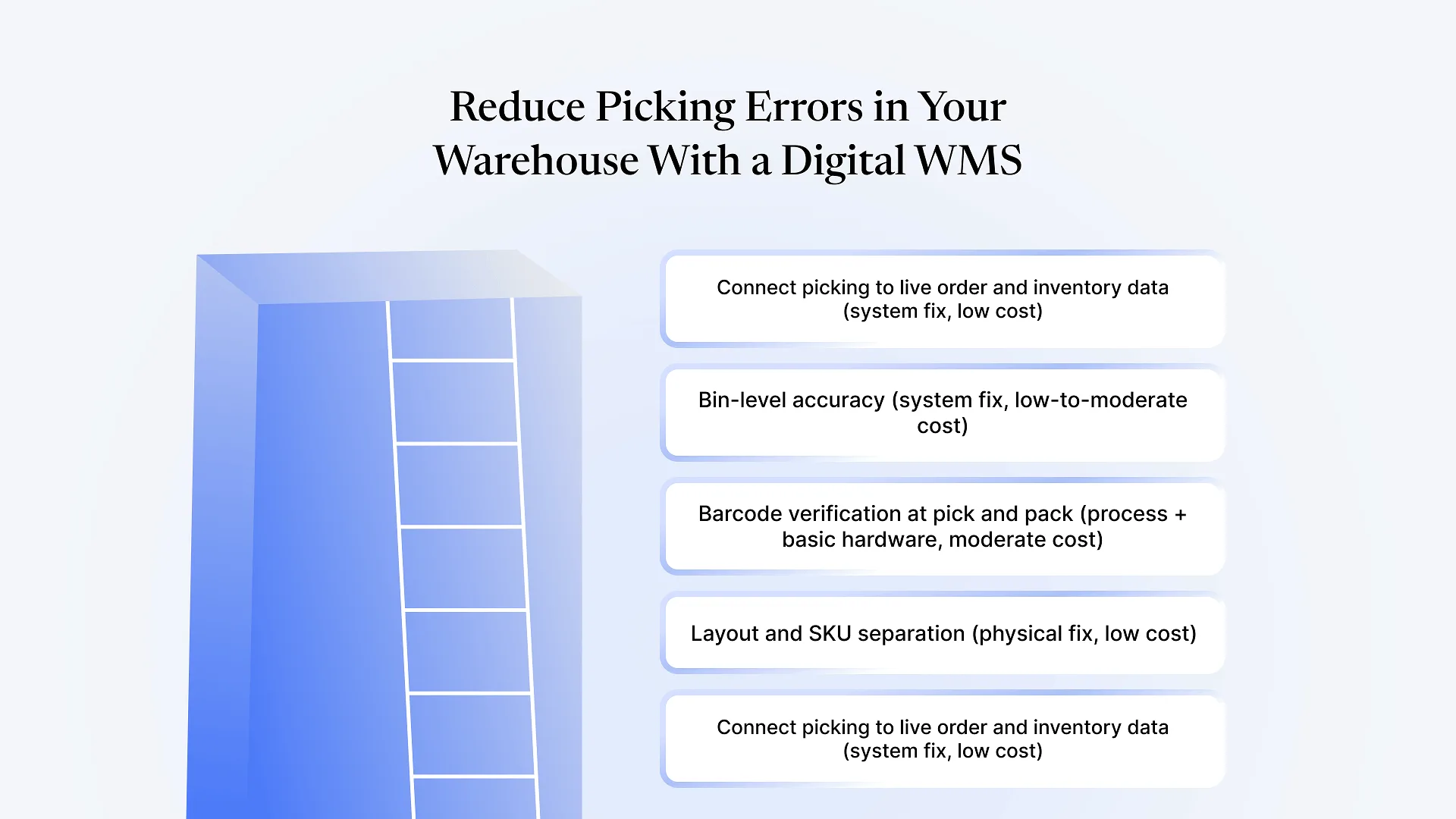
Updates happen at the point of transaction, via scanning, not via a batch job — ask specifically what triggers a stock update and how long the delay is between a physical action and the system reflecting it.
Visibility goes down to bin and batch level, not just SKU level, if your operation has more than one storage location per item or handles batch/expiry-sensitive stock.
There's one stock ledger across every location and every team that touches inventory — not a WMS number and a separate ERP number that get reconciled later.
The capture method actually works for the floor team — a barcode workflow that's technically real-time but too slow or clunky for a busy picker will quietly get abandoned in favor of the old paper log.
Frequently Asked Questions
If bridging inventory gaps with manual counts and side-spreadsheets sounds familiar, it’s worth seeing what real-time, bin-level visibility looks like in practice — see how it works.