



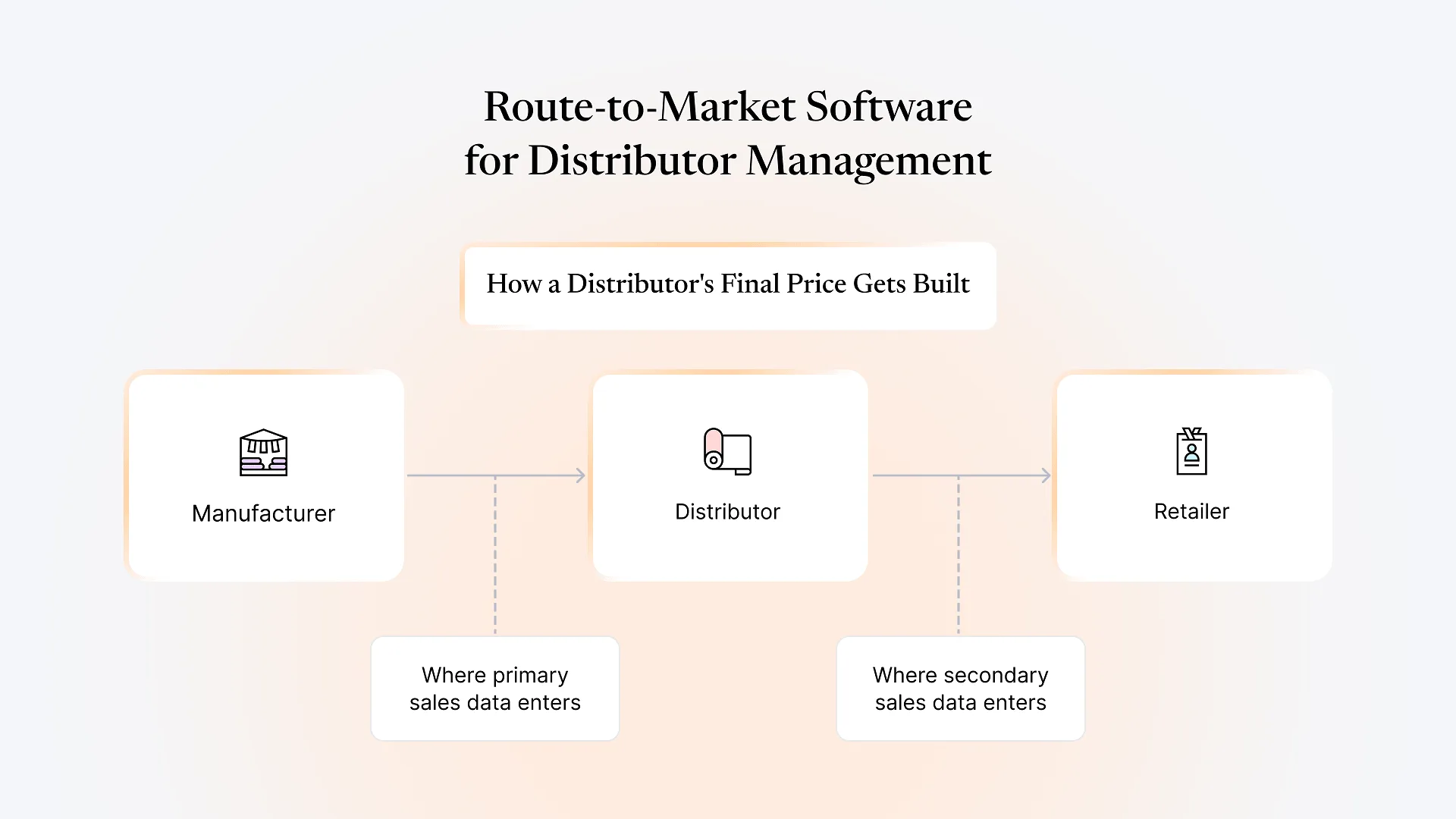
Route-to-market (RTM) software, usually called a distributor management system (DMS), is the platform that runs order capture, distributor stock, van sales, trade schemes, and secondary sales reporting between a manufacturer, its distributor network, and the retail trade. For FMCG and distribution businesses already running ERPNext, the real question isn’t whether to add one. It’s how tightly that DMS layer should connect to the inventory, sales, and finance data that already lives in your ERP.
Most guides to route-to-market software treat this as a feature question: does the tool support beat planning, does it have a van sales app, does it calculate schemes correctly. Those are real requirements, and worth getting right. But they’re also the part every DMS vendor already covers well. The part that determines whether the system actually works six months in is what happens at the boundary between the DMS and everything else your business runs on — and that’s where a lot of implementations quietly fail.
Why This Is a Different Project Than a Single-Site Rollout
Primary sales — orders and invoicing from the manufacturer into the distributor
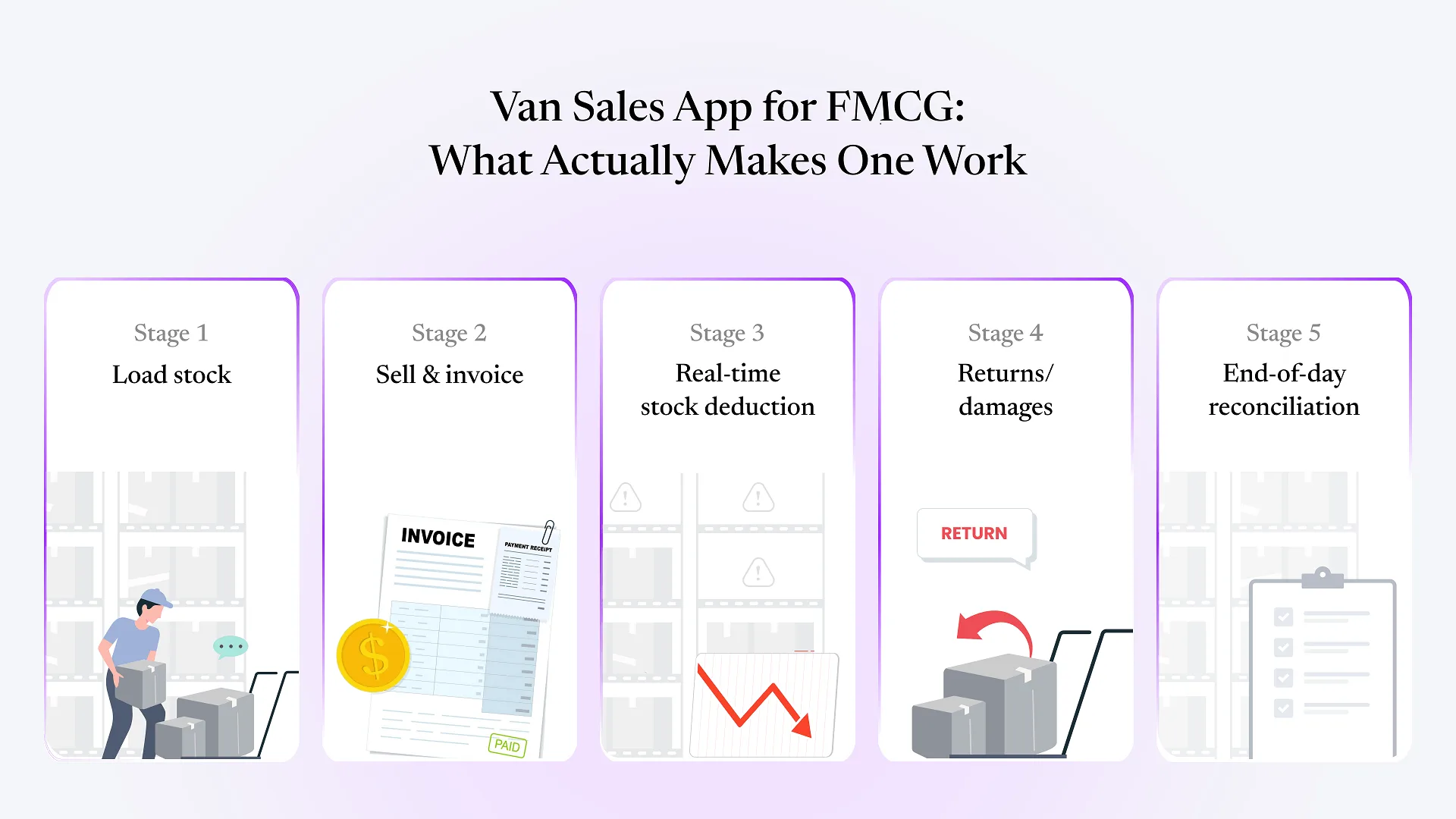
Secondary sales — orders and delivery from the distributor out to retail outlets, usually captured by a field sales or van sales app
Distributor stock and expiry — inventory sitting with each distributor, including batch and FEFO (first-expiry-first-out) tracking for perishable or dated goods
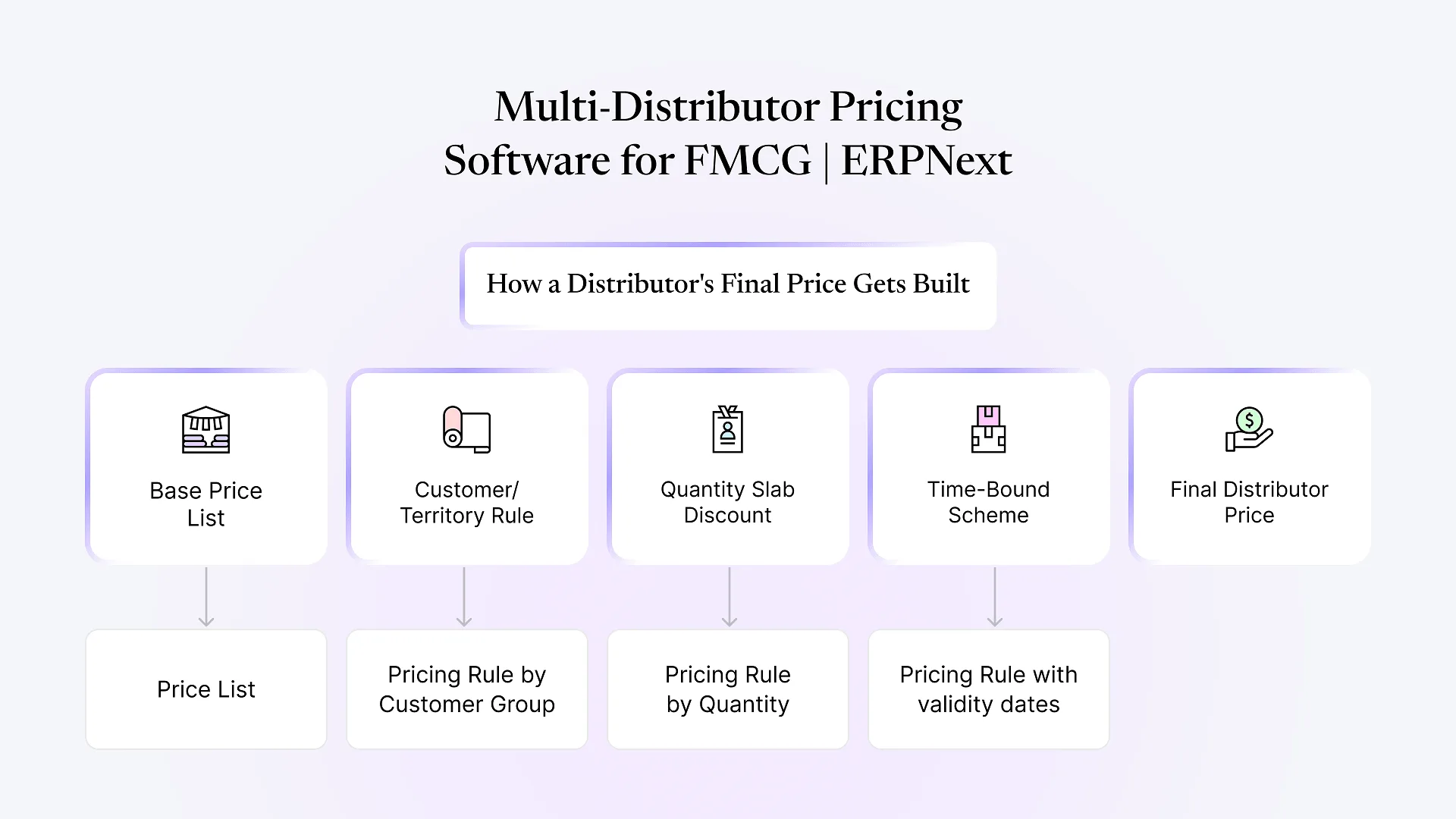
Schemes and trade promotions — slab discounts, volume incentives, and claims that need to be calculated correctly and settled without manual reconciliation
Beat and route planning — which outlets a salesperson or van visits, on what cycle
Distributor ledger and credit limits — outstanding balances, credit exposure, and payment collection
None of this is unusual to ask for. Every dedicated DMS product on the market (BeatRoute, FieldAssist, Distributo, and similar tools) covers this ground competently, and if your only requirement is a standalone app for field sales teams, one of them may be the right call.
If you’re evaluating this for a business that also runs its manufacturing, inventory, and accounting in ERPNext, though, the calculation changes.
The Integration Problem Most DMS Comparisons Skip
Here’s what usually goes wrong. A distribution team adopts a standalone DMS because it has a polished van sales app and a fast sales cycle. Six months later, finance is reconciling two ledgers by hand because scheme calculations happen in the DMS but invoicing and tax happen in the ERP, and the two don’t always agree on the numbers. Returns get logged in the DMS but never make it back into finished-goods stock in the ERP, so inventory reports are wrong. Distributor credit limits update in one system faster than the other, and someone eventually ships against a limit that was already breached.
None of this is a flaw in the DMS software itself. It’s a consequence of running two systems of record for data that’s genuinely one process: an order, a scheme, a stock movement, and a payment are the same event, just viewed from different desks. A connector that syncs nightly, or even hourly, treats them as separate events instead.
If you’re mapping out what actually needs to move between your distribution network and your books before committing to a tool, it’s worth looking at how this plays out for businesses at a similar scale — our case studies on FMCG and distribution implementations walk through the specific data flows we’ve built for clients running multi-distributor operations.
Point-Solution DMS vs. Distribution Built Inside ERPNext
| Standalone DMS + API connector | Distribution built natively in ERPNext | |
|---|---|---|
| Order-to-ledger latency | Minutes to hours, depending on sync schedule | Immediate — same database |
| Scheme and invoice agreement | Can drift if scheme logic differs between systems | Calculated once, applied consistently |
| Returns and stock reconciliation | Manual matching required across two systems | Automatic — one stock ledger |
| Cost over time | License fees for DMS plus integration maintenance | One platform, one implementation partner |
| Customization for your scheme rules | Limited to what the DMS vendor's API exposes | Full control via custom Frappe apps |
| Best fit | Field sales teams needing a fast, standalone app with no ERP in place yet | Businesses where inventory, finance, and distribution already need to agree |
What Should Sync in Real Time vs. What Can Run in Batch
Real time
stock availability at the distributor level, current pricing, and active scheme eligibility — a salesperson in the field needs this accurate the moment they're writing an order.
Near-real-time (minutes)
secondary sales orders flowing back to update distributor inventory and outstanding credit.
Batch (daily or on-demand)
finance reconciliation reports, claims settlement runs, and management dashboards, where a few hours' lag doesn't change any decision being made.
Where This Fits If You're Already Running ERPNext
If ERPNext is already your system of record for inventory and finance, extending it to cover distributor and van sales operations is typically a custom Frappe app development project rather than a standard module turn-on. It’s also, in our experience, one of the more contained ones: the data model for distributors, schemes, and secondary sales maps naturally onto ERPNext’s existing sales and inventory doctypes, so the build is closer to configuration and targeted app development than a from-scratch system. Our tailored ERPNext implementation work covers exactly this kind of extension, built around your existing scheme structure rather than forcing it into a generic template.
That said, it isn’t the right move for every business. If you don’t yet have distributors on any digital system and just need to get a basic van sales app running fast, a lightweight standalone tool bought off the shelf will get you there faster, and you can always integrate it more tightly later once you know which of your scheme rules and reporting needs are actually non-negotiable.
Frequently Asked Questions
Talk to Us About Your Distribution Setup
If you’re weighing a standalone DMS against extending ERPNext to cover your distribution network, the right answer depends on how many scheme types, distributors, and reconciliation points you’re already dealing with. Book a free ERPNext consultation and we’ll walk through what your specific setup would actually need.