



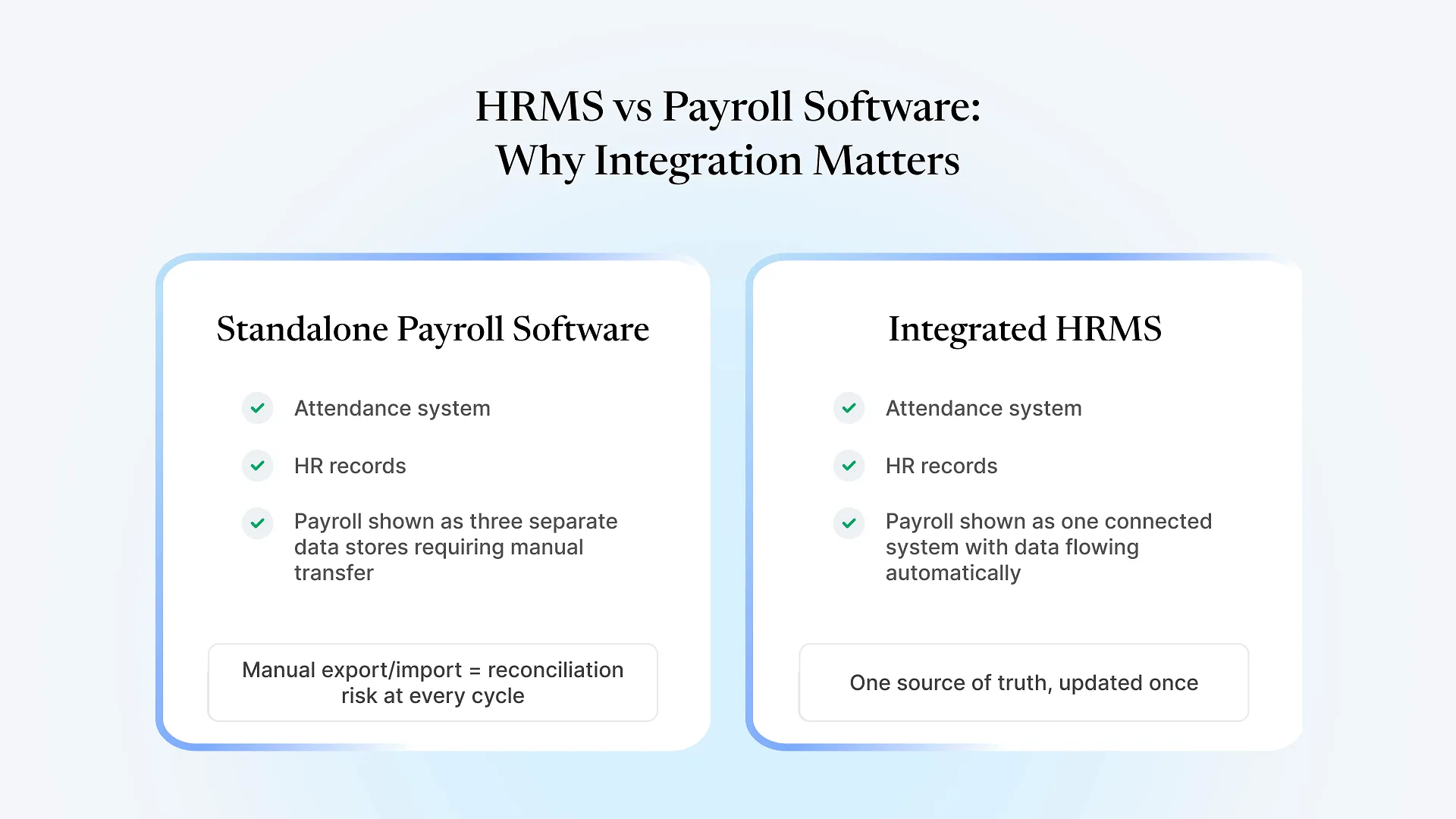
HRMS vs payroll software, in short: standalone payroll software calculates pay from data you feed it, while an HRMS manages the full employee lifecycle — attendance, leave, shift schedules, and compliance — and uses that same data to run payroll automatically, without manual reconciliation between systems.
For HR and operations leaders running multi-location or manufacturing teams, that difference tends to show up as reconciliation work nobody budgeted for.
What standalone payroll software actually does
Standalone payroll tools are built to do one job well: take inputs (hours worked, leave taken, salary structure, tax details) and calculate what each employee is owed, including statutory deductions like PF, ESI, and TDS. Most integrate with attendance systems through file uploads or scheduled syncs rather than live data sharing.
That’s a reasonable setup if your organization is small, single-location, and attendance rarely changes after the fact. It becomes a liability once any of those conditions stop being true — which is common across the multi-plant manufacturing and multi-location operations we work with in India and the Middle East.
What changes when payroll runs inside a HRMS
If a supervisor forgets to mark attendance for a night shift and it's corrected three days later, that correction is already inside the system payroll reads from. In a disconnected setup, someone has to remember to re-export attendance, re-upload it to the payroll tool, and manually re-check whether the correction changed anyone's pay.
Manufacturing and multi-plant operations often run multiple shifts with different differentials, and biometric attendance data needs to map correctly onto those shift definitions before payroll math is accurate. When attendance and payroll share a system, that mapping happens once, not twice — once in the attendance tool's logic and again when payroll software tries to interpret an exported file.
A salary revision that takes effect mid-cycle, or a correction that affects two pay periods, is straightforward to calculate when the HRMS has continuous employee history. In a standalone tool fed by periodic exports, arrears calculations often become a manual spreadsheet exercise, which is where errors creep into statutory filings.
PF, ESI, and TDS filings depend on accurate attendance and salary history. If payroll runs from a snapshot that's a few days or weeks old relative to HR's actual records, filings can be built on numbers that no longer match reality — a real audit risk, not a hypothetical one.
Read more on how Frappe HRMS handles statutory deductions and payroll compliance in India.
None of this means standalone payroll software is a bad product. It means the value of integrated HR and payroll grows with organizational complexity — more locations, more shift patterns, more frequent attendance changes.
When standalone payroll software is genuinely the right call
You operate from a single location with stable, predictable attendance patterns
Your headcount is small enough that manual reconciliation takes minutes, not hours, each cycle
You don't need shift-based attendance rules, biometric integration, or multi-plant visibility
HR processes like leave, onboarding, and self-service aren't a current pain point
HRMS vs Payroll Software at a Glance
| Standalone Payroll Software | Integrated HRMS (e.g. Frappe HRMS) | |
|---|---|---|
| Data source for payroll | Manual export/import from attendance system | Live attendance, leave, and employee data |
| Mid-cycle attendance corrections | Require re-export and manual re-check | Reflected automatically at next payroll run |
| Multi-shift / multi-plant attendance | Mapped separately in each system | Mapped once, applied consistently |
| Arrears across pay periods | Often manual spreadsheet calculation | Calculated from continuous employee history |
| Statutory filing accuracy | Depends on export timing | Draws from current system data |
| Employee self-service | Usually a separate portal, if any | Built into the same system HR and payroll use |
What integration means for employee self-service
One effect of running HR and payroll in one system that’s easy to underweight: employees can see their own attendance, leave balance, and payslips without routing every question through HR. That doesn’t just reduce HR’s ticket volume — it also means the data employees are looking at is the same data payroll is calculating from, so there’s no “the portal says X but my payslip says Y” confusion that disconnected systems tend to produce.
See what changes for HR teams when employee self-service runs through Frappe HRMS instead of a bolted-on portal.
Frequently Asked Questions
Where this leaves you
If your team is still manually reconciling attendance exports against payroll runs every cycle, that’s not a process problem to fix with more spreadsheets — it’s a sign the two systems should be one. For multi-location and manufacturing operations in particular, the operational cost of keeping them separate tends to grow, not shrink, as headcount and shift complexity increase.
See our HRMS implementation approach to understand how Aavatto approaches moving HR and payroll onto one system, including the attendance, shift, and compliance mapping that a clean migration depends on.