



Quick answer: A unified ERP replaces separate point solutions once the cost of manually reconciling data across systems outweighs the benefit of each tool’s specialized depth — typically once a business needs the same data (stock, sales, finance) visible consistently across more than two or three disconnected systems.
The unified ERP vs point solutions decision usually comes down to one question: does the daily cost of keeping separate systems in sync outweigh what you’d give up by moving inventory, production, sales, and finance onto one platform? For manufacturers and distributors past the point where a founder can eyeball the numbers, the honest answer is that it depends on how many systems you’re already running and how much cross-functional reporting your business actually needs — not a blanket rule in either direction. It’s also the real question hiding behind broader searches for the best ERP for manufacturing: not which named product ranks highest, but whether to consolidate at all.
This isn’t a case for ripping out every specialized tool you own. Point solutions exist because they’re good at one thing. The real question is when that depth stops being worth the coordination cost of running it alongside three or four other systems that don’t talk to each other.
Why this question shows up now, not at launch
Most businesses start with point solutions by necessity. A small manufacturer picks accounting software for compliance, a warehouse tool because stock was getting lost, maybe a separate payroll system when headcount crossed a threshold. Each decision made sense in isolation, and each tool did its one job well.
The problem surfaces later, usually around the point where a business runs multiple locations, more than a handful of SKUs or product variants, or a sales team that needs inventory visibility in real time. That’s when someone — usually the CFO, sometimes the CEO — notices that closing the books requires pulling numbers from four places, that the warehouse team’s stock count and the accounting system’s stock value don’t match, or that a new hire in one plant shows up correctly in payroll but not in the attendance system feeding it. None of these are catastrophic on their own. Together, they’re a full-time reconciliation job nobody budgeted for.
What point solutions are genuinely good at
Before making the case for a unified platform, it helps to be direct about what point solutions do well: a dedicated warehouse management tool will usually out-feature the inventory module of a general-purpose ERP on pure warehouse mechanics — bin-level put-away logic, wave picking, dock scheduling. A specialized payroll tool built for one country’s compliance rules will often handle edge cases faster than a broader HR module. Point solutions win on depth in their one domain, and they’re frequently faster to implement because the scope is narrow by design.
If your business genuinely operates as a single function at scale — a pure third-party logistics warehouse with no manufacturing or retail arm, for instance — a best-in-class point solution for that one function can be the right call indefinitely. The unified-platform argument gets stronger specifically as the number of connected functions grows, not as a universal rule.
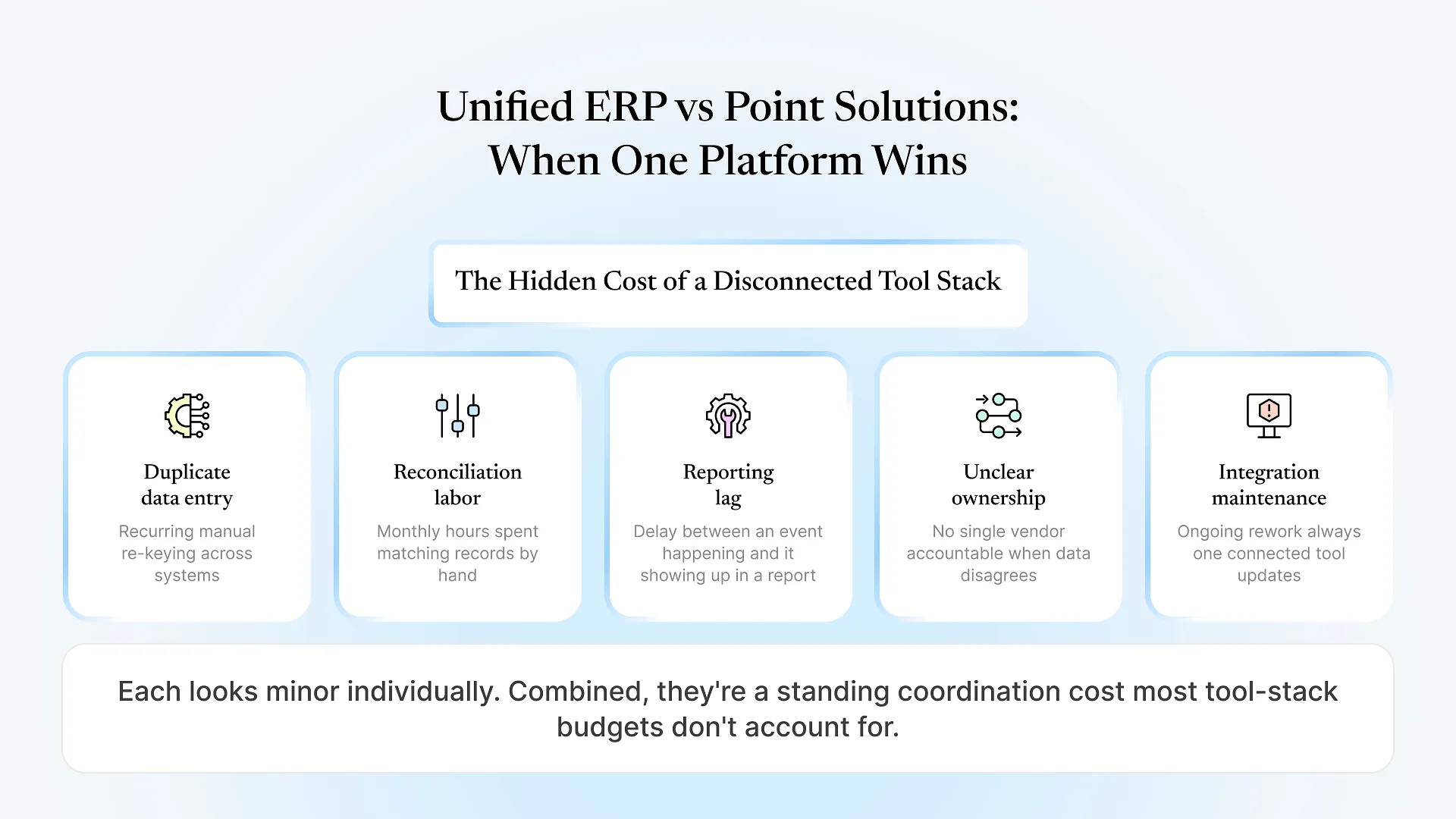
Where the point-solution stack starts costing more than it saves
The same purchase order, customer, or SKU gets keyed into two or three systems, and any typo or delay in one place creates a mismatch everywhere else.
Someone — often a finance team member — spends recurring hours each month manually matching stock movements, sales, and ledger entries across systems that don't share a database.
A CEO or CFO wanting a real-time view of cash, stock, and production has to wait for someone to compile numbers from separate sources, because no single system holds the full picture.
If a stock figure is wrong, is it the WMS, the accounting tool, or the manual export between them? With separate vendors, each one can point at the integration layer rather than take responsibility.
Point-to-point integrations between specialized tools need to be rebuilt or re-tested every time one vendor pushes an update, which is ongoing work with no natural end date.
Unified ERP vs. point solutions: a decision table
| Dimension | Point-solution stack | Unified ERP (e.g., ERPNext) |
|---|---|---|
| Depth in one function | Often deeper, purpose-built for that function | Strong but more general; may need customization for niche workflows |
| Time to implement one function | Usually faster in isolation | Slower initial rollout, but each new function added afterward reuses the same data model |
| Cross-functional reporting | Requires manual compilation or a separate BI layer | Native, since all functions share one database |
| Data consistency | Depends on integrations staying in sync | Single source of truth by design |
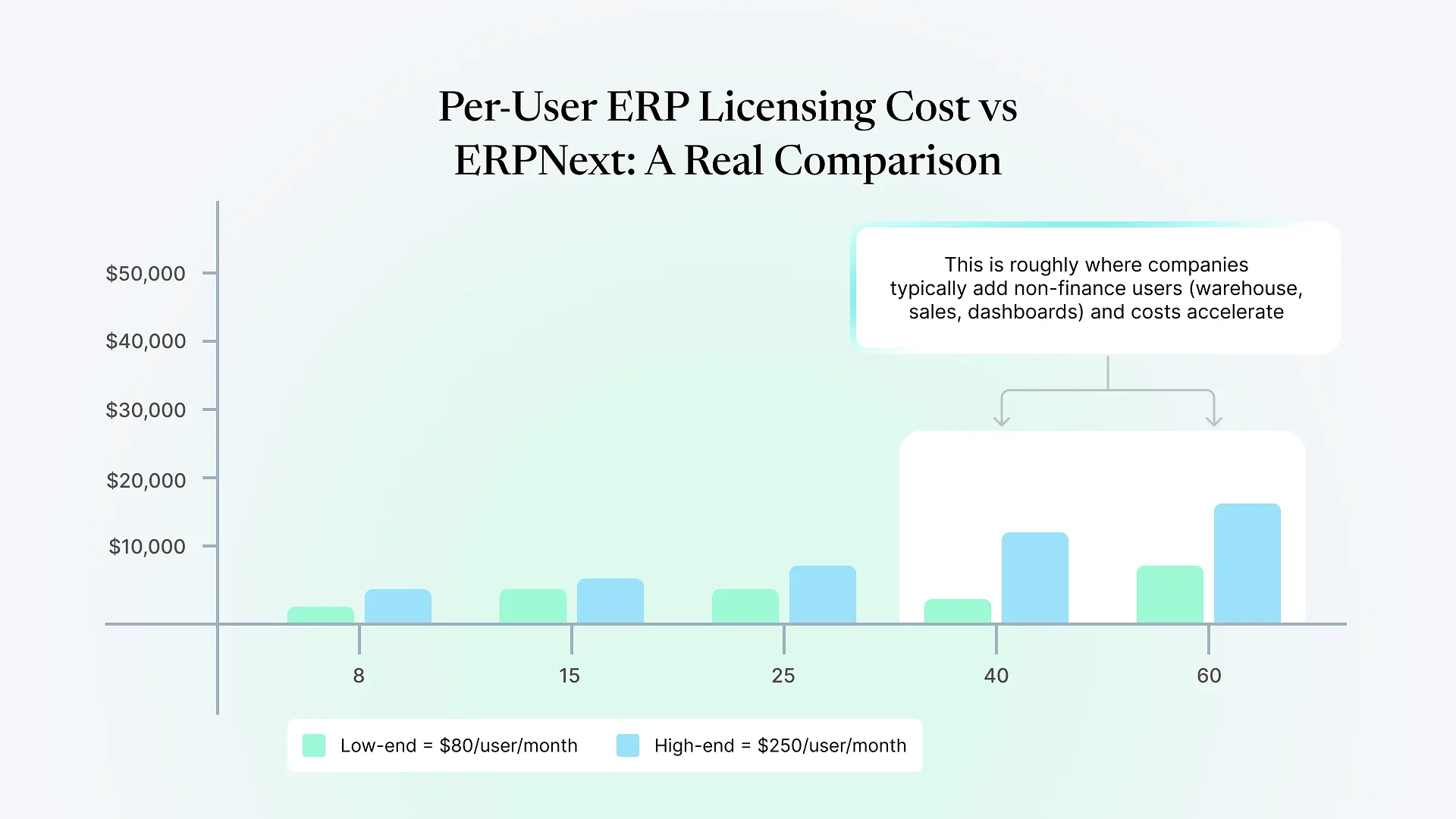
| Total cost over time | Lower per tool, but integration and reconciliation labor accumulates | Higher upfront, but coordination cost drops as more functions consolidate |
| Vendor accountability | Split across vendors; integration issues can fall into the gap | One implementation partner accountable for the full data flow |
| Customization for vertical workflows | Built-in for the one workflow it targets | Depends on the platform's flexibility and the partner's ability to extend it |
Where point solutions still win, even for growing businesses
A function with extreme regulatory or technical depth, where a general ERP module would need heavy customization to match a specialized tool's built-in compliance logic.
A newly added business line still being validated, where standing up a lightweight point tool is faster than extending the core ERP before you know the workflow will stick.
A genuinely single-function business, as noted earlier, where cross-functional reporting isn't a meaningful need in the first place.
For vertical manufacturers, this tradeoff shows up concretely. A textile or garment manufacturer weighing a dedicated production-floor tool against ERPNext needs to check whether that tool’s cutting-floor and job-card tracking can be matched inside an ERPNext setup built for textile and garment production — in many cases it can, without losing the shop-floor detail a specialized tool provides. An FMCG distributor evaluating a standalone batch-tracking or van-sales app should ask the same question of a unified system built for FMCG distribution: does the point solution’s depth justify running expiry tracking, distributor management, and field sales as separate systems from the ledger that has to reconcile all of it monthly. In practice, this is where implementation experience matters as much as the platform itself — what looks like a missing feature in a standard ERP module is often a solvable customization, but only to someone who has actually replaced these point tools before.
A practical framework for the decision
How many functions need to see the same data?
If inventory, sales, and finance all need the same real-time stock number, every additional disconnected system multiplies the reconciliation work.
Who currently owns fixing a data mismatch?
If the honest answer is "whoever notices it first," that's a sign the stack has outgrown ad hoc fixes.
Does the point solution's depth solve a problem you actually have, or one you might have someday?
Depth you're not using yet is a cost without a benefit.
What's the real cost of the integration work, including the people-hours no one's tracking?
Software licensing costs are visible; reconciliation labor usually isn't, until someone adds it up.