





Skip links
Table of Contents
    One System vs Disconnected Tools

    Garment Manufacturing ERP: Managing Production, Inventory and Dispatch in One System

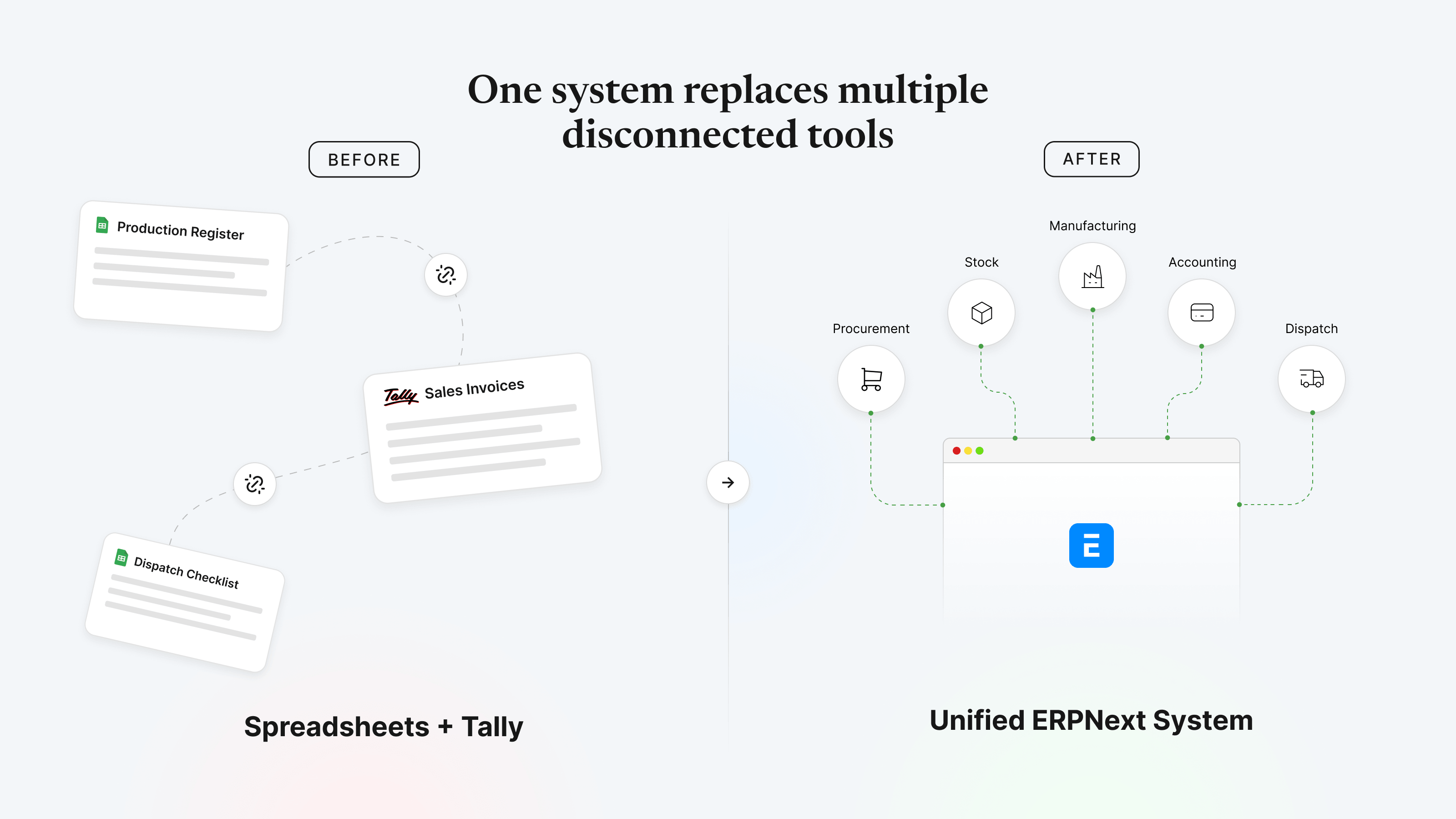
    Most textile and apparel manufacturers don’t run on one system — they run on several that don’t talk to each other. Production is tracked on the shop floor in a register or a spreadsheet, inventory sits in Tally or a separate stock ledger, and dispatch gets coordinated over WhatsApp and phone calls. A garment manufacturing ERP replaces that patchwork with one connected system, so a fabric consumption entry on the floor updates stock in real time and a dispatch note can’t go out against an order that isn’t actually ready. That connection — not any single feature — is what actually changes how a manufacturing unit runs day to day.


    For textile and apparel units specifically, the gap between “we have software” and “we have one system” tends to show up in three places: production planning that doesn’t reflect real material availability, inventory counts that drift from what’s physically on the shelf, and dispatch that depends on someone manually checking three different records before a truck can leave.

    Why Textile Manufacturers Outgrow Spreadsheets and Tally

    Tally handles accounting well. It was never built to track work-in-progress across cutting, stitching, and finishing stages, or to tell a production planner whether there’s enough grey fabric on hand before committing to a new order. Spreadsheets fill that gap manually, which works until order volume or SKU count grows past what one person can keep updated by hand.

    The result, in units we’ve worked with, is a familiar pattern: production planning based on what the register says should be available rather than what’s confirmed in stock, inventory counts that only get reconciled during a physical stock-take, and order processing that involves manually cross-referencing production status, stock, and customer commitments before a dispatch decision can be made.

    What Changes With ERPNext Textile Industry Implementation

    We implemented ERPNext for a textile manufacturer to replace exactly this setup — spreadsheets and Tally handling production, inventory, procurement, sales, and dispatch as disconnected pieces. The goal wasn’t to digitize each department separately; it was to put all five functions on one system so a change in one place reflects everywhere else automatically.
    FunctionBeforeAfter ERPNext implementation
    Production planningBased on register estimates, not confirmed stock28% faster planning, tied to real-time material availability
    InventoryReconciled manually during periodic stock-takes97.8% inventory accuracy
    Order processingManual cross-referencing across systems before dispatch42% reduction in order processing time
    Rollout-12-week implementation timeline
    The 28% improvement in production planning speed came directly from planners no longer needing to manually verify material availability against a separate stock record before scheduling a run — the system shows confirmed inventory at the moment a plan is being made. The 97.8% inventory accuracy figure reflects what happens when every material movement, from raw fabric receipt to finished goods dispatch, is logged in the same system that reports stock levels, rather than updated in batches. And the 42% cut in order processing time came from removing the manual reconciliation step between production status, inventory, and the sales order — dispatch could proceed as soon as the system confirmed an order was actually ready, instead of waiting on someone to check three places first.
    One System vs Disconnected Tools
    None of this happened as a single “go-live” event. Getting production, inventory, procurement, sales, and dispatch onto one system in 12 weeks meant sequencing the rollout — core inventory and production data first, procurement and sales workflows layered in once the foundation was stable, dispatch rules configured last once real order flow through the system could be tested. That sequencing, more than any single ERPNext feature, is why the transition didn’t stall the way “big bang” ERP rollouts often do in manufacturing environments. It’s worth being direct that a 12-week timeline reflects this specific engagement’s scope and starting data quality — a unit with more locations, more legacy data to clean up, or heavier customization needs should expect a longer runway, not assume this number as a universal promise.

    What This Looks Like for Your Unit

    If your team recognizes the pattern above — planning against what should be in stock rather than what is, a physical count that never quite matches the ledger, dispatch that depends on someone checking multiple places before a truck leaves — the fix isn’t more spreadsheet discipline. It’s removing the gap between the systems that track those three things in the first place.

    You can see the full detail of how this rollout was structured, including the specific workflows configured for production and dispatch, in our case study on ERPNext implementation for textile manufacturing and supply chain management.

    If you’re weighing whether an ERP for textile manufacturing is worth the transition for your unit, the honest answer depends on how much of your day currently goes into manually reconciling production, stock, and orders across separate tools — if that’s a real cost for your team, a connected system is where the return shows up fastest.

    Frequently Asked Questions

    ERPNext is used by manufacturing units across a range of sizes. The relevant question isn't factory size but whether production, inventory, and order processing are currently spread across disconnected tools — that gap exists at small and mid-sized units too, often with less capacity to absorb the manual reconciliation work.

    It depends on the unit's data quality, number of locations, and how much customization the workflows need. In the engagement referenced above, production, inventory, procurement, sales, and dispatch were all live within 12 weeks — but that reflects this specific project's scope, not a fixed timeline for every rollout.

    ERPNext can handle the accounting functions Tally covers along with production, inventory, and dispatch in the same system, which is what removes the disconnect between them. Some businesses choose to keep Tally running in parallel during a transition period, but the accuracy gains come from consolidating onto one system rather than syncing two.

    The most common failure point isn't the software — it's rolling everything out at once without sequencing the transition. Migrating core inventory and production data first, then layering in procurement, sales, and dispatch workflows once that foundation is stable, is what keeps day-to-day operations from stalling during the switch.


    Author
    Niraj Gohel
    Meet Niraj Gohel, the “Problem Solver”, and occasionally the problem creator at Aavatto. When he’s not traveling, watching a film, or having a cup of tea, he spends his days solving problems, debating ideas, and occasionally distracting the team with completely unrelated conversations. His philosophy is simple: technology is important, but being a good human is more important.
    gohel-niraj
    This can be a new journey !

    Have a Project in Mind?

    This can be a new journey !

    leaf