



Shopify, WooCommerce, and similar platforms are built to get a store live fast, and for most D2C brands early on, that’s exactly the right trade. The question this guide answers is different: how do you know when you’ve outgrown that template, and what actually changes when you move to custom ecommerce development?
In short: you’ve likely outgrown a template when your catalog, inventory, or fulfillment logic no longer fits the platform’s built-in data model — production batches, multi-warehouse stock, or B2B-plus-D2C pricing, for example — and you’re relying on apps, spreadsheets, or manual reconciliation to bridge the gap. Custom development replaces those workarounds with a system built around how your business actually operates.
Signs You Need to Scale Ecommerce Beyond a Template
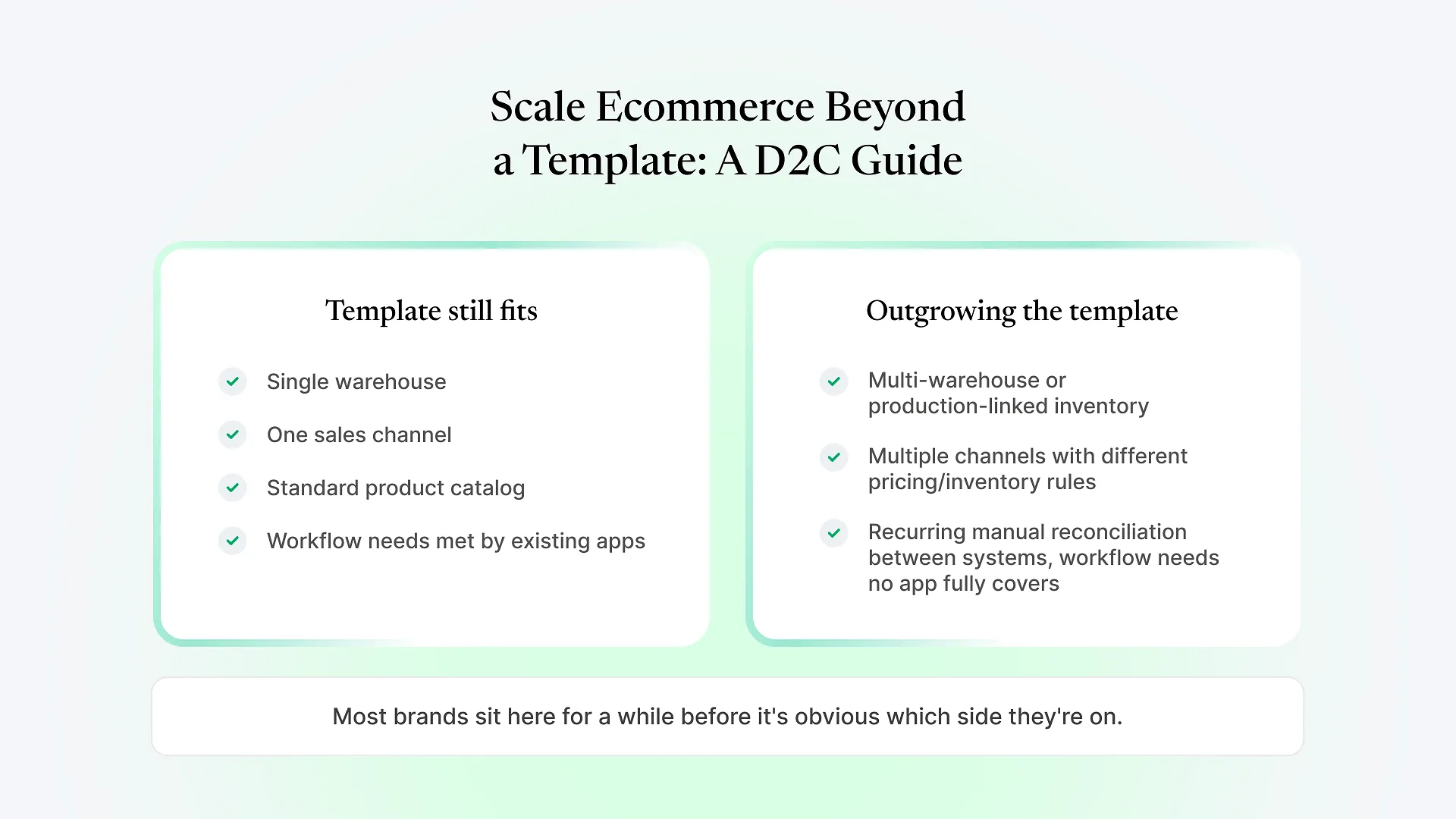
A templated store models your business as a fixed shape: products, variants, a single inventory count per SKU, a standard checkout flow. Most brands fit that shape comfortably for years. The brands that don’t tend to show a recognizable pattern, not a single trigger event.
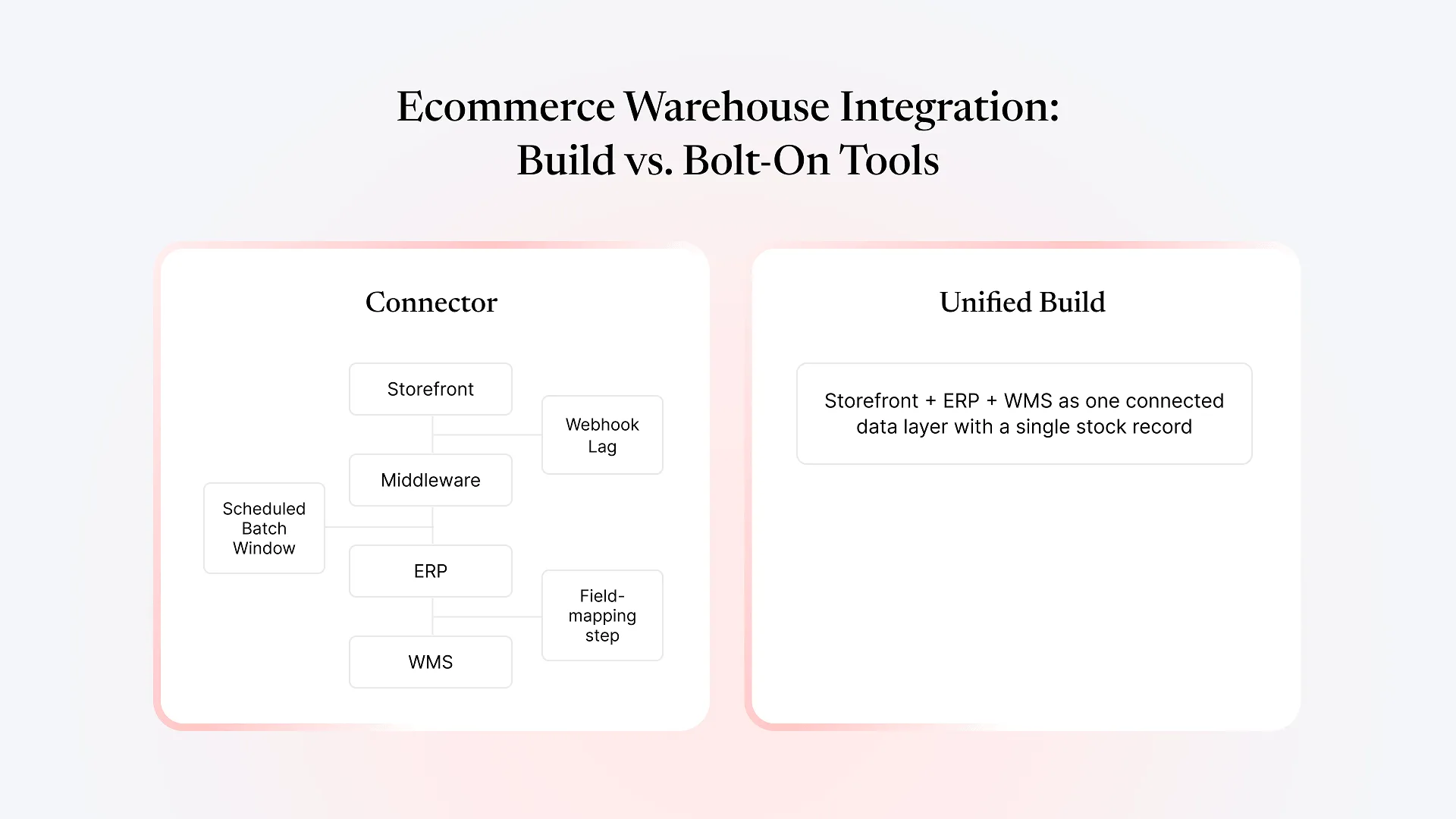
Common signs include running production and the storefront on separate systems that require manual updates to stay in sync, needing app after app bolted onto the platform to approximate a workflow the platform wasn’t built for, selling through more than one channel (D2C plus wholesale, marketplaces, or retail) with pricing or inventory rules that don’t map cleanly to one store, and finding that every new operational requirement turns into “which app might do this” instead of “how do we build this correctly.”
None of these individually means you need custom development. Together, and repeating month after month, they usually mean the platform is no longer the constraint you can work around — it’s the constraint shaping how you run the business.
What Actually Changes With Custom Ecommerce Development
| Templated Platform | Custom Ecommerce Development | |
|---|---|---|
| Data model | Fixed, defined by the platform vendor | Built around your actual catalog, inventory, and order logic |
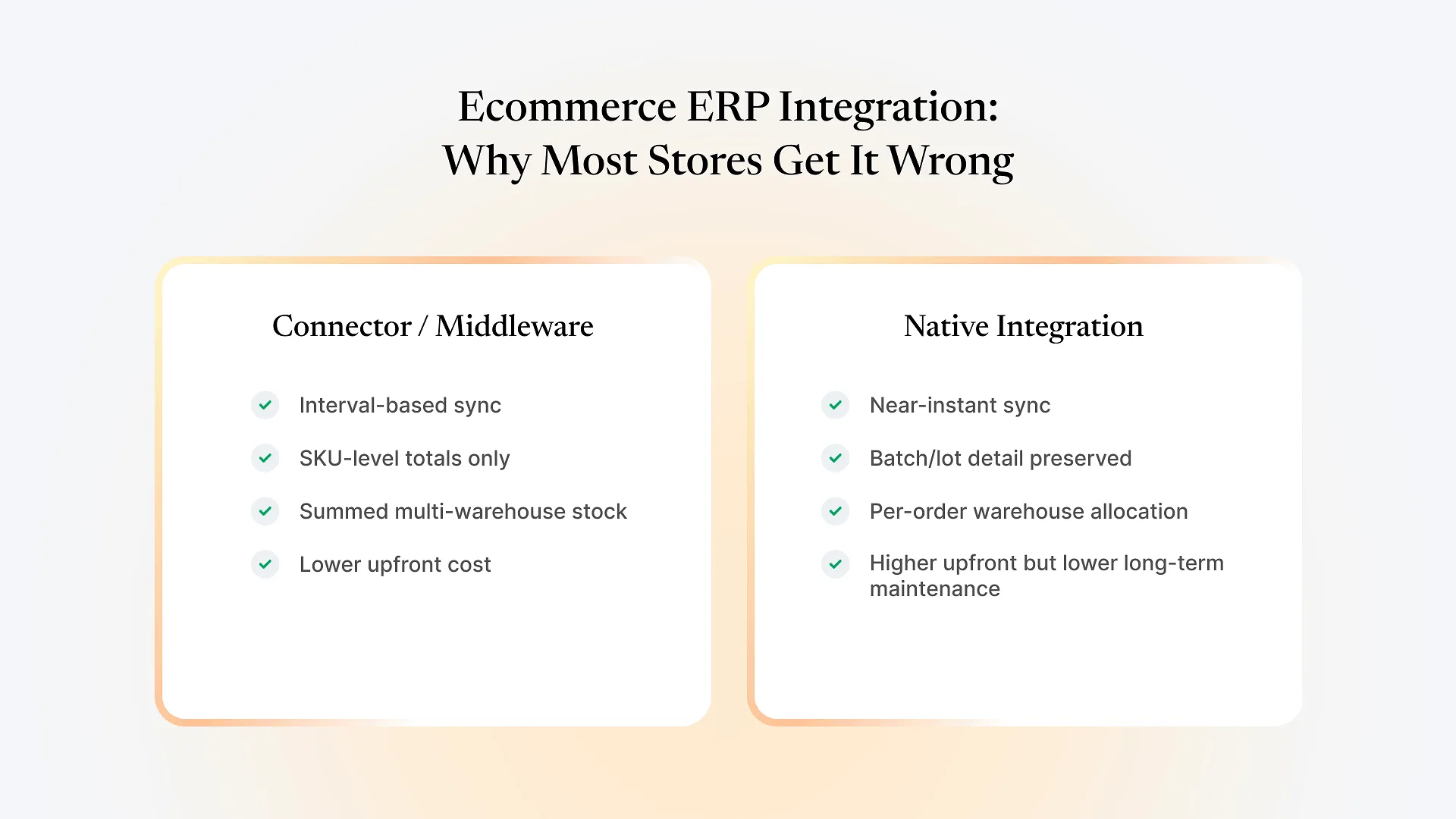
| Backend integration | Via third-party apps and connectors | Native connection to ERP, inventory, and production systems |
| Multi-channel / multi-warehouse | Often requires workarounds or multiple app subscriptions | Modeled directly, as a first-class part of the system |
| Change requests | Limited to what the platform or an app supports | Built to order, within your development capacity |
| Ownership | Platform controls architecture and future direction | You own the code, data, and roadmap |
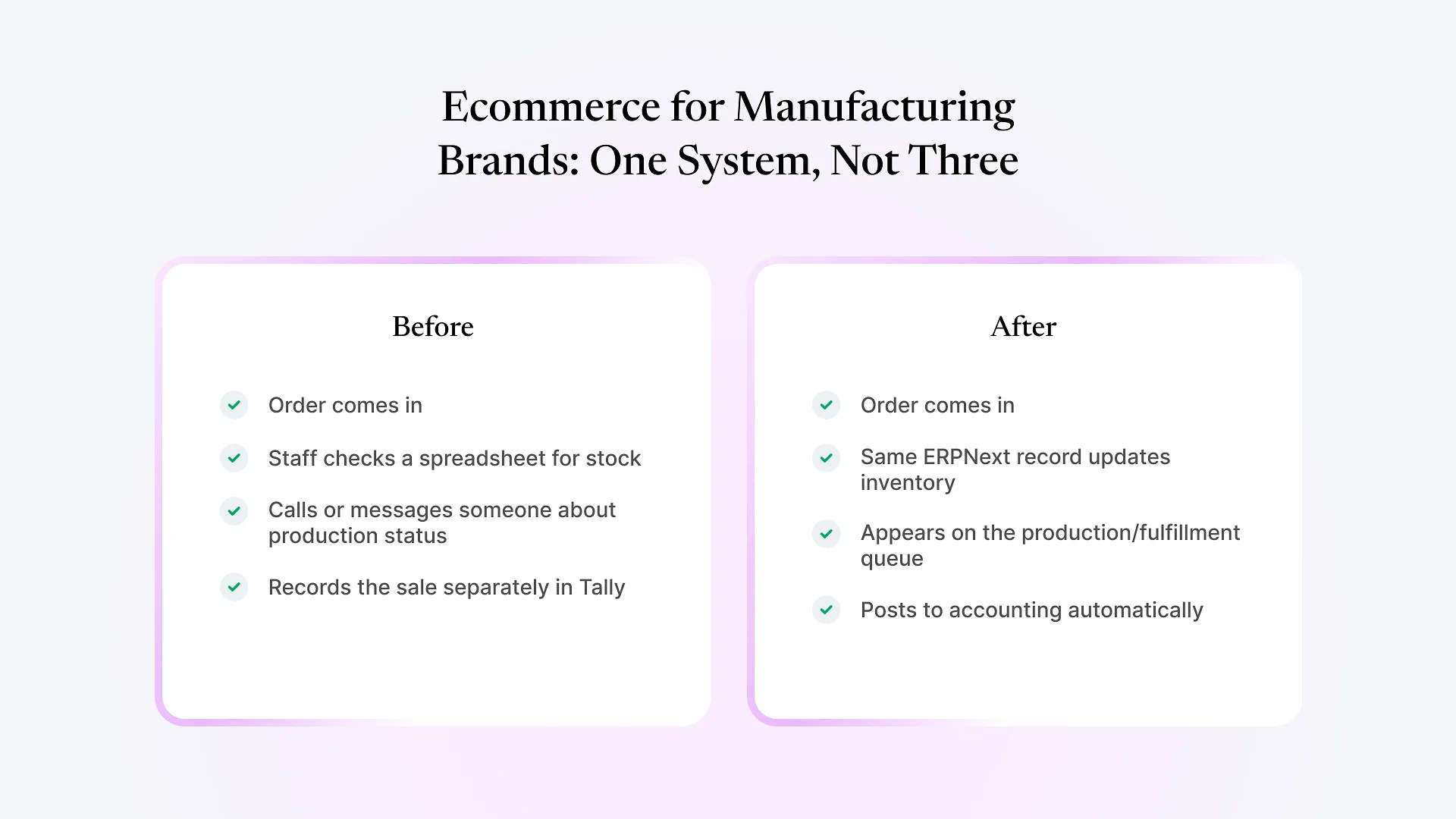
Custom ecommerce development doesn’t mean building a storefront from a blank page. In practice it usually means building or connecting a platform to your ERP, inventory, and production systems as one coherent architecture, rather than syncing several separate tools and hoping the sync jobs don’t drift. For a manufacturing or D2C brand, that typically means the storefront, order queue, inventory ledger, and production or procurement status are reading from the same underlying data — not four systems each with their own version of “what’s in stock.”
Already seeing your operations spread across a storefront, a spreadsheet, and an inventory app that don’t talk to each other? Talk to us about your e-commerce build — we can walk through whether the gap is a platform limitation or a process fix, before you commit to a rebuild either way.
What It Costs — In Effort, Not Just Money
Custom development is a bigger commitment than adding another app to a template, and it’s worth being direct about that rather than glossing over it. It requires a development team, a longer build timeline, and an ongoing relationship for support and iteration, rather than a monthly subscription and a plugin marketplace.
That cost shows up in two places: the build itself, and the team maintaining it afterward. If you’re evaluating what that ongoing relationship looks like, how much it costs to hire a dedicated Frappe developer is a useful reference point, since most custom ecommerce builds for growing D2C and manufacturing brands end up running on Frappe-based architecture specifically because of how directly it connects to ERP and inventory systems.
The return isn’t instant. It shows up over time, in the hours no longer spent reconciling stock counts across systems, and in not hitting a hard platform ceiling again in eighteen months. Brands considering this move should weigh it against a realistic backlog of what the template is currently costing them in manual work — not against the sticker price of a subscription plan.
Is Headless or Custom Always the Right Move?
Not always, and it’s worth saying so plainly. If your catalog is simple, you sell through one channel, and your current apps genuinely handle your workflow without daily manual patching, a template platform is still the right tool. Custom ecommerce development solves a specific class of problem — operational complexity outgrowing the platform’s data model — not a generic “better” version of the same store.
The decision point isn’t brand ambition or revenue size on its own. It’s whether the operational patterns above are already showing up, and whether they’re getting more frequent rather than less as you grow.
Frequently Asked Questions
If the patterns above sound familiar — inventory that’s never quite right across systems, a production team and a storefront that don’t share the same numbers, or a growing list of apps trying to patch the same gap — that’s usually the moment a template stops being the fast option and starts being the slow one. Talk to us about your e-commerce build and we’ll help you figure out, honestly, whether custom ecommerce development is the right next step for where your business actually is.