




A dedicated Frappe developer typically costs between $25 and $70 per hour, depending on whether you hire through a freelance marketplace, an offshore staffing shop, or a specialized ERPNext/Frappe development partner. Generalist offshore rates sit at the low end; developers with real Frappe framework depth — doctypes, server scripts, custom app architecture — command the higher end, and agency engagements typically bundle in code review and project management that a solo hire doesn’t include.
That range is wide because “Frappe developer” gets used loosely. Someone who has built a few custom fields in ERPNext and someone who can architect a multi-app Frappe bench, write clean server-side Python against the ORM, and debug a broken migration are both technically “Frappe developers” — but they are not interchangeable, and the rate difference reflects that gap more than it reflects geography.
What "Cost to Hire a Frappe Developer" Actually Includes
The technical work itself
building custom doctypes, writing server scripts and client scripts, extending or overriding core ERPNext behavior without breaking future upgrades, building integrations against the Frappe REST API, and maintaining a Frappe bench across dev, staging, and production.
The judgment layer around it
knowing which customizations belong in a custom app versus a direct core override (the difference matters enormously for upgrade safety), recognizing when a "quick fix" will create a migration headache six months later, and communicating tradeoffs to a non-technical founder in plain language.
The overhead you don't see on the invoice
ramp-up time on your specific instance, code review, version control discipline, and continuity if the developer moves on. A freelancer's quoted rate rarely includes any of this; an agency's rate usually does, which is part of why the two aren't directly comparable at face value.
Frappe Developer Hourly Rates by Engagement Model
| Engagement Model | Typical Hourly Range | What's Usually Included | What's Usually Missing |
|---|---|---|---|
| Freelance marketplace (Upwork, etc.) | $15–$40 | Raw coding hours | Code review, continuity, project management, Frappe-specific vetting |
| In-house hire (India-based) | $20–$45 effective (salary + overhead) | Full-time dedication, institutional knowledge | Recruiting time, benefits, backup coverage if they leave |
| Offshore dev agency (generalist) | $25–$50 | PM layer, some QA | True Frappe/ERPNext specialization — many "full-stack" shops treat Frappe as just another framework |
| Specialized Frappe/ERPNext partner | $40–$70+ | Framework-specific expertise, code review, upgrade-safe architecture, continuity | Lowest sticker price — you're paying for depth, not headcount |
These ranges reflect the broader offshore and dedicated-developer market, where general offshore rates run roughly $25–$60 per hour and rates climb with framework specialization. Frappe sits toward the higher end of that band because it’s a smaller talent pool than generic web development — there simply aren’t as many developers who’ve spent real time inside the framework’s ORM, hooks system, and doctype architecture.
Considering how this compares to a full ERPNext implementation rather than incremental developer hours? The typical cost breakdown for an ERPNext implementation in India covers that side of the budget in detail.
What Drives the Rate Up or Down
Depth of Frappe-specific experience
A developer who's shipped custom Frappe apps — not just configured existing ERPNext modules — will price higher and, in most cases, actually save you money by avoiding rework. Someone who learned Frappe on your project is rarely a bargain once you count the debugging time.
Scope stability
Well-defined, scoped work (a specific integration, a defined set of doctypes) is cheaper per hour than open-ended "help us with our ERPNext instance" engagements, because ambiguity forces padding into the rate or the timeline.
Upgrade-safety requirements
If the work needs to survive future Frappe/ERPNext version upgrades without breaking, that requires a developer who understands the difference between a custom app and a core hack — and that discipline costs more than a quick patch that works today and breaks at the next update.
Communication and time zone overlap
A developer who can work live hours with a US or Middle East-based team, in clear English, on calls where technical tradeoffs get explained rather than just executed, typically prices at a premium over async-only engagement.
Why the Engagement Model Matters as Much as the Rate
The cheapest hourly rate isn’t always the cheapest outcome. A $20/hour freelancer who takes twice as long to solve a problem, or who builds a customization that has to be redone during your next ERPNext upgrade, ends up costing more than a $50/hour developer who gets it right the first time and documents it for whoever touches the code next.
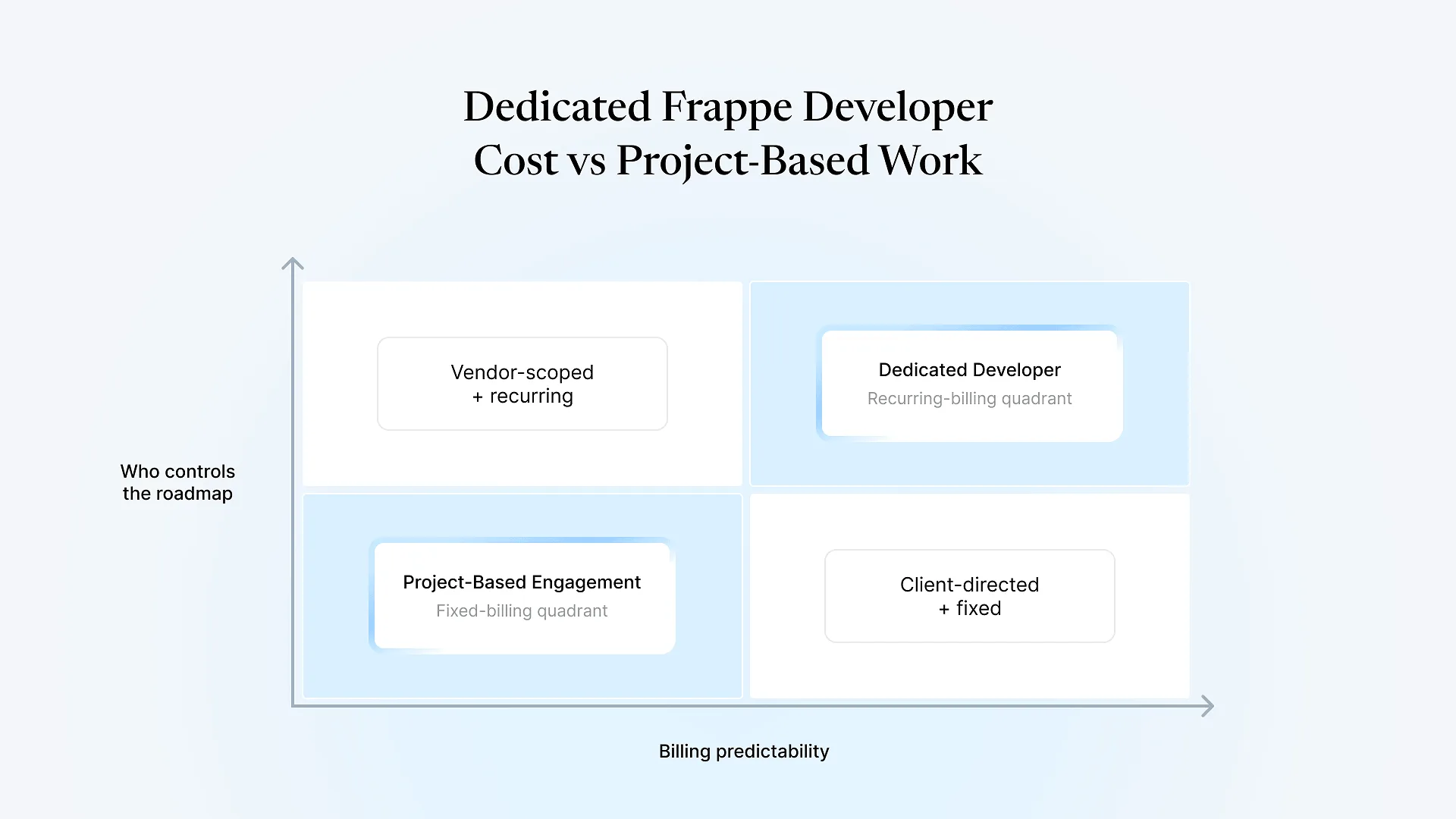
This is also where the engagement structure itself matters, not just the per-hour number. A dedicated developer working consistently on your instance builds context that compounds — they remember why a customization was made a certain way, which a rotating cast of project-based contractors won’t. Dedicated Frappe developer vs. project-based engagement breaks down when each model actually makes sense, since the right choice depends more on how ongoing your Frappe needs are than on price alone.
A Practical Checklist Before You Hire
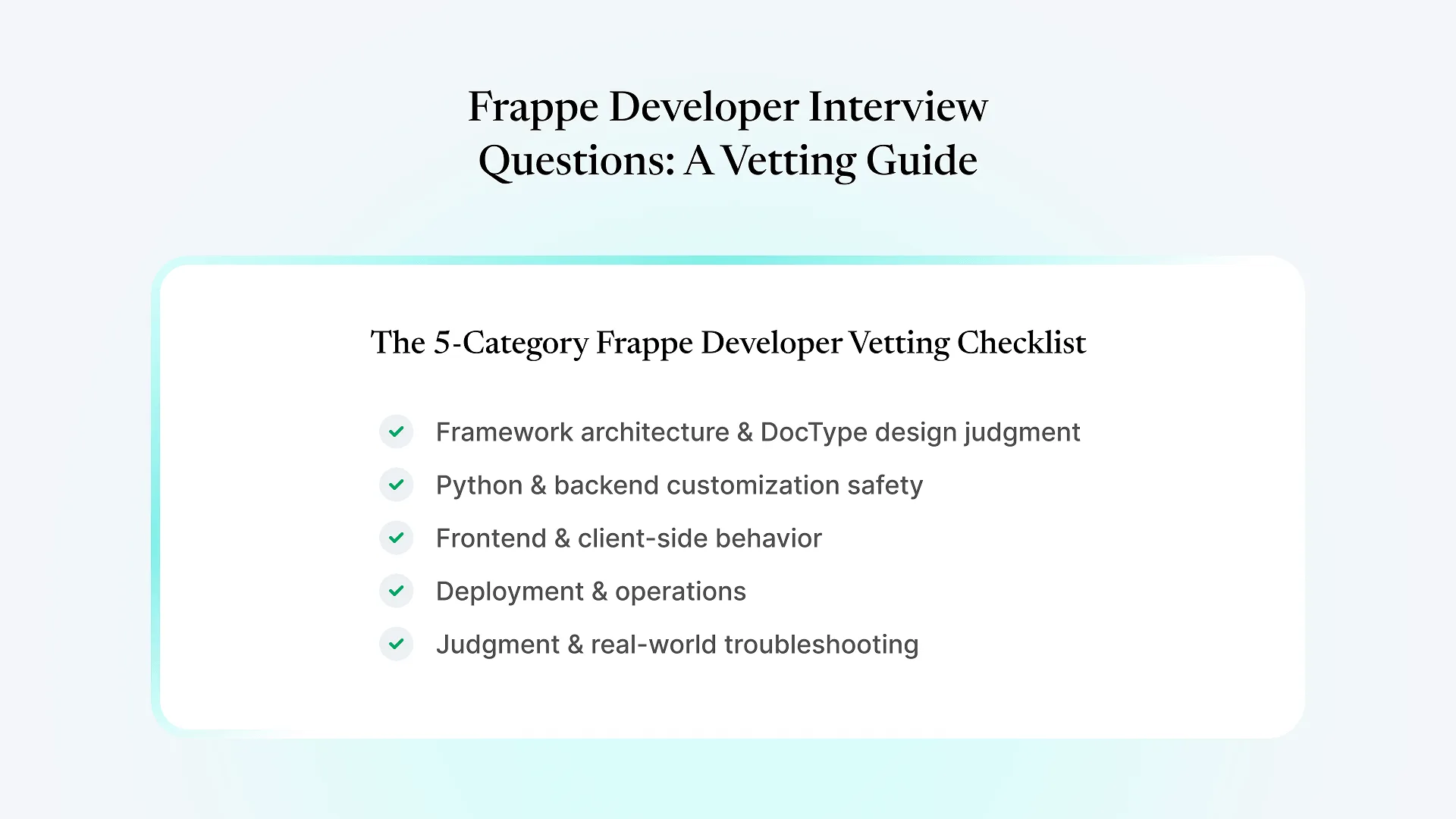
Ask for Frappe-specific work samples, not general web development portfolios — custom doctypes, server scripts, or a Frappe app they've built end to end.
Confirm they understand the custom-app vs. core-override distinction and can explain, unprompted, why it matters for upgrades.
Check their experience with your actual ERPNext modules, not just the framework in the abstract — manufacturing and inventory customization is a different skill set than HR or accounting customization.
Clarify what's included in the rate — code review, documentation, testing, and communication overhead, or just raw coding hours.
Ask what happens if they're unavailable — a solo freelancer with no backup is a single point of failure for your ERP.
Get a scoped estimate for a defined task first before committing to an open-ended retainer, so you can evaluate quality before scaling the relationship.
Ready to add Frappe capacity without gambling on an unvetted freelancer? See Aavatto’s developer engagement options for current rates and how the engagement actually works.