



The Frappe developer interview questions that actually tell you something are the ones with no single correct answer: ask a candidate to walk through a DocType design decision they made, a hook or patch they wrote, and how they’d handle a customization that breaks after an ERPNext version upgrade. How they reason through it, not whether they recite a definition, is what separates someone who has shipped Frappe work from someone who has only read the documentation.
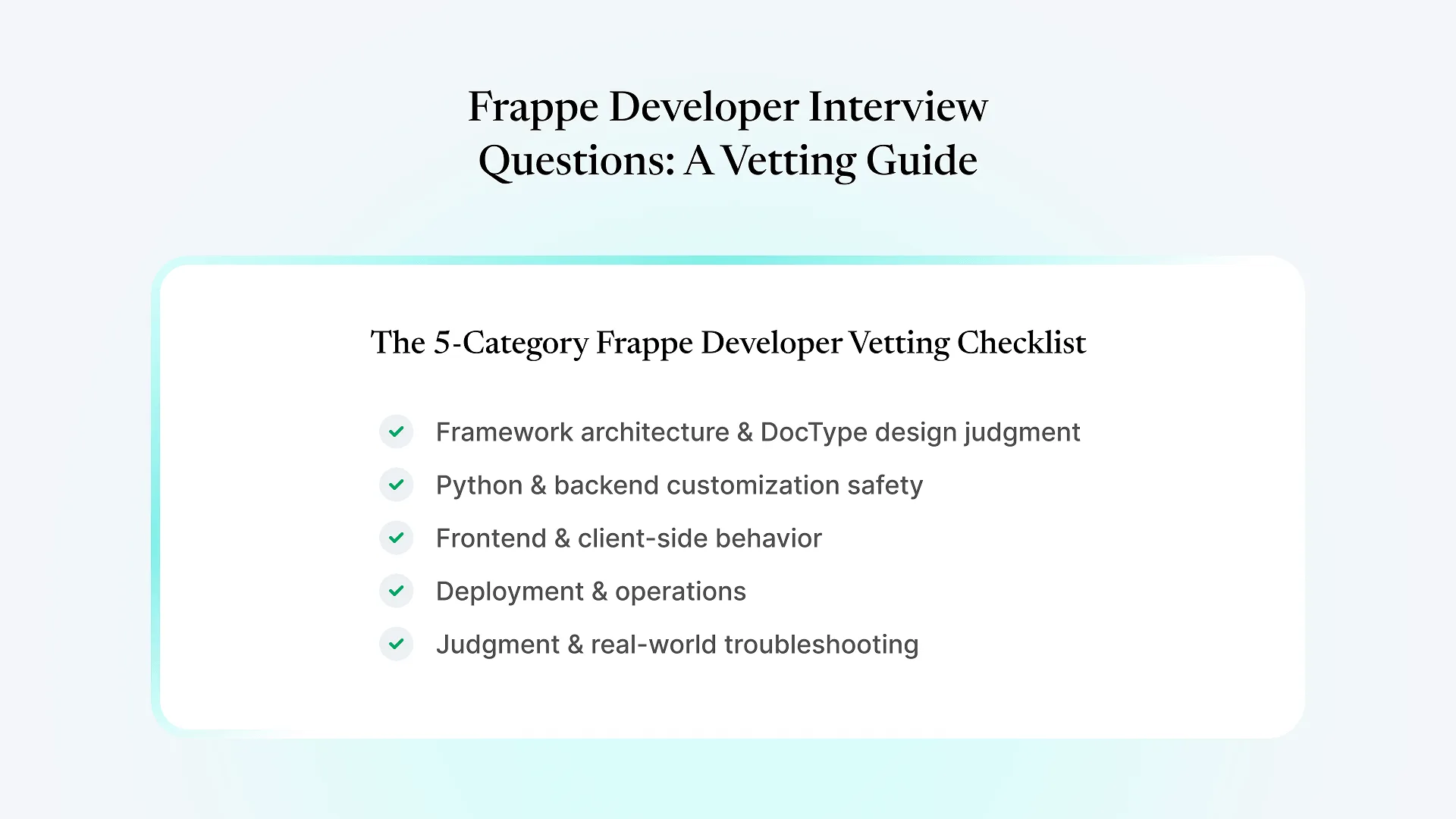
That’s not a shortcut around a proper interview — it’s the interview. Below is a five-part framework for structuring it, the questions each part should include, and how to tell a strong answer from a rehearsed one.
Why a Generic Developer Interview Misses the Risk
Frappe isn’t a mainstream framework the way Django or Express is, and a strong general Python or JavaScript background doesn’t tell you much about someone’s grasp of DocTypes, the permission engine, or how customizations survive a core update. The most common hiring mistake is treating “built a CRUD app in a Frappe tutorial” as equivalent to “maintained a production ERPNext instance through multiple version upgrades” — they’re not close, and a generic technical interview won’t catch the gap.
If you’re still deciding whether an in-house hire is even the right call, our guide on hiring a Frappe developer — in-house, freelance, or agency covers that decision. This article assumes you’ve settled on hiring directly and need a way to tell strong candidates from weak ones.
A Five-Category Framework for Vetting Frappe Skill
Ask the candidate to describe a DocType they designed and why they chose the structure they did — a child table versus a separate linked DocType, for example. A strong answer explains the tradeoff (data duplication risk, reporting complexity, permission scope) in terms of the actual business problem. A weak answer defines what a child table is without ever getting to why they'd choose one.
This is the category that determines whether their code survives an upgrade. Ask how they'd add custom logic to a core DocType without editing core files directly, when they'd use a hooks.py event versus a server script, and how they decide what belongs in a whitelisted method versus a background job.
Ask when they'd reach for a client script versus a property setter or a plain custom field, and how form behavior differs between the Desk and a customer-facing portal. Candidates who've only worked inside the Desk often haven't had to think about the second half of that question.
Production Frappe knowledge shows up here more than anywhere else. Useful questions include:
What actually happens when you run a site migration, and what would make you check a backup first?
How do background workers and queues affect a report that's timing out?
What changes about the setup with multiple sites on one bench versus a single site?
Ask about a time a customization conflicted with a core update, or how they'd approach a client request that would technically work but compromise data integrity. This category is less about the "correct" technical answer and more about whether they think about consequences before they ship.
What a Strong Answer Sounds Like
Take the customization-safety question: “How do you customize a core DocType without breaking future upgrades?” A weak answer is “I just edit the DocType directly” or a vague reference to “being careful.” A strong answer names the actual mechanism — building a separate custom app, using property setters and custom fields instead of core edits, hooking into events rather than modifying core methods — and can explain why direct core edits get silently overwritten on the next update.
Or take “walk me through what a site migration does.” A weak answer restates the command name. A strong answer describes schema and patch execution, why patches can fail partway through, and why they’d check for a recent backup before running one on a production site with real data.
If a candidate can only handle the “what” and not the “why,” they can probably follow instructions from someone more senior — which may be fine for a supporting role, but is a real risk if they’re the only Frappe developer you’re hiring.
Red Flags to Watch For
Experience limited to Frappe tutorials or a single bootcamp-style project, with no production deployment involved
Can't articulate the difference between editing a core file and customizing through hooks or a custom app
No exposure to a version upgrade, migration failure, or rollback — even a minor one
Debugging answers that stop at "I'd search Stack Overflow" with no description of how they'd narrow down the cause first
Heavy reliance on GUI-level customization with no ability to explain what's happening underneath it
None of these disqualify someone outright on their own — a junior candidate with strong fundamentals and no production exposure yet can still be a good hire for the right role. But two or three of these together are a reason to slow down before extending an offer.
If running this kind of vetting process on your own for every candidate feels like more overhead than your team wants to carry, that’s the specific gap a developer engagement built around already-vetted Frappe talent is meant to close.
Beyond the Interview: A Small Paid Test Task
Frequently Asked Questions
Once you know what strong looks like, the harder problem is often finding enough qualified candidates to run this process against. If that’s where you’re stuck, see our developer engagement options for how a pre-vetted Frappe developer could plug into your team directly.