



AI automation for manufacturing means using software to handle repetitive, data-heavy tasks — demand forecasting, quality flagging, document processing, customer queries — with less manual intervention than a traditional system requires. For most manufacturing and distribution businesses, the right starting point isn’t a new AI tool. It’s making sure the underlying data and processes are structured enough for that tool to actually work.
That single point trips up more implementations than any technology choice does.
Why "AI automation" gets oversold
Search around this topic and you’ll find no shortage of vendors promising that AI will “transform” your factory floor or “unlock” hidden efficiency. Most of that content comes from enterprise software companies selling platforms, not from people who’ve sat inside a mid-sized manufacturer’s operations and watched where automation actually breaks down.
Here’s the less exciting reality: AI automation is not a replacement for having your processes and data in order — it’s a layer on top of them. A forecasting model can’t produce useful demand predictions from sales data that’s split across three spreadsheets and a legacy accounting tool. A document-processing tool can’t reliably extract line items from supplier invoices if your purchase order numbering is inconsistent. The AI isn’t the hard part. The data plumbing underneath it is.
This is also why AI automation and ERP implementation are more connected than most AI vendor content admits. If your business already runs on a structured ERP — where sales orders, inventory movements, and production data live in one consistent system — you have most of the foundation AI automation needs. If you don’t, that gap is usually the actual first project, whether or not it gets labeled “AI.”
Where AI automation genuinely helps first
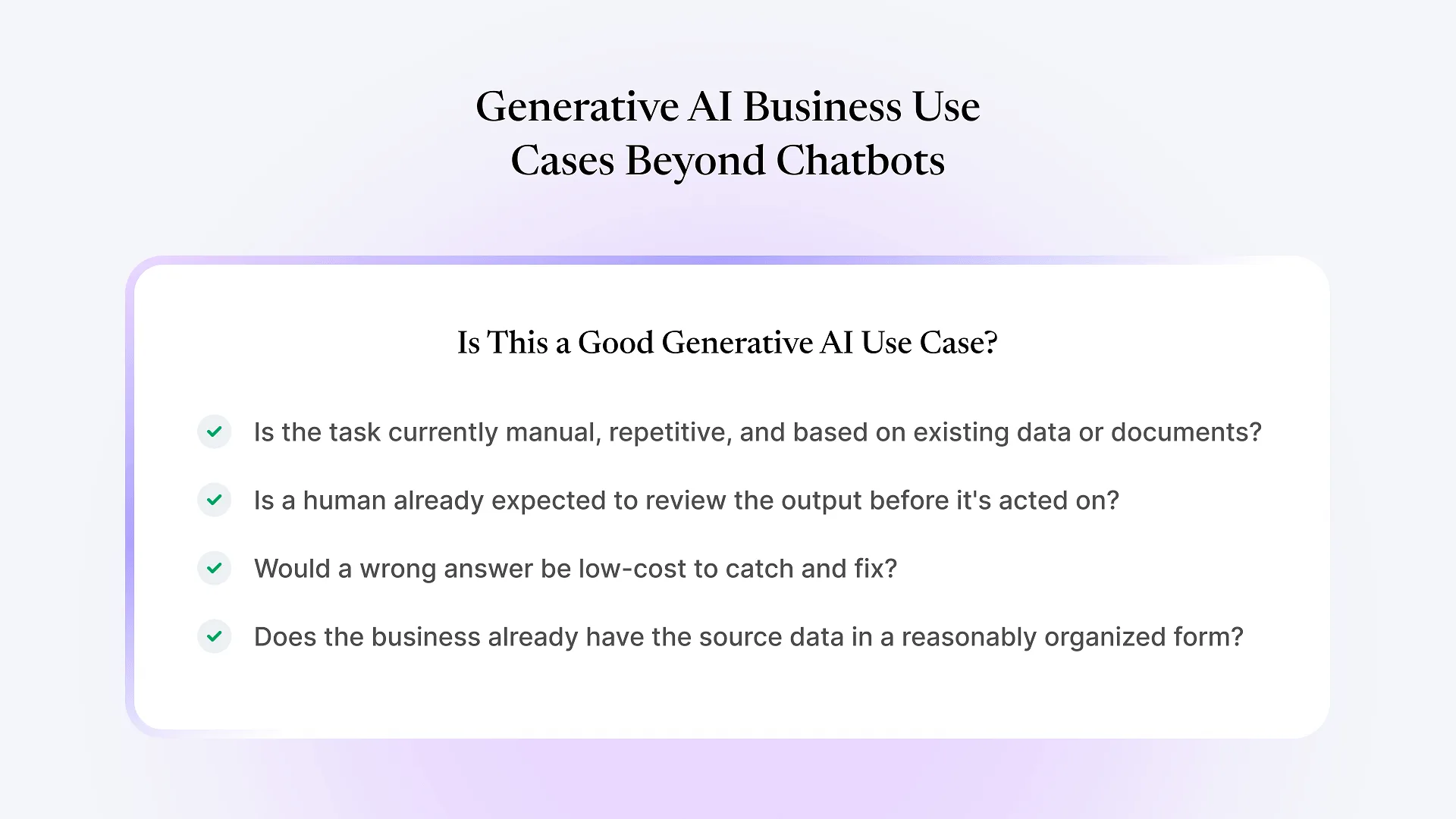
Not every part of a manufacturing or distribution business is a good candidate for AI automation right now. The use cases that tend to deliver real value early share one trait: they’re repetitive, data-driven, and forgiving of occasional errors that a person can catch.
A few examples worth evaluating first:
Using historical sales and seasonality data to flag likely stockouts or overstock before they happen, rather than reacting after the fact.
Extracting line items, quantities, and amounts from supplier invoices or purchase orders automatically, instead of manual data entry.
Flagging unusual patterns in production data — a batch running outside normal tolerances, a sudden spike in rejections — for a human to review, not to decide on its own.
Automating routine questions (order status, stock availability) through a chatbot or WhatsApp integration, freeing staff for exceptions that actually need judgment.
These are all forms of business process automation AI applied narrowly, not a wholesale reinvention of how the business runs. That narrowness is the point — a scoped pilot on one process tells you whether the approach works before you’ve committed budget to a bigger rollout.
If you’re already exploring what a broader rollout could look like, it’s worth exploring this service to see how it fits alongside whatever systems you’re running today.
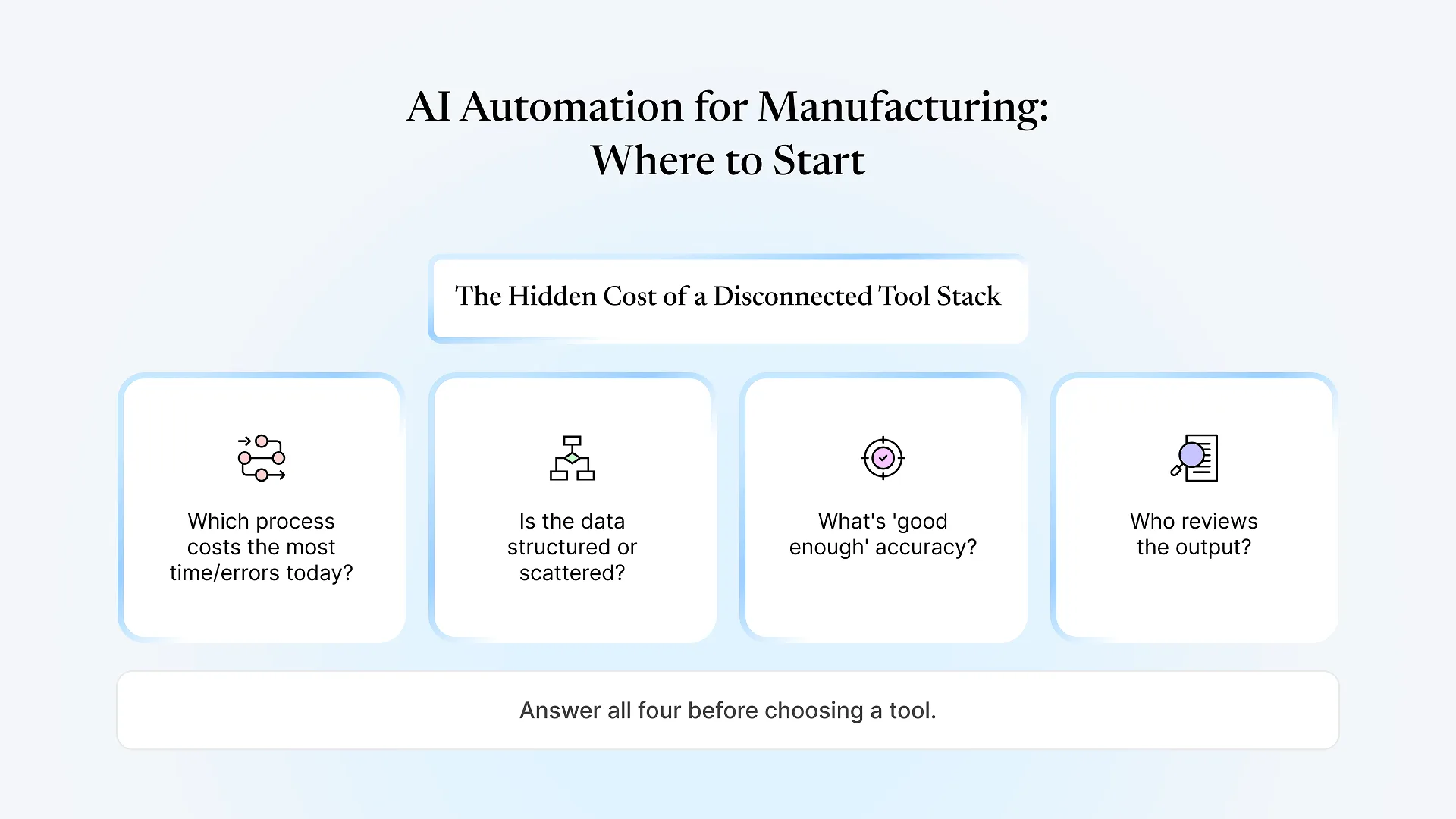
A simple framework for getting started
Which single process costs the most in manual time or error rate today?
Pick one — not five. A scoped pilot succeeds or fails visibly; a five-front rollout just gets confusing.
Is the data behind that process already structured, or scattered?
If it lives in one system with consistent fields, you're closer than you think. If it's split across spreadsheets, emails, and someone's memory, that's the actual first fix.
What does "good enough" accuracy look like for this process?
Forecasting doesn't need to be perfect — it needs to be better than a gut estimate and reviewed by a person. Set that bar before you evaluate any tool against it.
Who owns reviewing the output?
AI automation that runs unsupervised on a process nobody's watching tends to drift quietly wrong. Someone needs to own spot-checking it, at least early on.
Where this fits with an existing ERP
Frequently Asked Questions
Getting started
AI automation for manufacturing and distribution businesses isn’t a single product decision — it’s a sequence: pick one costly process, check whether the data behind it is usable, pilot narrowly, and assign someone to watch it. Businesses that treat it that way tend to get further than those chasing the newest tool first.
If you want a second opinion on where your own operation stands — and whether your current systems are ready for this kind of automation or need attention first — explore this service to see how Aavatto approaches it.