



Most “custom software vs off-the-shelf” comparisons frame this as a one-time fork in the road. In practice, it’s rarely one decision — it’s a series of smaller ones, made function by function, often after a business already has a core system running. Build custom software when a workflow is genuinely unique to how your business operates and generic, off-the-shelf tools force constant, repeated workarounds around it. Buy off-the-shelf when the function is common, already well-solved, and not something your business needs to differentiate on.
That’s the short version. The more useful version accounts for where most businesses actually are: not choosing a single platform from scratch, but deciding whether the next gap in their operations deserves a workaround, a new subscription, or a purpose-built piece of software.
Custom Software vs Off-the-Shelf: Why This Isn't a One-Time Decision
Off-the-shelf software is built to serve the average case across thousands of customers. That’s exactly why it works well for functions where your business doesn’t need to be different — accounting, basic CRM, email, standard HR record-keeping. Nobody gains a competitive edge from a uniquely built payroll calculator.
The friction shows up in the functions that don’t fit the average case: a production process with sequencing rules the generic tool doesn’t support, an approval workflow with conditions unique to your industry, a reporting need that requires stitching together three tools with a spreadsheet in between. Off-the-shelf software doesn’t fail at these outright — it just makes you work around it, permanently, in ways that quietly cost time every week.
This is why the decision resurfaces repeatedly rather than getting settled once. A business running ERPNext, for instance, gets most of its core operations covered out of the box — accounting, inventory, basic manufacturing, HR. The question of “custom or off-the-shelf” then comes back at the module level: does this one workflow fit inside what the platform already does well, or is it different enough to justify a purpose-built extension?
When off-the-shelf is the right call
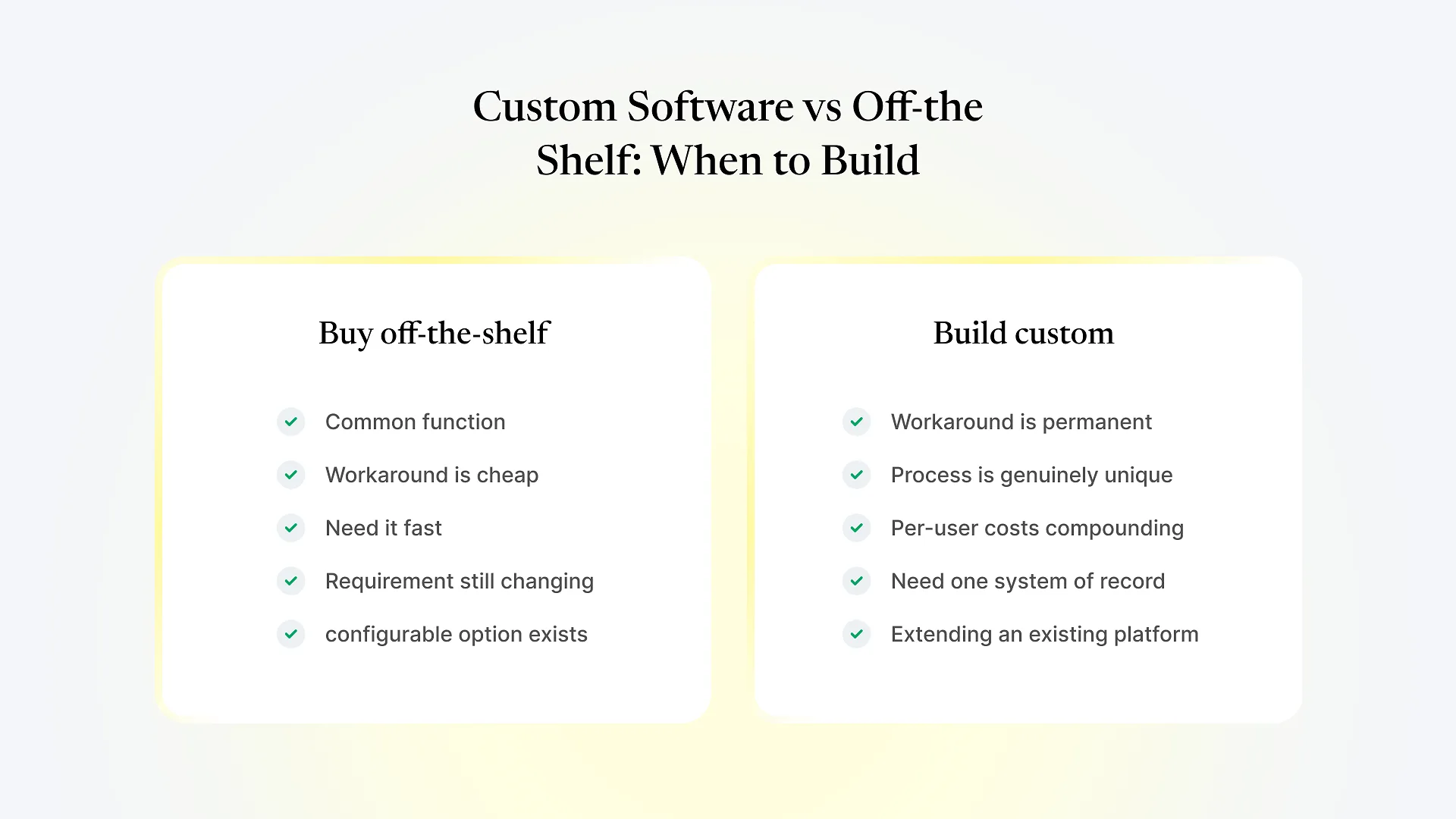
The function is common across your industry, not something customers experience as part of what makes you different.
The workaround costs less than the build. A small, occasional manual step is rarely worth custom development, regardless of how inelegant it feels.
You need it running quickly, and the standard tool already covers the large majority of what you actually need.
The requirement is still changing. Building custom software around a process that hasn't stabilized yet usually means rebuilding it.
A configurable option already exists inside a platform you're using — customizing within an existing system is a different, smaller decision than building something new from scratch.
When custom software earns its cost
The workaround has become permanent and repetitive — the same manual reconciliation, the same spreadsheet bridge, done every single cycle because no off-the-shelf tool models your process correctly.
The process is genuinely specific to your business — a sequencing rule, a compliance requirement, a multi-step approval chain that generic software treats as an edge case rather than a core scenario.
You're paying for licenses per user or per transaction on a function you use heavily, and that cost compounds every year the business grows.
You need one system of record, and stitching together multiple off-the-shelf tools with manual exports is creating data that disagrees with itself.
The gap sits next to a platform you already run. Extending something like ERPNext with a purpose-built module is a smaller, cheaper decision than building a standalone system from zero — you inherit the data model, the users, and the permissions you've already set up.
A quick way to frame it
| Question | Leans off-the-shelf | Leans custom |
|---|---|---|
| Is this function core to how you compete? | No | Yes |
| How often does the workaround repeat? | Rarely | Every cycle |
| Is the requirement stable? | Still changing | Settled |
| What's the cost driver? | Time to deploy | Cost that compounds with scale |
| Does it sit next to an existing platform? | Standalone need | Extension of what you run |
Frequently Asked Questions
If you’re weighing this decision for a specific process right now, explore Aavatto’s custom software development work to see how this framework applies to what you’re dealing with.