




Yarn and fabric costing software calculates true product cost by tracking raw material, process, and job-work charges at every stage — yarn, weaving or knitting, dyeing or printing, and finishing — rather than applying one static cost per fabric. Most spreadsheets fail because they price fabric once, using assumed waste percentages, instead of building cost stage by stage.
If you run a textile or apparel manufacturing unit, you’ve probably already built a costing spreadsheet — more than one, most likely, each patched together by a different person over a few years — or looked at a generic textile costing software tool that prices a fabric once and calls it done. The problem is that the number it gives you is usually wrong, and nobody notices until a customer negotiates on a quote that was too low, or a finance review shows a fabric that was supposed to be profitable barely broke even.
Why Fabric Costing Breaks Down in Practice
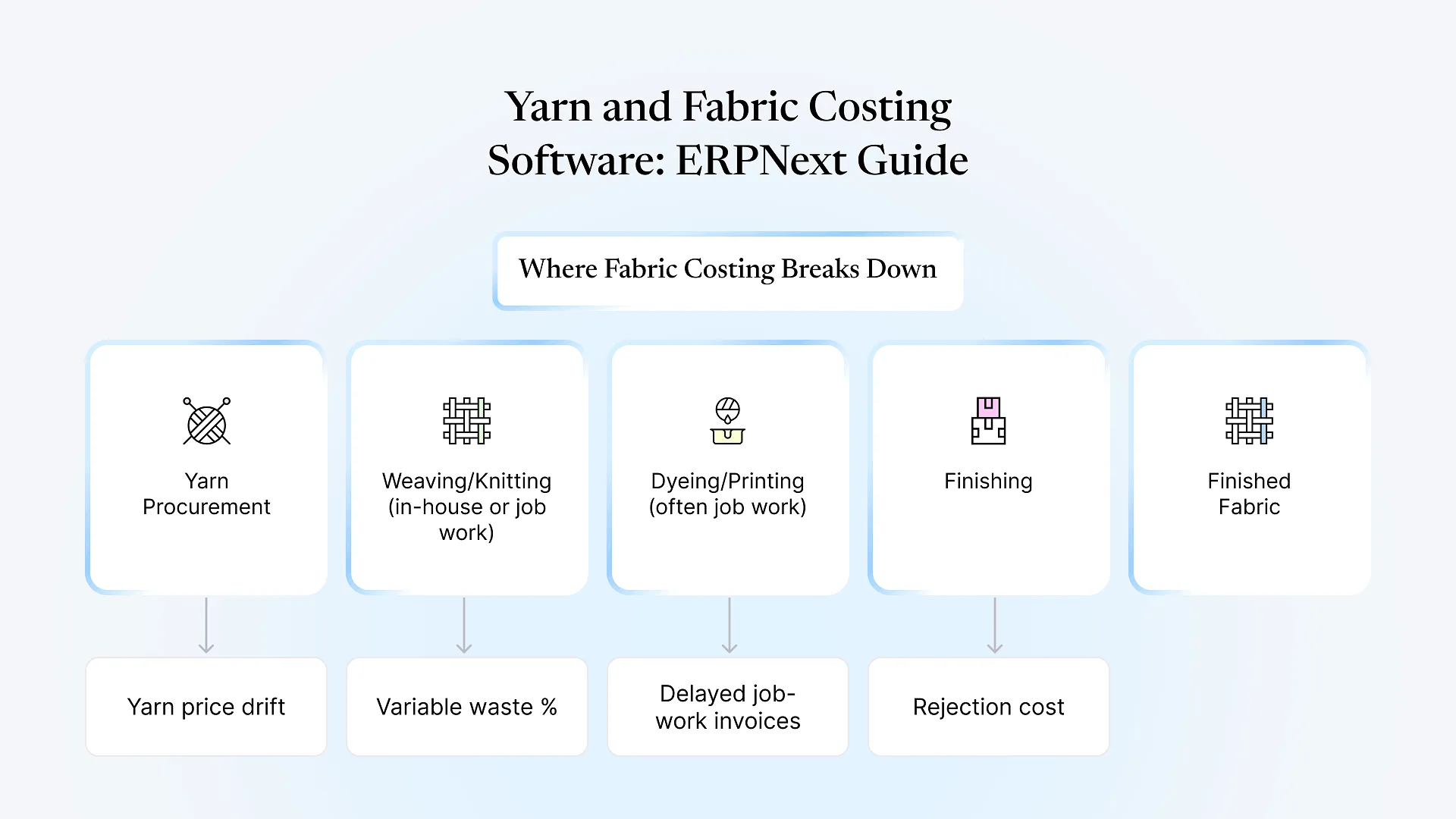
Fabric doesn’t have one cost. It has a cost built up across stages, and each stage is a place where the real number can drift from the assumed one.
Take a typical process: yarn is procured or spun, sent for weaving or knitting (often through a job worker), the resulting grey fabric goes to a separate unit for dyeing or printing, and then to finishing before it’s ready to sell or cut. A spreadsheet usually captures this as a single blended cost — “grey fabric input cost + estimated dyeing charge + estimated finishing charge” — set once and rarely revisited.
In reality, each of those stages introduces variance a static number can’t capture:
Yarn price fluctuation
Yarn is a commodity-linked input. A costing sheet built on last quarter's purchase price is already stale by the time a new order is quoted.
Process waste that isn't constant
Waste percentages in weaving, dyeing, and finishing vary by fabric construction, shade, and even by which job worker handles the batch. A single assumed waste percentage flatters some orders and quietly loses money on others.
Job-work billing that lags production
When dyeing or printing is subcontracted, the job-work invoice often arrives well after the fabric has already moved to the next stage — and sometimes after it's shipped. If costing isn't tied to actual job-work charges, the "cost" used for pricing was a guess that never gets corrected.
Rework and rejection
A batch that fails shade matching and needs redyeing adds real cost that a static costing sheet has no mechanism to absorb into the next quote.
What Accurate Yarn and Fabric Costing Software Actually Requires
A bill of materials (BOM) per fabric variant, not per fabric family
Cost varies by construction, count, and finish — a BOM that treats "cotton fabric" as one line item will always be an approximation. Each distinct variant needs its own BOM with current yarn consumption norms.
Routing that reflects real processing stages, including subcontracted ones
If dyeing happens at a job worker, the routing step needs to capture that as a stage with its own cost — including the job-work charge, and any wastage or rejection tied specifically to that stage — rather than folding it into a single "processing cost" guess.
Costing that updates from actual transactions, not fixed assumptions
Yarn purchase rate, job-work invoice amount, and actual consumption from stock entries should feed the cost calculation, so a quote reflects what production has actually been costing recently — not a number set a year ago and never revisited.
This is where a general-purpose fabric cost calculator runs out of road. A calculator can multiply rate × quantity for a single stage. It can’t connect that to a live yarn purchase rate, a job-work subcontracting entry, and a rejection record from the shop floor — because those live in different systems, if they’re tracked at all.
If you’re evaluating whether your current setup can support this level of tracking, it’s worth comparing it against how a multi-stage textile implementation handles the same problem end to end, from yarn procurement through finished fabric.
How This Works Inside ERPNext
A BOM for each fabric variant, referencing the yarn count, blend, and consumption norm for that specific construction.
A routing with an operation for each processing stage — weaving/knitting, dyeing/printing, finishing — each carrying its own standard time and cost.
Subcontracting configured for stages handled by job workers, so the job-work rate and any material sent out (yarn or grey fabric) are tracked against that specific batch, and the job-work invoice ties back to the actual order rather than a monthly lump estimate.
Batch-wise costing, so a batch that goes through rework or partial rejection carries that cost forward instead of it disappearing into a rounding error.
The practical effect: when a batch clears finishing, the system has accumulated actual yarn cost, actual job-work charges per stage, and actual wastage — not the estimate that was used to quote the order months earlier. That gap between quoted cost and actual cost is exactly what erodes margin quietly over a year, and it’s the gap this kind of setup is meant to close.
This doesn’t happen automatically out of the box — ERPNext’s manufacturing and subcontracting modules need to be configured around your specific process flow (which stages are in-house, which are job-worked, how batches are tracked) before the costing output is trustworthy. That configuration work is the difference between “ERPNext has a manufacturing module” and “ERPNext tells you your real fabric cost.” It’s the kind of process-mapping a tailored ERPNext implementation starts with, well before costing numbers are trusted for quoting decisions.
Signs Your Current Costing Setup Is Already Losing You Money
Quotes are based on a costing sheet that hasn't been updated since the last time yarn prices moved significantly.
Job-work invoices routinely arrive weeks after the batch has shipped, and nobody reconciles them against what was assumed at quoting time.
Waste percentage in the costing sheet is a single number used across all fabric constructions, regardless of complexity.
Nobody can quickly answer "what did this specific batch actually cost us," only "what did we assume it would cost."