





Most apparel brands run manufacturing and e-commerce as two separate operations that happen to sell the same products. Production is tracked on the shop floor or in a spreadsheet. Online orders come in through a storefront that has no real visibility into what’s actually in stock or what’s still on the production line. The result is a familiar failure mode: a size sells out on the website while it’s sitting finished in a warehouse, or an order gets confirmed for stock that was never actually available. An ERP for apparel brands that connects manufacturing and e-commerce on one system closes that gap, so what’s confirmed in production and inventory is what the storefront is allowed to sell.
For brands running both a factory floor and an online store, the disconnect usually shows up in three places: order confirmations that outpace real stock, fulfillment delays because nobody can see production status against open orders, and inventory counts that drift between what the warehouse has and what the website shows.
Why Manufacturing and E-Commerce Drift Apart
Manufacturing systems and e-commerce platforms are usually chosen separately, for different reasons, by different people. The factory side gets whatever handles production scheduling and material tracking. The e-commerce side gets whatever plugs into the website fastest. Neither was built to know what the other is doing in real time.
That gap tends to widen as a brand grows. A few SKUs and a manual stock update once a day is manageable. Dozens of SKUs across sizes and colors, moving between production, warehouse, and an online storefront that never closes, is not — not without the two systems actually talking to each other.
What Changes With an Apparel Manufacturing ERP Implementation
We implemented ERPNext for a client running exactly this setup: disconnected Excel sheets and Tally handling inventory, production, and order management separately, with no live connection to the online storefront. The goal was to put manufacturing, inventory, sales, procurement, and order fulfillment on one system, so a change on the production floor updates what the storefront can sell without anyone manually reconciling the two.
| Function | Before | After ERPNext implementation |
|---|---|---|
| Order processing | Manual cross-checks across spreadsheets before confirming | 32% faster order processing |
| Inventory | Tracked separately in Excel and Tally, prone to drift | 99.2% inventory accuracy |
| Manual work | Daily reconciliation across systems | 55% reduction in manual work |
| Rollout | - | 10-week implementation timeline |
The 32% improvement in order processing came from removing the manual cross-check between what the spreadsheet said was in stock and what was actually available before an order could be confirmed — the system now reflects real inventory the moment it changes. The 99.2% inventory accuracy figure reflects material and finished-goods movement being logged in the same system that reports stock, rather than Excel and Tally being updated separately and reconciled later. The 55% cut in manual work came from eliminating the daily reconciliation step that previously connected production, inventory, and order records by hand.
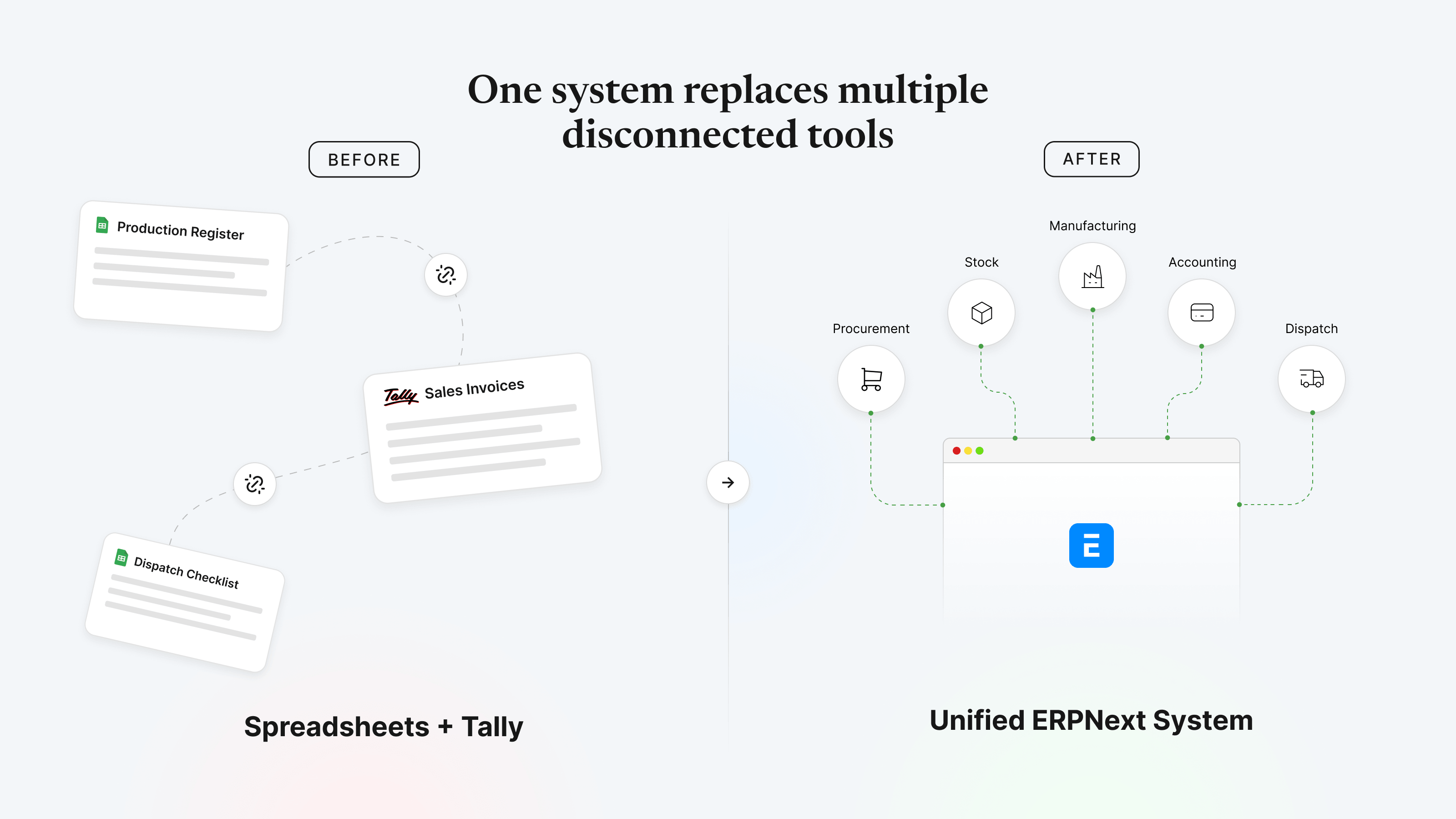
If your team is weighing whether connecting production and fulfillment onto one system is worth the transition, the case study below walks through exactly how this rollout was sequenced — worth a look before deciding what your own starting point requires.
None of this was a single cutover. Bringing manufacturing, inventory, procurement, sales, and fulfillment onto one system in 10 weeks meant migrating core inventory and production data first, then layering in procurement and sales workflows once that foundation held, then connecting fulfillment last so orders only released against confirmed stock. That sequencing is specific to this engagement’s scope and data quality — a brand with more SKU complexity or heavier customization needs should expect a longer runway, not treat 10 weeks as a fixed benchmark.
What This Looks Like for Your Brand
If the pattern above is familiar — orders confirmed against stock that turns out unavailable, fulfillment delays because production status isn’t visible from the sales side, inventory that only matches reality after a manual count — the fix isn’t tighter spreadsheet discipline on either side. It’s removing the gap between the systems that track manufacturing and the ones that handle sales in the first place.
You can see exactly how this rollout was structured, including how inventory, production, and order fulfillment were connected to the storefront, in our case study on apparel manufacturing and e-commerce management.
Frequently Asked Questions
A standard e-commerce platform tracks orders and, at best, a manually updated stock count. An ERP connects that storefront to live production and inventory data, so what's sellable online reflects what's actually confirmed in stock and on the production line, not a number someone updated that morning.
ERPNext is generally implemented to connect with an existing storefront rather than replace it outright, syncing inventory, orders, and fulfillment status between the two. The specific integration approach depends on which platform the storefront runs on and how much of the fulfillment workflow needs to move into ERPNext.
It depends on SKU complexity, data quality, and how much customization the fulfillment workflow needs. In the engagement referenced above, manufacturing, inventory, procurement, sales, and fulfillment were all live within 10 weeks — but that reflects this specific project's scope, not a fixed timeline for every brand.
The relevant factor isn't brand size but whether production and online sales are currently run on disconnected tools. That gap causes the same order-confirmation and inventory-drift problems at smaller brands, often with less staff capacity to catch the errors manually before they reach a customer.
If your production and storefront are still running as two separate systems, see how we connected both for a textile manufacturer in the case study above — it walks through the exact sequencing, not just the outcome.