



A dedicated Frappe developer typically costs more per month than a single fixed-scope project, but less per feature over time if your ERPNext system needs continuous changes. Project-based engagement costs less upfront and suits a defined scope with a clear end date — dedicated capacity suits ongoing customization, integration, and support work that doesn’t have one.
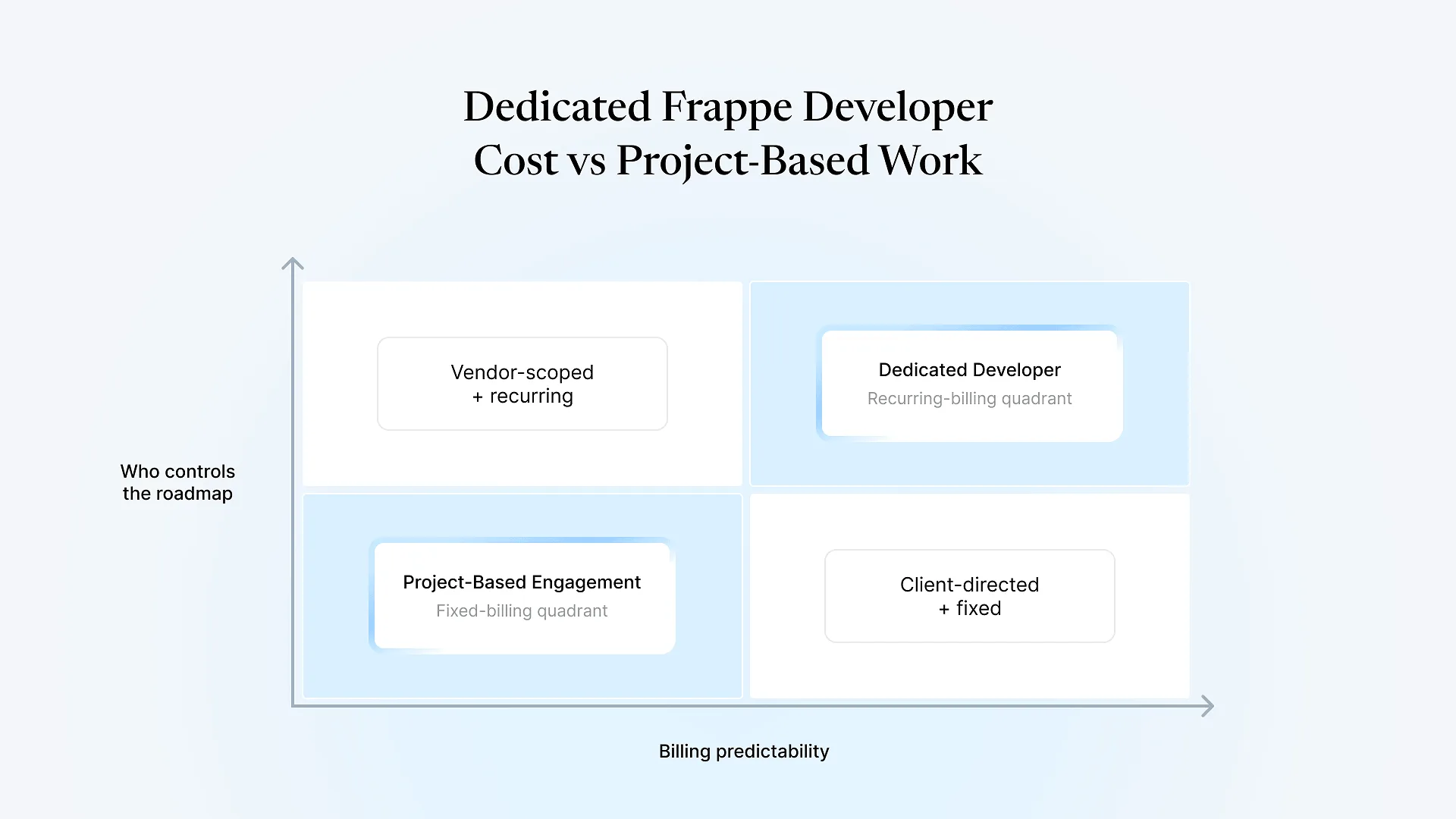
If you’re comparing dedicated Frappe developer cost to a fixed-price project quote, you’re really comparing two different questions: how much will this cost, and who decides what gets built next. Both matter, and the right answer depends on whether your Frappe backlog looks like a single deliverable or an ongoing list that keeps growing after go-live.
What "Dedicated Developer" Actually Means in a Frappe Engagement
A dedicated Frappe developer is capacity you retain on an ongoing basis — typically billed monthly, working from your backlog rather than a fixed spec, and available to move between tasks as priorities shift. It’s the model that fits a business that already has ERPNext or Frappe running and expects a steady stream of small builds: a new report here, a workflow tweak there, an integration that comes up mid-quarter.
Project-based engagement is the opposite structure. You define a scope, agree on deliverables and a timeline, and the vendor is accountable for that specific outcome. It works well when the requirement is contained — a new module, a migration, a defined integration — and doesn’t assume any ongoing relationship once it ships.
Dedicated Frappe Developer Cost vs Project-Based Pricing
| Dedicated Developer | Project-Based Engagement | |
|---|---|---|
| Billing structure | Recurring monthly capacity | Fixed price or milestone-based, tied to scope |
| Best fit | Ongoing customization, integrations, support | A single, well-defined deliverable |
| Cost predictability | Predictable per month, less predictable per feature | Predictable per project, less flexible if scope shifts |
| Idle-capacity risk | Real — you pay even in a slow week | None — you only pay for the defined scope |
| Scope-change handling | Absorbed into the ongoing backlog | Usually a formal change order |
Control: Who Sets the Priorities Changes Between the Two Models
This is the part cost comparisons alone miss. Under a project-based engagement, the vendor controls execution but you controlled scope upfront — once it’s signed off, changing direction means a change order, a new estimate, and usually a delay. Under a dedicated model, you control prioritization week to week. If a compliance deadline suddenly outranks the feature you’d planned to ship, you can simply re-sequence the backlog instead of renegotiating a contract.
That flexibility cuts both ways. It’s genuinely useful if your Frappe needs are unpredictable — which is common once a business is actually running on ERPNext and discovering gaps in real usage. But it also means the discipline of prioritization sits with you. A dedicated developer without a clear owner setting priorities on your side tends to drift toward whatever’s loudest that week, not what matters most.
When a Dedicated Developer Makes More Sense
Your ERPNext system is already live and generating a steady stream of small requests — reports, workflow adjustments, integration fixes
You expect Frappe development needs to continue for the foreseeable future, not end at a defined date
You want the flexibility to re-prioritize work without renegotiating scope each time
You have someone internally (a CTO, ops lead, or founder) who can actually own the backlog and set weekly priorities
When a Fixed-Scope Project Makes More Sense
You have one clearly defined deliverable — a migration, a new module, a specific integration — with a natural end point
You want cost certainty on that specific piece of work before it starts
You don't yet have a clear, continuous backlog of Frappe work beyond this one project
You'd rather have a vendor accountable for a fixed outcome than manage prioritization yourself
If your situation looks closer to the second list right now, it’s worth comparing fixed-price and hourly structures within that project model before deciding — the tradeoffs there are different again, and covered in our fixed-price vs hourly ERPNext development comparison.
What This Doesn't Cover
Frequently Asked Questions
If your Frappe backlog looks more continuous than a single project, see our developer engagement options — including how dedicated capacity is structured, billed, and prioritized once it’s running.