





Manufacturing ERP finance integration means production and finance share one ledger inside ERPNext, so every material issue, labor hour, and unit of scrap posts a real GL entry the moment it happens — not weeks later in a hand-built month-end journal entry that someone has to reconstruct. In most manufacturing businesses without this, production data and financial data live in two different systems, reconciled by hand, often weeks after the fact.
That’s the short version. The longer, more useful version is understanding exactly what moves, where it goes, and what has to be set up correctly for the numbers to mean anything.
The problem this is actually solving
Talk to most manufacturing SME owners who haven’t connected their shop floor to accounting software, and the pattern is familiar: production tracks what got made, using a spreadsheet, a whiteboard, or a standalone MES-lite tool. Accounting tracks what it cost, using Tally, QuickBooks, or a separate accounting module that only sees purchase and sales invoices. Somewhere between the two, someone — usually the accountant, usually once a month — manually estimates work-in-progress (WIP) value, allocates labor cost to finished goods, and posts a journal entry to true it up.
That journal entry is a guess dressed up as a number. It’s usually close enough for statutory filing. It’s rarely close enough to tell you, in real time, whether a specific product line is actually profitable once labor and scrap are accounted for.
What Manufacturing ERP Finance Integration Looks Like Inside ERPNext
ERPNext doesn’t treat inventory and accounting as two systems that sync — it treats them as one ledger. Every stock movement is, simultaneously, an accounting transaction. That single design decision is what makes the rest of this work.
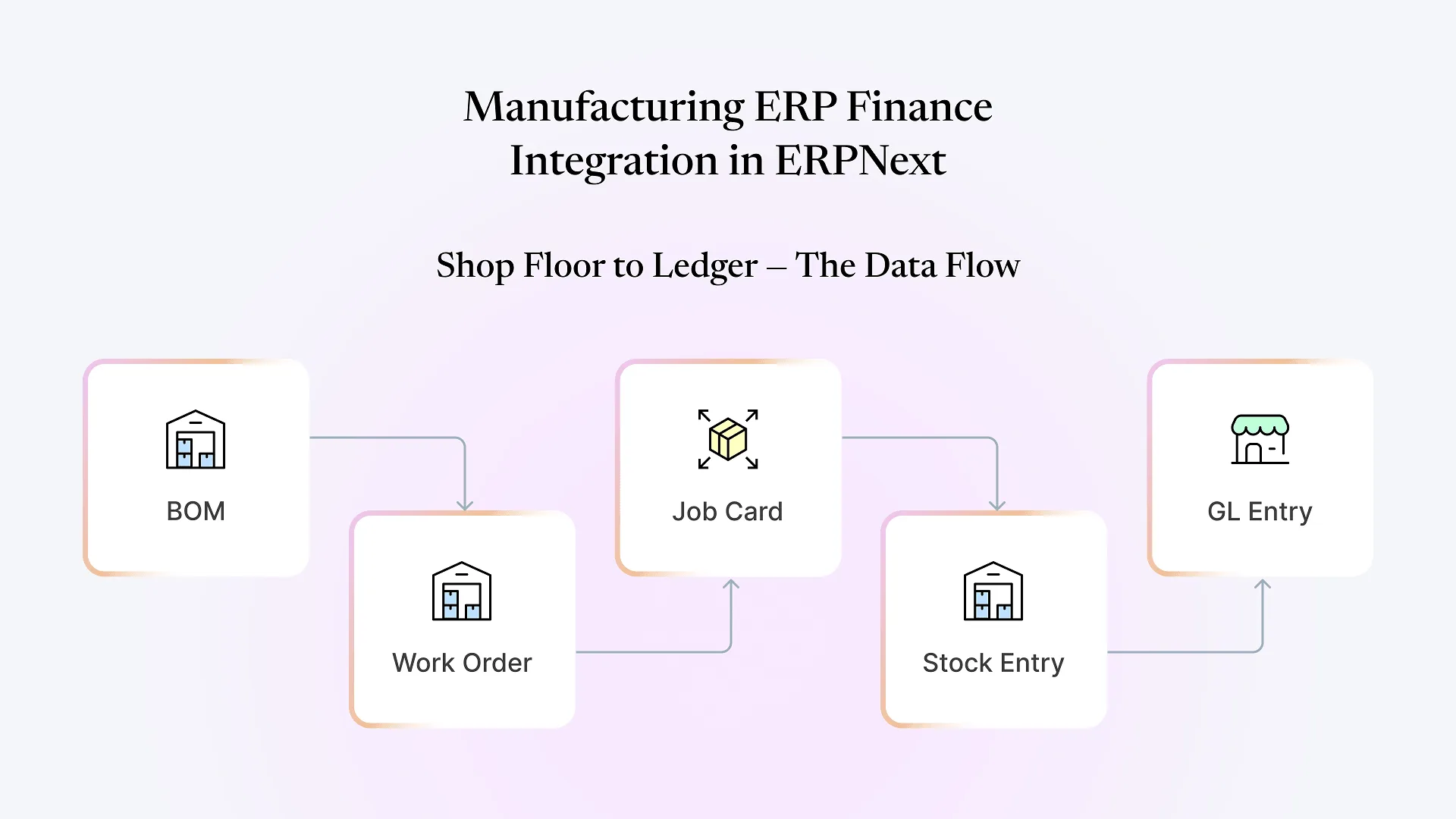
Here’s the chain, in the order it actually happens on a production run:
A BOM defines what raw materials and operations should go into one unit of a finished good, and at what standard cost. This is the baseline everything downstream gets compared against.
This is where planning meets the floor — it specifies quantity, warehouse, and which operations (if any) need to be tracked through Job Cards.
If operations are tracked, each Job Card records actual time against actual operators or workstations, at whatever hourly cost rate is configured. This is where planned cost starts to diverge from actual cost — and where a lot of manufacturers with disconnected systems lose visibility entirely.
A "Material Transfer for Manufacture" entry issues raw materials from stores to the work-in-progress warehouse. A "Manufacture" entry receives finished goods out of WIP. Each of these is not just a stock movement — it simultaneously debits and credits the relevant accounts (raw material stock, WIP, finished goods stock) based on the item's valuation rate at that moment.
Labor from Job Cards, actual material consumption, and any scrap or rework all land in the WIP account before the Manufacture entry closes it out. If actual consumption exceeds the BOM standard, that variance shows up as a stock adjustment — visible in the P&L without anyone writing a manual entry.
Where the numbers actually come from — a quick comparison
| Disconnected systems (spreadsheet/MES + separate accounting) | Unified ERP (production + finance in one ledger) | |
|---|---|---|
| WIP valuation | Estimated manually, usually monthly | Live, updated with every stock movement |
| Labor cost to product | Allocated in bulk, after the fact | Captured per Job Card, per operation |
| Scrap/variance visibility | Buried in a month-end adjustment | Visible as it happens, traceable to the run |
| Reconciliation effort | Recurring manual task, every close | Reconciliation is mostly a review, not a rebuild |
| Trust in per-product margin | Low — built on averages and assumptions | Higher — built on actual consumption and time |
This isn’t a claim that ERP eliminates accounting judgment. Someone still needs to review variances, close periods, and catch anomalies. What changes is that the underlying data is already correct and already posted — the accountant’s job shifts from reconstructing numbers to reviewing them.
Considering whether this level of visibility is worth the setup effort for your production process? That’s usually the real question — not whether ERPNext can do it, but whether your current process is broken enough to justify the change. Worth a conversation before deciding either way.
What has to be right for this to actually work
Default accounts must be mapped correctly per warehouse and item group
If your WIP warehouse isn't linked to the right account, or an item group's default expense account is wrong, the automatic GL entries will post — just to the wrong place. The system won't warn you; it'll just be quietly incorrect.
BOMs need to reflect reality, not history
A BOM that hasn't been updated since a supplier or process changed will generate variance noise that looks like a production problem but is actually a data problem.
Costing method needs a deliberate choice
Moving Average and FIFO produce different valuation behavior, especially with volatile raw material pricing. This should be a decision, not a default left unexamined.
Job Card tracking has to match how the floor actually works
If operators don't log time consistently, labor cost allocation degrades regardless of how well the system is configured.
This is also the most common gap we find when we’re asked to review an existing ERPNext implementation — not a broken system, but a shop floor and a finance team that were technically on the same platform and never actually linked together.
None of this is a reason to avoid the integration — it’s a reason to treat the setup phase as seriously as the production process itself. A configuration that’s mostly right will produce numbers that look precise and are quietly wrong, which is worse than an honest manual estimate that everyone knows is rough.
Frequently Asked Questions
Where this leaves you
If your production and accounting numbers currently meet once a month, in a spreadsheet, reconciled by someone doing their best — that’s not a finance problem, it’s a systems problem. The fix isn’t a better spreadsheet. It’s removing the gap between the two data sets entirely.
Getting the mechanism right (BOM, Work Order, Job Card, Stock Entry, and correct account mapping) is implementation work, and it’s easy to get partially wrong in ways that don’t surface until someone questions a margin number months later. If you’re evaluating whether this is worth doing for your production setup, book a free ERPNext consultation — we’ll look at how your current production and accounting actually connect (or don’t) and tell you honestly what it would take to close the gap, rather than assuming every manufacturing setup needs the same fix.