





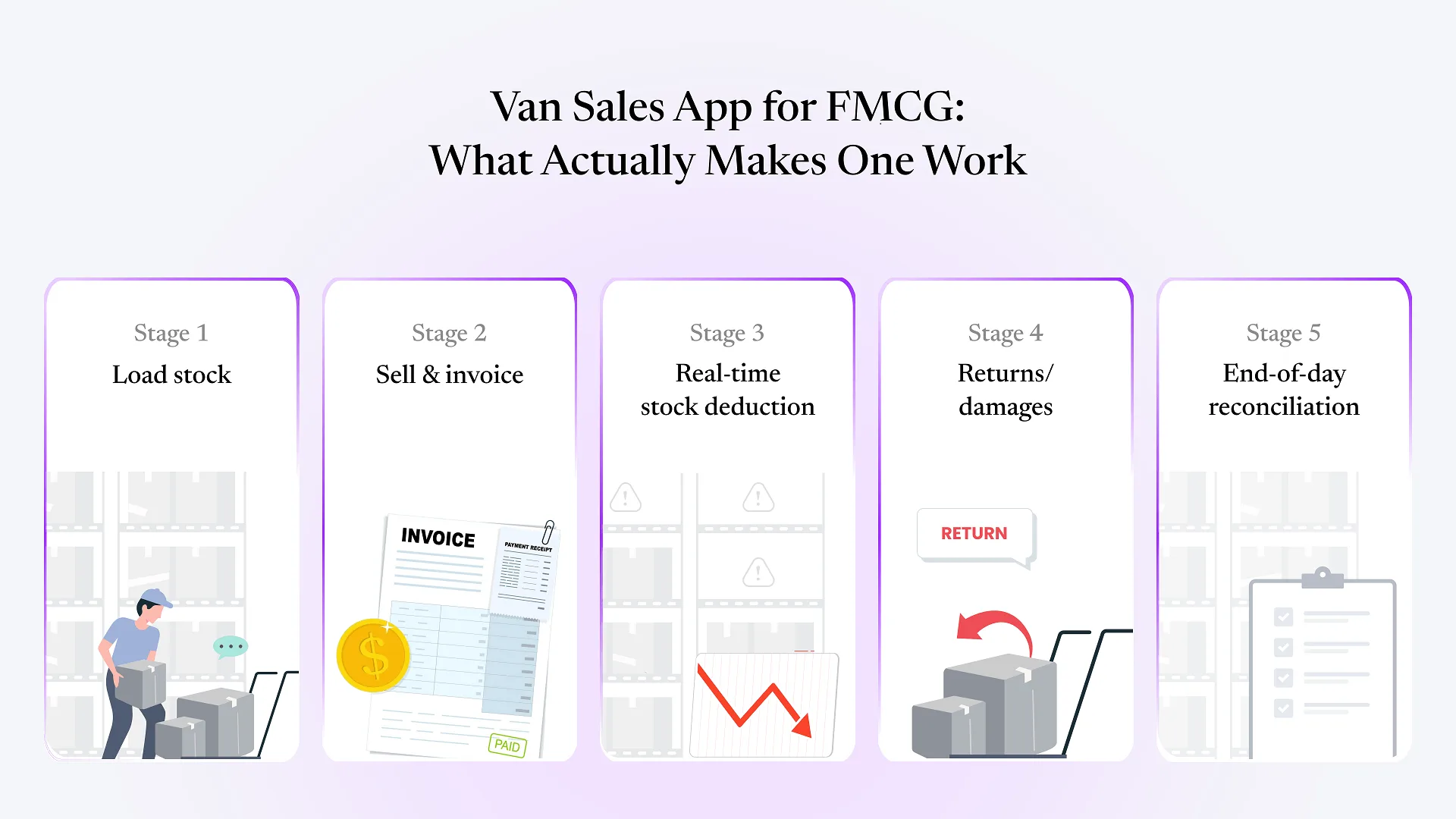
A van sales app for FMCG lets a rep sell, invoice, and collect payment directly from a stocked delivery vehicle, in one visit, instead of booking an order for later fulfillment. The part that determines whether it actually works is less about the app screen and more about whether that sale updates your real stock and accounts the moment it happens, not hours or days later.
That distinction is where most van sales and direct store delivery (DSD) software conversations go wrong. Most of what’s written about “van sales apps” focuses on the field-facing features — order booking, route planning, digital invoicing, offline mode — as if the app is the whole system. For an FMCG manufacturer or distributor, the app is the visible part of a much less visible problem: keeping van stock, warehouse stock, and your books all telling the same story by the end of the day.
What a Van Sales App for FMCG Actually Needs to Do
recording exactly what stock (by SKU, batch, and quantity) leaves the warehouse and goes onto a specific van, so there's a starting number to reconcile against later.
creating a GST-compliant invoice at the point of sale, applying any active scheme or discount, and recording the payment method (cash, UPI, credit against a retailer account) without the rep re-entering it later from memory or a paper log.
reducing the van's stock count the moment a sale is logged, not at end-of-day, so a rep two stops later knows what's actually still on the truck.
comparing what left the warehouse against what was sold, returned, or damaged, and closing the gap (cash collected, stock returned, shortages flagged) before that van goes out again the next morning.
Where Most Van Sales Apps Fall Short for FMCG
Looking at what currently ranks for FMCG van sales software, nearly all of it is written by vendors of standalone van-sales or field-sales apps, describing what the app itself does — order booking, offline mode, GPS tracking, scheme management. Almost none of it addresses the question that actually determines whether the app is useful for an FMCG business specifically: what happens to that data once it leaves the app.
That gap shows up in three recurring patterns:
Van stock looks accurate inside the app all day, but the warehouse and finance system don't see those numbers until the next sync, so anyone checking central stock or cash position mid-day is looking at yesterday's picture.
The van sales app logs a quantity sold, but not which batch it came from, so batch-level traceability and expiry-driven markdowns — both routine requirements for FMCG — have to be reconstructed manually after the fact.
which is exactly the kind of gap that turns into a stock-take surprise at month-end.
None of these are app-quality problems. They’re integration problems — the app is doing its job, but nothing has made sure it’s talking to the same stock ledger and accounts your business actually runs on. How well that sync actually works in practice depends on how the van sales app’s API and your ERP’s stock ledger are connected, and that’s a setup detail worth asking about directly rather than assuming any app “integrates” out of the box.
Van stock, in a properly connected setup, isn’t a separate number the app happens to track — it’s the same warehouse stock ledger your business already runs on, just with one more location (the van) recognized as a stock point. That’s the same underlying idea covered in more general terms in our explainer on what a warehouse management system actually does: stock accuracy depends on every location where inventory sits, including a moving one, posting to one ledger rather than several disconnected ones.
If your reps are already booking orders for later delivery rather than selling off the van directly, that’s a related but distinct model — pre-sales and sales force automation solves a different problem (order capture and territory coverage) than van sales solves (on-the-spot delivery, invoicing, and cash collection). Some FMCG operations run both models across different routes or product lines, which is worth clarifying before evaluating software, since a tool built for one doesn’t automatically fit the other.
Van Sales vs. Direct Store Delivery: Are They the Same Thing?
The terms get used almost interchangeably, but they answer slightly different questions. Van sales describes how the sale happens — a rep sells and delivers from stock carried on the vehicle, in a single visit. Direct store delivery describes the distribution structure — product moving straight from the manufacturer or depot to the retail store, bypassing a distributor’s separate warehouse and delivery layer.
In practice, most FMCG companies running DSD do it through a van sales model, because loading a truck with stock and having the same person sell, deliver, and invoice on the spot is the most direct way to skip the distributor middle step. The reason the distinction matters for software evaluation is that DSD software is sometimes marketed as route and territory management alone, without the point-of-sale billing and real-time stock deduction that van sales specifically requires. If your goal is bypassing a distributor layer and controlling retail relationships directly, confirm the software handles the selling and invoicing step, not just the routing.
If you’re mapping your current process against this, it’s worth pausing here: is the gap in your operation route visibility, or is it the stock-and-cash reconciliation happening a day late? Those point toward different fixes, and it’s easier to get a straight answer on that before comparing vendor feature lists than after.
Choosing a Van Sales App for FMCG: What to Check Before You Buy
Does it sync in real time, or in batches?
Ask specifically what happens between a sale being logged on the van and that stock deduction appearing in your central system — instantly, every few minutes, or only on a scheduled sync. The gap between those determines how current your stock and cash numbers actually are during the day.
Does batch and expiry data travel with the sale, or get lost at the point of sale?
If you carry dated or perishable stock, confirm the app captures batch-level detail on each transaction, not just a SKU and quantity.
How does it handle returns and damages?
Ask to see the actual flow from "rep marks a case as damaged" to "warehouse stock reflects it," and how long that takes in practice, not in the vendor's description.
Can it generate GST-compliant invoices on the spot,
including any applicable scheme or discount, without a rep needing to apply it manually or reconcile it later?
What's the offline behavior,
and what happens to a sale logged with no signal once the van reconnects — does it queue and sync cleanly, or does someone need to manually verify it landed correctly?
Is the app itself built to sit on top of your existing ERP and inventory system, or does it require running a second, separate system alongside it?
The second option is where most of the reconciliation problems described above tend to originate.
Frequently Asked Questions
If your van sales data and your central stock numbers tell two different stories by the time month-end reconciliation comes around, that gap is almost always in how the two systems are connected, not in the app your reps are using. Talk to us about your FMCG operations — we’ll look at how your current van sales or DSD process connects to your ERP’s stock and invoicing before recommending a fix.