





FMCG sales force automation software automates field sales tasks — order capture, route planning, outlet visits, and reporting — for reps covering retail and distributor networks. The best systems connect that field data to live inventory and pricing on the backend, not just to a dashboard.
That connection, more than any single app feature, is what separates SFA tools that reduce work from ones that generate a second set of numbers to reconcile later.
What FMCG Sales Force Automation Software Is Supposed to Solve
Field sales teams in FMCG distribution and manufacturing typically run on a mix of paper order books, WhatsApp, and spreadsheets, or on a standalone SFA app that was adopted because it solved the immediate visibility problem: where are my reps, what did they sell, which outlets did they visit. Most SFA platforms handle that layer competently. Route planning, outlet check-ins, order capture, photo-based compliance reporting, and dashboards for sales managers are table stakes across the category now.
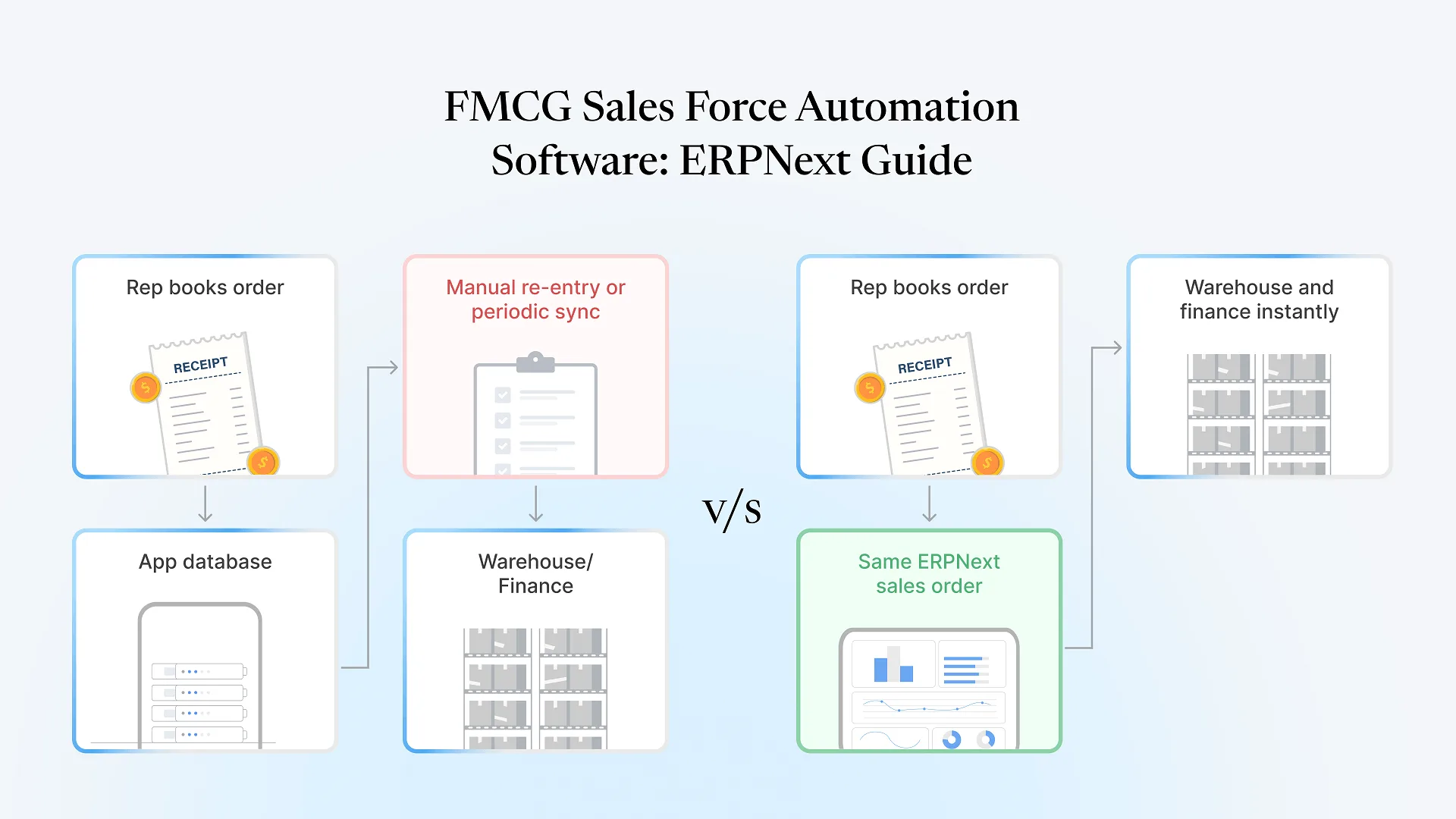
The harder problem, and the one that determines whether SFA actually reduces work instead of adding a reconciliation step, is what happens after a rep taps “submit” on an order. Does the system know, in that moment, whether the SKU and quantity are actually available at the servicing warehouse? Does it apply the correct distributor or channel pricing automatically? Does the order reach the warehouse and finance teams as a real transaction, or does someone still re-key it into the accounting or inventory system at the end of the day?
Where Most SFA Tools Stop Short
Standalone SFA apps are built to be sold and deployed fast, which usually means they’re designed to sit on top of whatever inventory or accounting system a business already runs, connected through a periodic sync or, in a lot of implementations, no real sync at all. That works fine for capturing the order. It works less well for everything downstream of it.
The gap shows up in a few predictable ways:
Stock shown to the rep is stale
If inventory only syncs a few times a day, a rep can confidently book an order for stock that was sold out an hour earlier, creating a fulfillment problem that surfaces at the warehouse instead of at the point of sale.
Pricing rules live in two places
Distributor tiers, scheme discounts, and promotional pricing get configured once in the SFA app and again in the accounting system, and the two drift out of sync whenever a scheme changes.
Orders re-enter the ERP as new data, not linked transactions
Someone on the finance or warehouse side re-keys the SFA order into the system of record. That's where data entry errors and delays creep in, and where the SFA app's real-time promise quietly breaks down.
Returns and rejections captured in the field don't flow back into stock automatically
so warehouse counts and field-reported returns need a manual reconciliation pass.
None of this is a flaw in SFA as a category. It’s a consequence of SFA and inventory/ERP being built and sold as two separate products that a business has to stitch together itself.
Talk to us about your FMCG operations if this pattern is familiar. It usually shows up first as a Friday afternoon spent reconciling two sets of numbers that shouldn’t disagree.
How ERPNext Connects Field Sales to Inventory in Real Time
ERPNext’s approach to sales force automation is different mainly because it isn’t a separate product bolted onto inventory and accounting. The stock, pricing, and finance modules are the same system the field sales workflow writes into. In practice, that changes what happens at each step of a field order:
Stock visibility reflects the actual ledger
A rep checking availability is querying the same warehouse stock records the warehouse team works from, not a cached snapshot from the last sync.
Pricing rules are defined once
in the same system that generates the invoice, so a distributor tier or scheme discount configured centrally applies automatically wherever an order is booked, in the field or otherwise.
An order captured in the field is the same transaction the warehouse picks against and finance invoices from
not a separate record that gets copied or re-entered into the system of record.
Returns and rejections logged by a field rep post back to stock and to the customer's account directly
instead of sitting in an app-specific log that someone has to reconcile against inventory manually.
This matters most for FMCG operations specifically because of multi-warehouse stock visibility and pick logic that has to stay accurate under a distribution network with regional warehouses, not just a single-location stockroom.
What This Looks Like Day to Day
| Field sales moment | Standalone SFA app (typical) | ERPNext-connected SFA |
|---|---|---|
| Rep checks stock at an outlet visit | Shows last synced figure, may be hours old | Shows live warehouse stock at time of query |
| Order is booked | Saved in the SFA app's own database | Created directly as a sales order in ERPNext |
| Pricing applied | Configured separately, can drift from ERP pricing | Same pricing engine as all other sales channels |
| Warehouse fulfills the order | Re-keyed or synced from the app | Picked directly against the same order record |
| Return or rejection logged | Sits in the app until manually reconciled | Updates stock and customer ledger immediately |
Implementation Considerations Worth Naming Honestly
Connecting field sales to real-time inventory isn’t a toggle. A few things are worth knowing before evaluating a rebuild or a new implementation:
Offline reliability still matters
Field reps work in areas with inconsistent connectivity, and a real-time architecture has to handle orders captured offline and synced correctly the moment a connection returns, without creating stock conflicts if two reps book against the same low-stock SKU.
Migrating from a standalone SFA app takes real planning
Historical order and outlet data, distributor mappings, and pricing structures configured in the old app need to be reconstructed or migrated, not just switched off overnight.
This is a distribution-structure decision, not just a software one
How warehouses map to territories, how routes are defined, and how returns are coded all need to match how the business actually distributes stock, not a generic default configuration.
There's no single timeline that fits every FMCG operation
A single-warehouse distributor with a handful of reps is a materially smaller project than a multi-plant manufacturer running its own field sales alongside third-party distributors.
This is where working with an implementation partner who has actually configured Frappe/ERPNext for FMCG field sales and distribution matters more than picking a feature list off a comparison page, since the failure points are almost always in the connections between systems, not in any single module. You can see how this plays out in practice in our case studies.
Frequently Asked Questions
ERPNext's sales and CRM modules can support field sales workflows — order capture, customer and territory management, pricing — directly, connected to the same stock and accounting data as the rest of the business. Whether that replaces a dedicated SFA app or extends one depends on how much mobile-specific functionality (offline capture, route optimization, photo compliance) the field team needs beyond what's built in.
Offline capture with sync-on-reconnect is a standard requirement for FMCG field sales and needs to be designed into the mobile workflow specifically, since it isn't automatic in every ERP configuration. It's a configuration and workflow decision to get right during implementation, not something that works identically out of the box regardless of setup.
Because FMCG products move fast and margins are thin, a stock figure that's even a few hours stale can lead to a rep confidently booking an order for stock that's already gone, which then surfaces as a fulfillment failure at the warehouse instead of being caught at the point of sale. Real-time sync moves that failure point earlier, where it's cheaper to handle.
Because FMCG products move fast and margins are thin, a stock figure that's even a few hours stale can lead to a rep confidently booking an order for stock that's already gone, which then surfaces as a fulfillment failure at the warehouse instead of being caught at the point of sale. Real-time sync moves that failure point earlier, where it's cheaper to handle.
Dedicated SFA platforms are often stronger on mobile-specific field features out of the box, such as route optimization, gamification, and photo-based compliance checks. ERPNext's advantage is that sales, inventory, pricing, and finance are the same system rather than connected through a sync layer, which matters most for businesses that keep hitting reconciliation problems between their SFA app and their backend systems.
Not necessarily. Depending on the existing app, the fix is sometimes a proper real-time integration rather than a full replacement, though if the underlying inventory and pricing data isn't well-structured in ERPNext to begin with, integration work alone won't solve the reconciliation problem.
If your field sales orders and warehouse stock are telling two different stories by the end of most weeks, talk to us about your FMCG operations — we work through the actual connection between field sales, inventory, and finance rather than treating SFA as a standalone app problem.