




If you’re searching for ways to reduce picking errors in your warehouse, you already know the cost: wrong items shipped, returns and re-deliveries eating margin, and customers who don’t call back to compliment your accuracy — they just quietly order less. The most reliable way to reduce picking errors in a warehouse is to connect the picker’s list to real-time inventory and order data, track stock at the bin level, and verify each pick with a barcode scan before it ships. Training helps at the margins, but it doesn’t fix a picker working from stale or disconnected information.
This guide walks through why picking errors happen, and a realistic, cost-ordered sequence of fixes — starting with what most distribution, FMCG, and manufacturing businesses should do first.
Why Picking Errors Happen in Your Warehouse
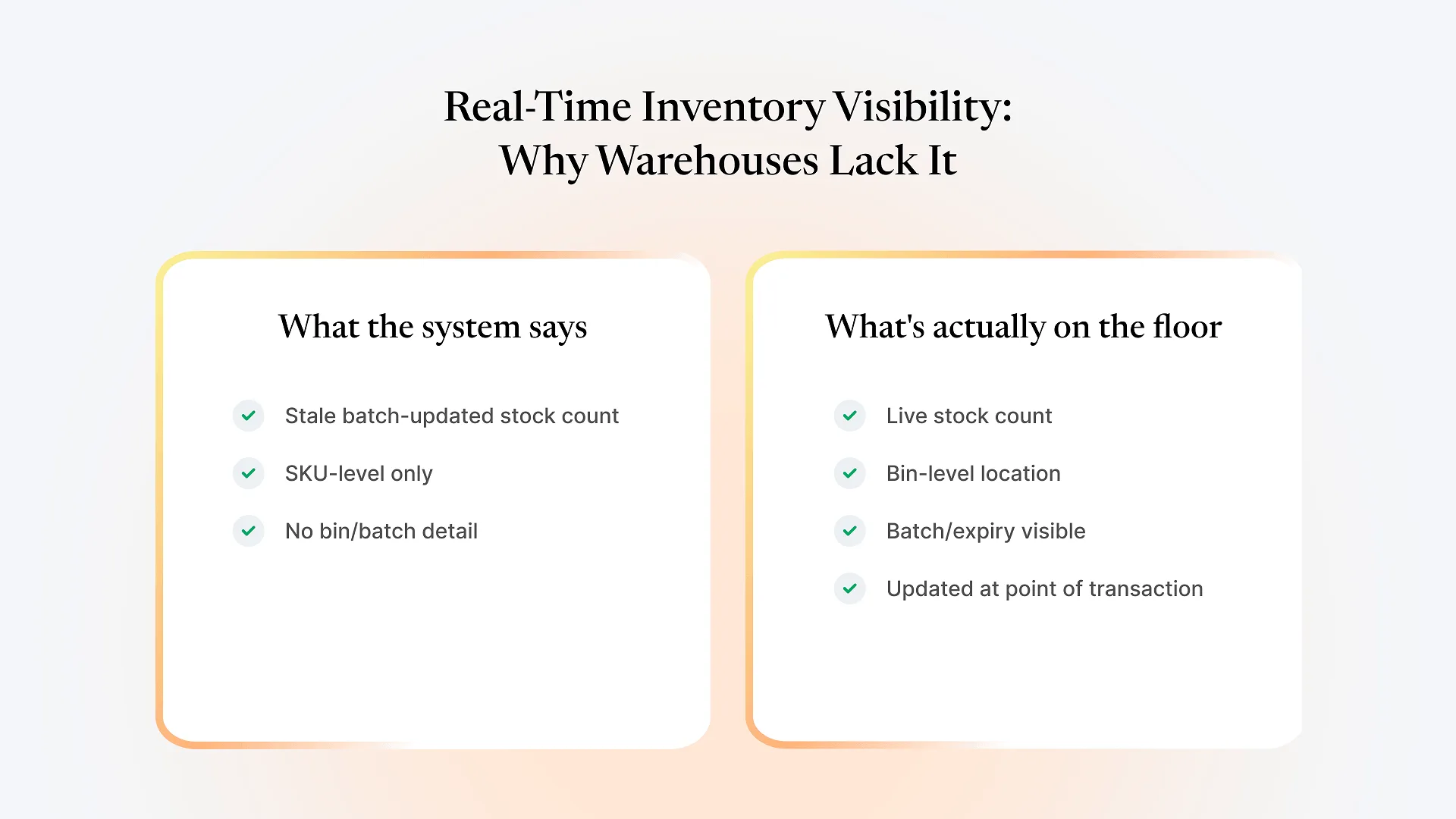
A picker working from a printed sheet or a spreadsheet exported an hour ago is picking against stale data. If stock moved, got reserved by another order, or was put away in a different bin since that list was generated, the picker has no way to know.
Many warehouses track inventory at the SKU level — "we have 400 units of this item somewhere" — rather than at the bin or location level. Without a bin-level view, pickers rely on memory or on walking the aisle to find stock, which invites both delay and mispicks between visually similar items.
Products that differ only in size, color, or pack configuration are a classic mispick source, especially when the warehouse layout groups them physically instead of separating them.
If nothing checks the pick against the order before it's packed and labeled, an error made at the shelf ships straight out the door.
When the order comes from one system, the pick list is generated in another, and inventory is tracked in a third, every handoff is a chance for a number to get typed wrong or a list to go stale.
The Fix, in the Right Order
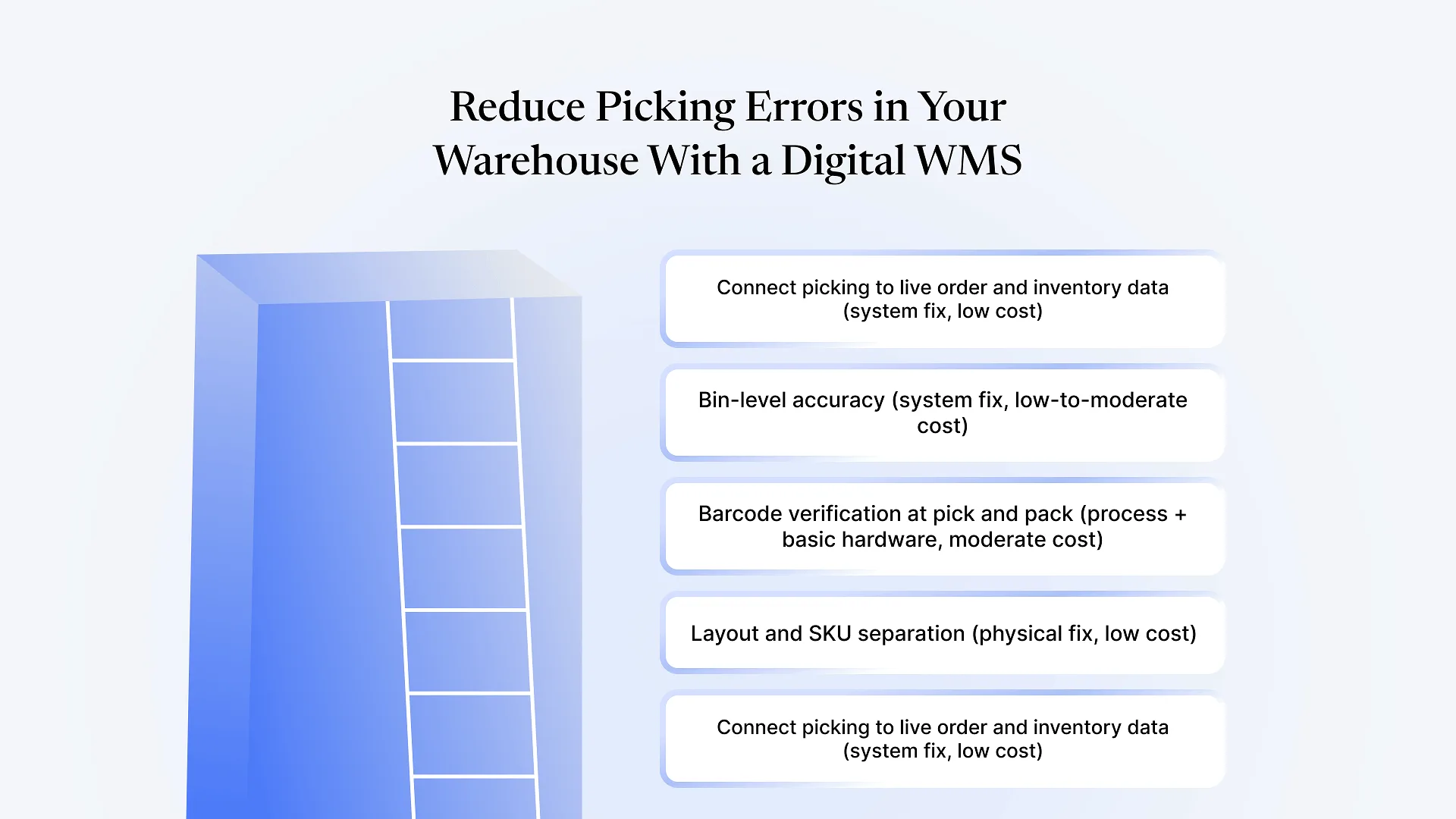
Before anything else, the picker's list needs to come from the same system that holds current stock levels and order details — not a static export. If your ERP and your warehouse operation are running on separate, loosely connected tools, this is the highest-leverage fix available, and it's largely a systems and process change rather than a capital investment. A WMS built to work with barcode and bin-level tracking closes most of the gap described above without adding new hardware costs beyond basic scanners.
Once picking is generated from live data, the next lever is knowing exactly which bin holds the stock — not just that it exists somewhere in the warehouse. Bin-level tracking turns "go find it" into "go to bin C-14," which shortens picking time and removes the guesswork that leads to grabbing the wrong item from a similar-looking spot nearby.
A barcode scan at the point of picking, checked against the order line, catches a mispick before it leaves the shelf — not after a customer opens the box. This is typically the point where warehouses see the sharpest drop in shipping errors, because it adds a hard checkpoint rather than relying on the picker to self-verify.
This is a low-cost, physical fix: audit your storage layout for products that look alike or share packaging, and deliberately separate them, or add clear signage and color-coded labeling so a picker moving quickly doesn't have to slow down to double-check.
These technologies are genuinely effective, but they amplify whatever process sits underneath them. Layering pick-to-light on top of disconnected, non-bin-level data mostly means you've made a flawed process faster, not more accurate. They're worth evaluating once steps 1–4 are in place and you've hit the ceiling of what process and system fixes alone can deliver.
Quick Comparison: What Each Fix Actually Solves
| Fix | Solves | Relative cost | Best for |
|---|---|---|---|
| System-connected pick lists | Stale data, mismatched orders | Low | Any warehouse still using spreadsheets or disconnected tools |
| Bin-level tracking | "Where is it" guesswork | Low–moderate | Warehouses tracking stock only at SKU level |
| Barcode verification | Mispicks reaching the customer | Moderate | Any warehouse without a pick/pack checkpoint |
| Layout and SKU separation | Confusion between similar items | Low | Warehouses with visually similar or commonly confused SKUs |
| Pick-to-light / automation | Picking speed and error rate at scale | High | Warehouses that have already solved 1–4 and need throughput |
Frequently Asked Questions
Where to Go From Here
Picking errors are rarely fixed by asking people to be more careful. They’re fixed by making sure the person picking the order is working from the same accurate, real-time data as the rest of the business — and then verifying the pick before it ships. Get that foundation right, and the hardware layer becomes optional rather than urgent.
If your warehouse is still running on spreadsheets, disconnected tools, or a WMS that doesn’t talk to your ERP, see how a connected WMS handles this in practice to understand what a connected pick, pack, and ship process actually looks like — and where it fits alongside the system you already run.